Skip to content
Palletised freight is a transport method that moves goods securely on pallets, improving handling, storage, and distribution across local, national, and international supply chains. Using the correct pallet size and preparing loads properly helps maximise vehicle space, protect goods during transit, streamline warehouse operations, and reduce transport costs. Businesses across retail, manufacturing, construction, healthcare, logistics, and many other industries rely on palletised haulage to transport a wide range of goods safely and efficiently.
From collection to final delivery, palletised freight moves through coordinated pallet networks where shipments are inspected, sorted, tracked, and delivered via regional depots. The system supports efficient freight consolidation, wider delivery coverage, and scalable distribution while reducing manual handling and improving operational efficiency. However, palletised freight also has limitations, including pallet preparation requirements, size and weight restrictions, network schedules, and suitability for specific types of goods. Understanding these benefits, limitations, costs, and best practices helps businesses determine whether palletised freight is the right solution for their transport requirements.
What is a Pallet?
A pallet is a flat transport platform, a simple bed, or, in some contexts, a shaping tool, depending on the industry and application. In logistics and material handling, a pallet is a flat, portable platform used to support, store, stack, and transport goods safely and efficiently. It provides a stable base for products, allowing them to be easily moved with forklifts or pallet jacks. Pallets are made from wood, plastic, metal, or composite materials and are available in standardised sizes for compatibility with storage racks and shipping containers. Their durability, stackability, and load-bearing capacity make them essential for efficient warehousing, shipping, and supply chain operations.
What Is Palletised Shipping?
Palletised shipping is the process of transporting goods that have been securely stacked, wrapped, and fastened onto a pallet to form a single, stable load. This method protects products from damage, simplifies handling, and allows forklifts and pallet trucks to move freight efficiently through warehouses and distribution centres. Once goods are palletised, they become palletised freight that can move efficiently through local, national, and international supply chains. Standardised handling improves loading efficiency, reduces transit risks, and streamlines storage and delivery operations.
Does Pallet Size Matter During Palletised Freight Transport?
Yes, pallet size matters during palletised freight transport because it affects load stability, vehicle space utilisation, handling efficiency, and shipping costs. The two primary pallet sizes are the UK Standard Pallet (1,200 × 1,000 mm) and the Euro Pallet (EUR1) (1,200 × 800 mm). Using non-standard or mismatched pallet dimensions can cause logistical complications, reduce transport efficiency, and increase the risk of handling and storage issues.
What Are the Standard Pallet Sizes and Dimensions in the UK?
Standard pallet sizes include the UK Standard Pallet, Euro Pallet (EUR1), Full Pallet, Half Pallet, Quarter Pallet, Mini Pallet, Oversized Pallet, and Custom-Sized Pallet, with each designed to accommodate different load capacities, storage requirements, and palletised freight applications. Selecting the appropriate pallet size helps optimise storage space, improve handling efficiency, and ensure goods can be transported safely and cost-effectively throughout the supply chain.
5 Standard pallet sizes and dimensions in the UK are:
- Standard UK Pallet
The Standard UK Pallet measures 1,200 × 1,000 mm (approximately 47.2 × 39.4 inches) and serves as the benchmark pallet size across the UK’s logistics industry. It features a four-way entry and perimeter-based wooden construction, allowing easy access with forklifts and hand pallet trucks from all sides. This pallet is widely used in warehouses, distribution centres, and racking systems due to its compatibility with standard handling equipment. It is ideal for transporting retail goods, boxed products, industrial components, and bulk materials within domestic UK supply chains.
- Euro Pallet
When shipping goods between the UK and mainland Europe, the Euro Pallet (EUR1) is the preferred pallet standard, measuring 1,200 × 800 mm and featuring a footprint around 20% narrower than the UK standard pallet for efficient loading in European transport vehicles. As a result, it is fully compatible with forklifts and pallet trucks, although additional care may be required when storing it in UK racking designed for wider pallets. It is widely used for international palletised freight, import and export shipments, and European pallet pooling systems.
- Full Pallet
A Full Pallet uses the standard 1,200 × 1,000 mm footprint with a maximum height of 2,200 mm and a typical load capacity of 1,200 kg. It is designed to maximise both vertical and horizontal trailer space, making it suitable for transporting heavy or high-volume consignments. Full pallets are handled using forklifts and pallet trucks and require sufficient trailer clearance during loading and unloading. They are commonly used for bulk shipments, manufacturing goods, wholesale distribution, and other large commercial deliveries.
- Half Pallet
For medium-sized shipments that do not require the full height of a standard pallet, a Half Pallet provides a practical solution. It retains the standard 1,200 × 1,000 mm footprint but has a maximum height of 1,200 mm, with some freight networks limiting it to 1,000 mm, and supports loads of up to 500 kg. As a result, it can be handled using forklifts, pallet trucks, and tail-lift vehicles, making deliveries easier to residential properties and commercial premises with limited access. It is widely used for retail replenishment, split deliveries, and moderate-volume freight.
- Quarter Pallet
Businesses transporting lighter or lower-volume freight often choose a Quarter Pallet for its compact size and ease of handling. Built on the standard 1,200 × 1,000 mm footprint, a Quarter Pallet has a maximum load height of 800 mm and supports loads of up to 250 kg. Because of this, it can be moved efficiently using pallet trucks and tail-lift vehicles. It is commonly used for fast-moving consumer goods, promotional displays, seasonal stock, and urgent replenishment deliveries.
- Mini Pallet
A Mini Pallet is a compact version of a quarter pallet, generally supporting loads up to 600 mm in height with a typical weight capacity of around 150 kg. Its smaller profile makes it easy to transport, unload, and manoeuvre in confined spaces such as retail stores and smaller delivery locations. Mini pallets are commonly used for lightweight goods, point-of-sale displays, promotional products, and small replenishment orders where efficient handling and reduced storage space are important.
- Oversized Pallet
Businesses transporting large, heavy, or irregularly shaped freight often require an Oversized Pallet to accommodate non-standard loads. An Oversized Pallet exceeds standard dimensions in length, width, height, or weight and can support loads of up to 2,000 kg. This requires specialised handling equipment, such as cranes or extended-fork forklifts, as oversized pallets cannot be handled by standard transport systems and are often classified as “ugly freight”. They are commonly used for industrial machinery, engineering components, construction materials, automotive parts, and bulky furniture.
- Custom-Sized Pallet
A Custom-Sized Pallet is manufactured to specific dimensions to safely transport products that cannot fit standard pallet sizes. These pallets may be constructed from wood, plastic, or composite materials, depending on the product and transport requirements. Their bespoke design helps eliminate dangerous overhang, improves load stability, and protects fragile or unusually shaped items during transit. Custom-sized pallets are commonly used for aerospace components, wind turbine parts, bespoke glass panels, structural timber, and other specialist industrial products.
Why Does Palletised Freight Matter for Businesses?
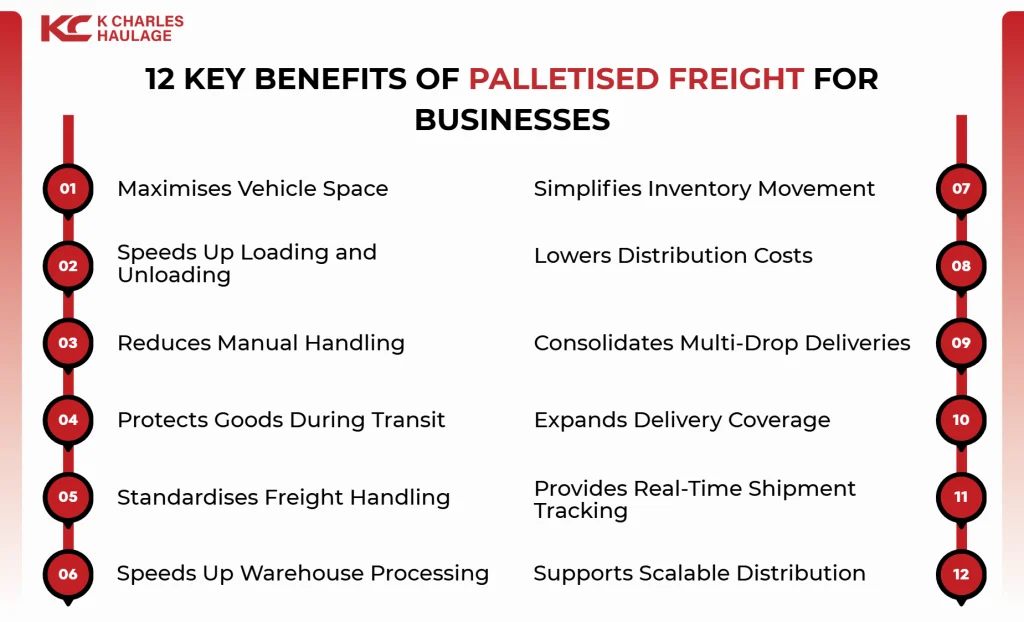
Palletised freight matters for businesses because it maximises vehicle space, speeds up handling, protects goods during transit, reduces distribution costs, and supports efficient warehouse operations, inventory movement, and scalable deliveries. These benefits help businesses improve operational efficiency, reduce freight costs, and ensure goods are delivered safely and on time.
12 key benefits of palletised freight for businesses are:
- Maximises Vehicle Space
Palletised freight allows businesses to maximise vehicle space by organising goods into stable, stackable loads that fit efficiently within trailers. Standard pallet dimensions reduce unused space and improve load distribution, enabling more products to be transported in a single journey. Better vehicle utilisation reduces the number of trips required, lowers transport costs, and improves the overall efficiency of freight operations across the supply chain.
- Speeds Up Loading and Unloading
Busy warehouses rely on palletised freight to move complete shipments quickly, allowing businesses to reduce loading delays and keep deliveries on schedule. Forklifts and pallet trucks can handle an entire pallet in a single operation instead of moving individual packages. Faster loading and unloading reduce vehicle turnaround times, improve workforce productivity, and enable warehouses and distribution centres to process higher freight volumes throughout the day.
- Reduces Manual Handling
Businesses processing large volumes of freight rely on palletised freight to minimise repetitive lifting and improve workplace safety. Complete pallet loads can be transported using forklifts and pallet trucks instead of manually moving individual cartons. This reduces physical strain on warehouse employees, lowers the risk of manual handling injuries, and improves operational efficiency by allowing staff to process freight more quickly and consistently.
- Protects Goods During Transit
For businesses shipping fragile or high-value products, palletised freight provides greater load stability and reduces the risk of damage during transport. Goods are securely stacked on pallets and wrapped or strapped to minimise movement throughout loading, transit, and unloading. Improved product protection reduces replacement costs, limits customer complaints, and helps businesses maintain reliable deliveries while protecting their reputation for quality service.
- Standardises Freight Handling
As goods move between suppliers, warehouses, and customers, palletised freight gives businesses a consistent handling method across every stage of the supply chain. Standard pallet sizes are compatible with forklifts, pallet trucks, warehouse racking, and transport vehicles, allowing freight to move efficiently between facilities. This reduces handling errors, improves operational consistency, and supports smoother logistics operations from collection through to final delivery.
- Speeds Up Warehouse Processing
During busy fulfilment periods, palletised freight allows warehouse teams to process incoming and outgoing stock more efficiently. Complete pallet loads require fewer handling steps than individual cartons, making it easier to receive, store, pick, and dispatch goods. Faster warehouse processing improves inventory flow, shortens order fulfilment times, and enables businesses to handle increasing demand without reducing operational efficiency.
- Simplifies Inventory Movement
Keeping stock organised becomes much easier when businesses use palletised freight to move complete pallet loads throughout the warehouse. Standardised handling methods simplify stock transfers between storage areas, loading bays, and dispatch zones while reducing unnecessary handling. Better inventory movement improves stock accuracy, supports faster replenishment, and enables warehouse teams to fulfil customer orders more efficiently.
- Lowers Distribution Costs
Every delivery adds transport and handling expenses, making palletised freight an effective way for businesses to improve efficiency and reduce distribution costs. Better vehicle utilisation, fewer handling stages, and improved product protection lower fuel, labour, and replacement expenses. Reducing these operational costs enables businesses to maintain reliable freight services while improving profitability across their supply chain.
- Consolidates Multi-Drop Deliveries
Businesses delivering to multiple locations can simplify daily operations by using palletised freight to organise shipments before vehicles leave the depot. Individual pallet loads prepared for each destination allow drivers to unload freight quickly without sorting products at every stop. Faster deliveries improve route efficiency, reduce delays, and enable transport providers to complete more deliveries during each working day.
- Expands Delivery Coverage
Reaching customers beyond the local area becomes more practical when businesses use palletised freight through established regional and national distribution networks. Shared logistics infrastructure allows freight to move efficiently between transport hubs without requiring businesses to operate their own extensive vehicle fleet. This supports market expansion, improves delivery flexibility, and provides reliable freight services across wider geographic areas.
- Provides Real-Time Shipment Tracking
When customers expect regular delivery updates, palletised freight gives businesses greater visibility through real-time shipment tracking. Modern tracking systems monitor freight throughout the transport journey, allowing businesses to identify delays, monitor delivery progress, and communicate accurate updates to customers. Better shipment visibility strengthens logistics planning, improves customer service, and supports more reliable supply chain management.
- Supports Scalable Distribution
As order volumes increase, palletised freight enables businesses to expand distribution without introducing unnecessary operational complexity. Standardised pallet handling and established distribution networks make it easier to transport larger freight volumes while maintaining consistent processes. This flexibility supports business growth, improves supply chain performance, and allows organisations to meet increasing customer demand efficiently and cost-effectively.
How Does Palletised Haulage Work?
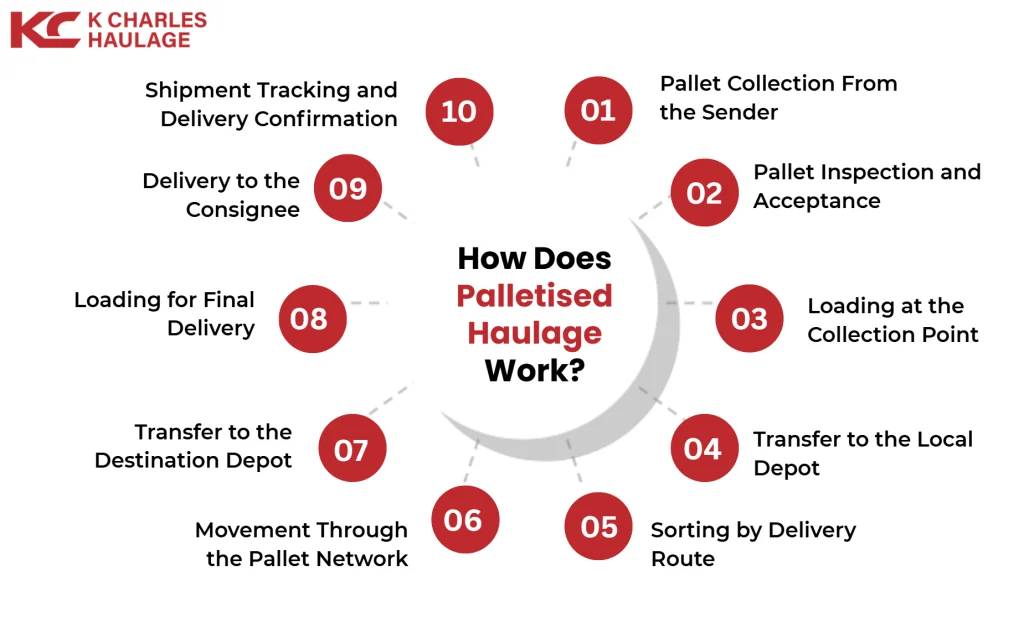
Palletised haulage follows a structured logistics process that moves goods efficiently from collection to final delivery through a coordinated pallet network. Each stage, from pallet collection and inspection to depot transfers, route sorting, shipment tracking, and final delivery, ensures freight is handled securely, transported efficiently, and delivered safely while maintaining visibility throughout the journey.
Palletised haulage works in the following ways:
- Pallet Collection From the Sender
The process begins when the carrier collects the palletised goods from the sender’s premises at the agreed time. The pallet is checked for visible damage before transportation begins. From there, it is taken for inspection and acceptance to confirm it meets the carrier’s transport requirements.
- Pallet Inspection and Acceptance
Once the pallet arrives, it is inspected to verify its size, weight, packaging, and overall stability. Shipments that meet the carrier’s requirements are accepted into the pallet network. After approval, the pallet is loaded onto a collection vehicle for transport to the local depot.
- Loading at the Collection Point
Following inspection, the pallet is loaded onto the collection vehicle using forklifts or pallet trucks to ensure safe handling. Proper loading helps maintain load stability during transport. The vehicle then transports the shipment to the nearest local depot for processing.
- Transfer to the Local Depot
The collection vehicle delivers the pallet to the local depot, where shipments from multiple customers are received and processed together. The depot acts as the first distribution point within the network. Once received, the pallet is sorted according to its delivery destination.
- Sorting by Delivery Route
At the local depot, the pallet is grouped with other shipments travelling to the same region or destination. Route planning ensures freight follows the most efficient transport path. After sorting is complete, the pallet continues its journey through the pallet distribution network.
- Movement Through the Pallet Network
The pallet is transported through one or more regional distribution hubs, depending on its delivery destination. Each transfer keeps the shipment moving closer to the consignee while maintaining efficient routing. The pallet is then delivered to the destination depot responsible for the final delivery area.
- Transfer to the Destination Depot
Once the pallet reaches the destination depot, it is unloaded and prepared for local distribution. Depot staff confirm the shipment details and organise deliveries for the surrounding area. The pallet is then loaded onto the vehicle assigned for final delivery.
- Loading for Final Delivery
The destination depot loads the pallet onto a local delivery vehicle using appropriate handling equipment. Delivery schedules are organised to optimise routes and arrival times. The vehicle then departs to deliver the shipment to the consignee’s address.
- Delivery to the Consignee
The delivery driver transports the pallet to the consignee and unloads it safely using suitable handling equipment where required. The recipient checks the shipment upon arrival. Following successful delivery, the shipment status is updated, and delivery confirmation is recorded.
- Shipment Tracking and Delivery Confirmation
Throughout every stage of transport, tracking systems provide updates on the pallet’s location and delivery progress. Once the consignee accepts the shipment, proof of delivery is recorded, confirming the haulage process has been completed successfully.
How Long Does Palletised Haulage Delivery Take?
Palletised haulage delivery takes between 1 and 3 working days for most domestic shipments, depending on the selected service, such as next-day, economy, or timed delivery. Delivery times are influenced by several factors, including the collection and delivery locations, pallet size and weight, delivery postcode, collection cut-off times, network capacity, and weather or traffic conditions. Choosing the appropriate service level and preparing pallets correctly can also help avoid delays and keep shipments moving efficiently through the pallet distribution network.
How Is Palletised Haulage Different From Loose-Loaded Freight?
Palletised haulage transports goods that are securely stacked and wrapped on pallets for efficient handling, storage, and delivery, whereas loose-loaded freight transports individual items without pallets, requiring more manual handling and longer loading and unloading times.
| Feature | Palletised Haulage | Loose-Loaded Freight |
| Loading Method | Goods are secured on pallets and moved as a single load. | Goods are loaded and unloaded individually. |
| Handling Efficiency | Requires fewer handling steps, speeding up operations. | Requires more manual handling, increasing processing time. |
| Product Protection | Pallets keep goods stable and reduce the risk of damage. | Goods are more likely to shift or become damaged during transit. |
| Transport Efficiency | Standard pallet sizes maximise vehicle space and improve load planning. | Irregular loading can reduce vehicle space utilisation. |
| Best Suited For | Bulk shipments, retail goods, pallet network freight, and regular distribution. | Irregular, oversized, or non-palletisable items requiring individual handling. |
What is Pallet Network?
A pallet network is a collaborative distribution system that connects multiple regional haulage companies to transport palletised freight efficiently across local, national, and international destinations. By sharing depots, vehicles, and delivery routes, pallet networks consolidate palletised shipments from different businesses into a single transport system, improving delivery efficiency, reducing transport costs, and providing reliable next-day and economy pallet distribution services.
How Does a Pallet Network Work?
A pallet network works by collecting, sorting, consolidating, transporting, and delivering palletised freight through connected local depots and regional hubs. This coordinated network allows multiple haulage companies to share transport resources, optimise delivery routes, reduce transit times, and provide cost-effective pallet distribution across wider geographic areas.
Pallet networks work in the following ways:
- Receives Pallets at the Local Depot: Palletised freight is collected from the sender and delivered to the nearest local depot. The depot receives and prepares each pallet for processing within the distribution network.
- Scans and Sorts Pallets by Destination: Each pallet is scanned to record its shipment details and sorted according to its delivery destination. Accurate sorting ensures the freight follows the correct transport route.
- Consolidates Pallets Into Trunk Loads: Pallets travelling to the same region are grouped into larger trunk loads. Consolidating shipments improves vehicle utilisation and reduces transport costs.
- Transfers Freight Between Regional Hubs: Trunk loads are transported between regional hubs to move freight closer to its final destination. This allows pallets to travel efficiently across the network.
- Routes Pallets to the Destination Depot: Once the freight reaches the appropriate region, pallets are sent to the destination depot responsible for the delivery area. The depot prepares shipments for local distribution.
- Allocates Pallets to Local Delivery Vehicles: The destination depot assigns pallets to local delivery vehicles based on planned delivery routes. Efficient vehicle allocation supports timely deliveries.
- Delivers Pallets Through Local Member Hauliers: Local member hauliers deliver the pallets to the consignee using their regional transport network. This final stage completes the physical delivery process.
- Tracks Shipments Throughout the Network: Tracking systems monitor each pallet from collection to delivery. Real-time shipment updates improve visibility and provide delivery confirmation once the consignee receives the freight.
What Does a Properly Prepared Pallet Look Like?
A properly prepared pallet has evenly distributed, securely stacked, and well-protected goods that meet the required size, weight, and handling standards for safe palletised transport. This ensures the pallet can be handled efficiently, minimises the risk of damage during transit, and supports smooth movement throughout the pallet distribution network.
Key features of Pallet include:
- Evenly Distributed Weight: The pallet appears balanced, with the load spread evenly across the base and no side carrying noticeably more weight. Distribute heavier items evenly across the pallet and avoid concentrating the weight in one area.
- Securely Stacked Goods: Goods are arranged in neat, compact layers with boxes aligned closely together and minimal gaps. Stack cartons evenly and securely to create a stable load that can withstand handling and transport.
- No Overhanging Items: All products fit neatly within the pallet’s edges without extending beyond its length or width. Position every item within the pallet footprint before securing the load.
- Stable and Level Load: The load has a flat top and stands upright without leaning or uneven stacking. Arrange the goods evenly to create a level surface and maintain load stability.
- Shrink-Wrapped or Strapped Load: The entire load is tightly wrapped or strapped, holding every item firmly against the pallet. Secure the load with shrink wrap, straps, or both to prevent movement during transit.
- Clear and Visible Labels: Shipping labels are positioned on the outside of the pallet where they are easy to read and scan. Attach labels to a clear, visible side of the pallet so they remain readable throughout the journey.
- Undamaged Pallet Base: The pallet base is intact, with no broken boards, loose nails, or visible structural damage. Inspect the pallet before loading and replace any damaged pallet to ensure safe transportation.
- Accessible Forklift Entry Points: Forklift openings remain clear and unobstructed on the required sides of the pallet. Keep goods, wrapping, and straps away from the forklift entry points to allow safe lifting.
- Load Within Height and Weight Limits: The completed pallet remains within the carrier’s permitted height and weight limits while maintaining a uniform shape. Measure the finished load and confirm it complies with the carrier’s specified limits before collection.
- Firmly Secured Loose Items: Loose or irregularly shaped items are securely attached to the main load with nothing protruding or moving freely. Fasten loose items using additional straps, wrap, or suitable packaging before transport.
How Do You Prepare a Pallet for Freight Transport?
Preparing a pallet for freight transport involves selecting a suitable pallet, stacking and securing the load correctly, and ensuring it meets the carrier’s handling, size, and weight requirements. Following the correct preparation process improves load stability, reduces the risk of damage, and helps pallets move safely and efficiently through the freight distribution network.
Pallet for freight transport are prepared by following ways:
- Choose a Pallet That Matches the Shipment Size and Weight
- Check the Pallet for Broken Boards and Damaged Blocks
- Place the Heaviest Items at the Bottom
- Distribute the Weight Evenly Across the Pallet
- Align Boxes Within the Pallet Edges
- Avoid Overhanging Goods on Any Side
- Stack Items to Maintain a Stable Load
- Use Edge Protectors and Internal Cushioning for Fragile Goods
- Secure the Load With Shrink Wrap, Straps, or Banding
- Keep the Load Within the Carrier’s Height and Weight Limits
- Attach Shipping Labels Where They Remain Clearly Visible
- Carry Out a Final Stability Check Before Collection
What Does a Poorly Prepared Pallet Look Like?
A poorly prepared pallet has an unstable, damaged, or improperly secured load that fails to meet safe handling and transport requirements. These preparation issues increase the risk of product damage, shipment delays, rejected freight, and safety hazards throughout the pallet distribution network.
- Damaged or Weak Pallet Base
- Unevenly Distributed Weight
- Heavy Items Stacked on Top
- Overhanging Boxes or Goods
- Gaps Between Stacked Items
- Leaning or Unstable Load
- Loose Items Without Proper Restraint
- Insufficient Shrink Wrap or Banding
- Crushed or Collapsing Boxes
- Load Exceeds Height or Weight Limits
- Missing or Unreadable Shipping Labels
- Blocked Forklift Entry Points
What Kind of Goods Are Moved as Palletised Freight?
Palletised freight transports a wide range of goods, including cartons and boxed goods, food and beverage products, packaged consumer goods, industrial equipment, construction materials, automotive parts, pharmaceuticals, textiles, furniture, and agricultural products. These goods are securely stacked and transported on pallets to improve handling efficiency, protect products during transit, and support reliable distribution across the supply chain.
- Cartons and Boxed Goods
- Food and Beverage Products
- Packaged Consumer Goods
- Industrial Equipment and Machinery Parts
- Construction Materials
- Automotive Parts and Components
- Electrical and Electronic Equipment
- Chemicals and Cleaning Products
- Pharmaceutical and Medical Supplies
- Textiles and Clothing
- Furniture and Homeware
- Agricultural Products and Animal Feed
Which Industries Use Palletised Freight Transport?
Palletised freight transport is used across a wide range of industries, including retail, manufacturing, food and beverage, construction, automotive, healthcare, electronics, and logistics. These industries rely on palletised freight to move goods safely, improve handling efficiency, and support reliable distribution throughout the supply chain.
8 industries that use palletised freight are:
- Retail, E-Commerce, and Wholesale
Meeting high customer demand requires palletised freight to move large volumes of packaged goods efficiently between suppliers, warehouses, distribution centres, and retail stores. Standardised pallet handling speeds up loading, simplifies inventory movement, and supports timely replenishment. This helps retailers and wholesalers maintain stock availability while fulfilling customer orders quickly and accurately.
- Manufacturing and Industrial Production
Keeping production lines running depends on palletised freight to transport raw materials, components, and finished products safely between manufacturing facilities and customers. Secure pallet loads simplify warehouse handling, reduce product damage, and improve delivery reliability. Reliable material movement keeps production schedules on track and reduces operational disruptions.
- Food, Beverage, and Agriculture
Supplying supermarkets, food processors, and distributors requires palletised freight to transport packaged food, beverages, fresh produce, and agricultural products safely. Standard pallet handling protects goods during transit while improving loading efficiency and warehouse operations. Efficient distribution keeps products moving through the supply chain without unnecessary delays.
- Construction and Building Materials
Delivering heavy and bulky building materials to construction sites relies on palletised freight for safe and efficient transport. Pallets simplify loading, unloading, and storage while protecting products from damage during transit. Timely deliveries help construction projects maintain planned schedules and minimise downtime.
- Automotive and Engineering
Producing and repairing vehicles requires palletised freight to move automotive parts, engineering components, and industrial equipment between suppliers, manufacturers, and service centres. Secure pallet loads improve handling efficiency and reduce the risk of product damage. Consistent parts availability supports uninterrupted manufacturing and repair operations.
- Pharmaceutical, Healthcare, and Chemicals
Maintaining product integrity need palletised freight to transport pharmaceuticals, medical supplies, and packaged chemicals securely between manufacturers, healthcare providers, and distributors. Stable pallet loads reduce handling risks and support efficient warehouse operations. Safe transportation ensures essential products reach their destination in the required condition.
- Electrical, Electronics, and Homeware
Transporting fragile electrical products, consumer electronics, and homeware depends on palletised freight to minimise handling and protect goods throughout the delivery journey. Secure pallet loads reduce movement during transit and simplify warehouse operations. Better product protection reduces damage claims and improves delivery reliability.
- Logistics, Distribution, and Third-Party Fulfilment
Managing freight for multiple customers rely on palletised freight to consolidate, store, and distribute shipments efficiently across regional and national delivery networks. Standardised pallet handling speeds up warehouse processing, improves vehicle utilisation, and supports accurate order fulfilment. Greater operational efficiency enables logistics providers to deliver reliable and cost-effective distribution services.
What Kind of Goods Should Not Be Shipped as Palletised Freight?
Goods that should not be shipped as palletised freight include loose, oversized, hazardous, temperature-sensitive, fragile, high-value, live, or unstable goods. These shipments require specialised handling, packaging, or transport methods to ensure safety and regulatory compliance.
8 kinds of goods that should not be shipped as palletised freight are:
- Loose or Unsecured Items: Goods that are not securely packaged or fastened to the pallet can move during handling and transport. Movement increases the risk of damage, product loss, and safety hazards, making them unsuitable for palletised freight.
- Oversized or Overweight Loads: Loads that exceed the pallet network’s maximum size or weight limits cannot be handled using standard equipment. These shipments require specialised vehicles, lifting equipment, or heavy haulage services instead of standard pallet transport.
- Hazardous or Restricted Materials: Dangerous goods, such as flammable chemicals, explosives, or corrosive substances, must comply with strict transport regulations. Many pallet networks restrict these materials because they require specialist handling, documentation, and safety procedures.
- Perishable Goods Without Temperature Control: Temperature-sensitive products, including fresh food and certain pharmaceuticals, require refrigerated or temperature-controlled transport. Standard palletised freight cannot maintain the conditions needed to preserve product quality and safety.
- Fragile Items Without Protective Packaging: Delicate goods without suitable cushioning or protective packaging are more likely to be damaged during loading, unloading, and transit. Proper packaging is essential before fragile products can be transported safely on a pallet.
- High-Value or Irreplaceable Goods: Valuable items, including jewellery, artwork, or confidential equipment, often require enhanced security and specialist transport. Standard pallet networks may not provide the level of protection or insurance these goods require.
- Live Animals and Plants: Live animals and many living plants require controlled environmental conditions, specialist care, and continuous monitoring during transport. Standard palletised freight services are not designed to meet these welfare requirements.
- Leaking, Damaged, or Unstable Goods: Goods that are leaking, structurally damaged, or unstable present safety risks to other shipments and handling staff. These loads should be repaired, repackaged, or secured before entering the pallet distribution network.
What Are the Advantages of Palletised Freight Transport?
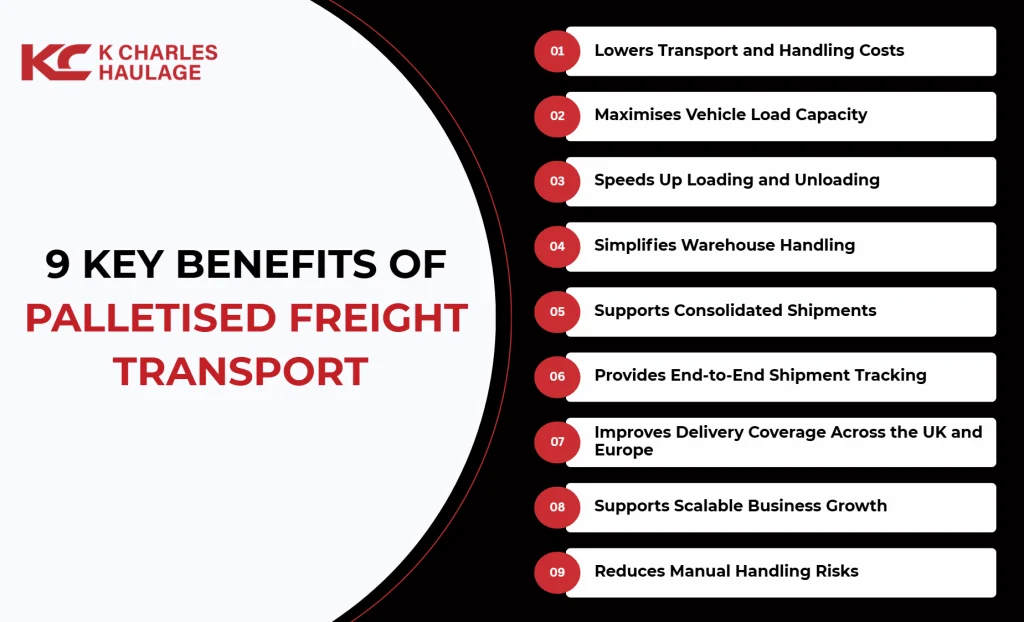
The advantages of palletised freight transport include better product protection, lower transport costs, improved load efficiency, faster handling, streamlined warehousing, shipment consolidation, end-to-end tracking, wider delivery coverage, scalable distribution, and reduced manual handling risks. These benefits help businesses improve operational efficiency, reduce logistics costs, and deliver goods more safely and reliably.
9 key benefits of palletised freight transport are:
- Lowers Transport and Handling Costs: By reducing manual handling and improving vehicle utilisation, palletised freight lowers overall transport costs. Faster freight processing also reduces labour requirements and improves operational efficiency.
- Maximises Vehicle Load Capacity: With uniform pallet loads, palletised freight makes better use of available trailer space without compromising stability. Organised load planning allows more goods to be transported within each vehicle movement.
- Speeds Up Loading and Unloading: Using forklifts and pallet trucks, palletised freight moves complete loads in a single operation. Mechanical handling reduces turnaround times and keeps warehouse operations running efficiently.
- Simplifies Warehouse Handling: Across warehouse operations, palletised freight creates standardised loads that are easier to receive, store, and dispatch. Consistent load sizes also simplify stock organisation and inventory management.
- Supports Consolidated Shipments: Within shared distribution networks, palletised freight combines compatible shipments into efficient transport loads. Shared vehicle capacity improves distribution efficiency while reducing unnecessary transport movements.
- Provides End-to-End Shipment Tracking: From collection through to final delivery, palletised freight provides continuous shipment visibility through tracking systems. Real-time updates help businesses monitor progress and respond quickly to delivery enquiries.
- Improves Delivery Coverage Across the UK and Europe: Through connected pallet networks, palletised freight reaches destinations across the UK and Europe efficiently. Extensive depot coverage enables reliable deliveries across regional, national, and international routes.
- Supports Scalable Business Growth: As shipment volumes increase, palletised freight adapts through established distribution networks without disrupting operations. Flexible network capacity supports expanding businesses without significant logistics changes.
- Reduces Manual Handling Risks: By moving complete pallet loads with mechanical handling equipment, palletised freight reduces repetitive manual lifting. Safer handling practices lower the risk of workplace injuries and improve operational safety.
What Are The Limitations of Palletised Freight Transport?
The limitations of palletised freight transport include pallet preparation requirements, shipment restrictions, additional costs, network dependency, and delivery constraints. These factors may affect shipment suitability, transport flexibility, and overall distribution efficiency depending on the freight requirements.
10 limitations of palletised freight transport are:
- Requires Proper Pallet Preparation: Requires goods to be stacked, secured, and wrapped correctly before collection. Poor pallet preparation increases the risk of damage, delays, or rejected shipments.
- Has Size and Weight Restrictions: Depends on meeting the carrier’s size and weight limits for each pallet. Oversized or overweight loads may require specialist transport or incur additional charges.
- May Cost More for Small Shipments: Cost more when transporting small or low-volume consignments. Fixed transport costs can make pallet delivery less economical than parcel services.
- Accepts Limited Types of Goods: Accepts only goods that are suitable for standard pallet transport. Fragile, hazardous, oversized, or temperature-sensitive items often require specialist handling.
- Requires Suitable Loading and Unloading Facilities: Depends on suitable vehicle access and mechanical handling equipment at both locations. Limited site facilities can delay collections or deliveries.
- Involves Shared Transport Schedules: Operates on planned collection and delivery schedules within pallet networks. Less flexibility is available compared with dedicated transport services.
- May Require Additional Packaging Materials: May require shrink wrap, straps, corner protectors, or other protective packaging. Proper packaging helps keep the load secure throughout transit.
- Can Incur Surcharges for Non-Standard Pallets: Charges additional fees for oversized, overweight, or irregular pallet loads. Using standard pallet dimensions usually avoids these extra costs.
- Relies on Pallet Network Coverage: Depends on the carrier’s pallet network and depot coverage. Remote locations may have fewer service options or longer transit times.
- May Not Suit Urgent Time-Critical Deliveries: Depends on scheduled network operations rather than dedicated express transport. Dedicated express or direct haulage services are often more appropriate for urgent freight.
How Much Does Palletised Freight Haulage Cost?
Pallet haulage costs range from £35 to £150+ per pallet, excluding VAT, depending on pallet size, delivery distance, and shipment weight. Haulage costs in the UK are influenced by pallet dimensions, weight, transport distance, and the selected delivery service. Pallet haulage services are widely used for warehouse distribution, retail deliveries, and commercial freight movement.Comparing pallet sizes and delivery options before booking can help businesses choose the most cost-effective haulage solution.
Should You Choose Palletised Haulage?
Yes, palletised haulage is a suitable transport solution if your shipment requires secure handling, efficient distribution, and cost-effective delivery. Whether you should choose palletised haulage depends on your shipment size, the type of goods being transported, delivery requirements, and available loading facilities. For businesses moving palletised goods through regional or national distribution networks, it offers a reliable and efficient freight solution.
When Is Palletised Freight a Suitable Transport Option?
Palletised freight is a suitable transport option for goods that exceed standard parcel size or weight limits, require safer handling during transit, or benefit from cost-effective shared distribution. It is particularly well suited to mid-sized and bulk consignments.
- Multiple Boxes: Ideal for transporting several cartons or boxes to the same destination as a single secure pallet load.
- Heavy or Bulky Items: Suitable for moving heavy machinery, industrial equipment, or bulky goods that exceed standard parcel weight or size limits.
- Fragile Goods: Provides greater stability by securing delicate items to a single pallet, reducing movement and the risk of damage during transit.
- Retail and Wholesale Stock: Suitable for transporting packaged inventory in bulk between warehouses, distribution centres, and retail stores.
- Building Materials: Ideal for moving palletised construction products such as bricks, cement bags, tiles, timber, and other packaged building supplies safely and efficiently.
When Is Palletised Freight Not Suitable?
Palletised freight is not suitable for shipments that require specialist handling, exceed standard pallet limits, or cannot be transported safely through shared distribution networks. It is generally unsuitable for fragile, hazardous, perishable, high-value, or irregularly shaped goods that require dedicated transport conditions.
Small Parcel Shipments: Individual parcels or lightweight consignments are usually more cost-effective to send through standard courier services.
Fragile Goods: Antiques, glassware, ceramics, and other delicate items face a higher risk of damage during multi-stage handling.
Hazardous Materials: Flammable liquids, corrosive chemicals, explosives, and other dangerous goods require specialist transport that complies with safety regulations.
Perishable Goods: Fresh food, frozen products, and temperature-sensitive items require refrigerated or climate-controlled transport.
Oversized or Irregular Loads: Goods that exceed standard pallet dimensions or cannot be stacked securely often require dedicated haulage or specialist vehicles.
How Do You Choose the Right Palletised Freight Provider?
Choosing the right palletised freight provider involves evaluating delivery coverage, transit times, service reliability, tracking capabilities, pallet network membership, pricing, shipment limits, customer support, insurance cover, and customer feedback. Selecting the right pallet haulage provider helps ensure reliable service, competitive pricing, and efficient freight transportation.
10 key ways to choose the right palletised freight provider are:
- Check Delivery Coverage: Confirm that the provider delivers to your required collection and destination locations. Wider coverage helps ensure reliable collections and deliveries across your service areas.
- Compare Transit Times: Choose a provider that offers delivery speeds matching your shipment requirements. Selecting the right service helps meet customer expectations and delivery deadlines.
- Review Service Reliability: Assess the provider’s delivery performance and history of on-time shipments. Consistent service reduces delays and improves supply chain reliability.
- Verify Shipment Tracking: Ensure real-time tracking is available from collection through to final delivery. Shipment visibility allows you to monitor progress and respond quickly to delivery enquiries.
- Evaluate Pallet Network Membership: Select a provider that belongs to a reputable pallet network for wider coverage and reliable service. Established networks usually offer better distribution efficiency and delivery consistency.
- Compare Pricing and Surcharges: Review transport rates and any additional charges before booking. Understanding the total cost helps avoid unexpected fees and supports better budgeting.
- Check Weight and Size Limits: Verify that your pallet complies with the provider’s permitted dimensions and weight limits. Meeting these requirements helps prevent rejected shipments and additional charges.
- Assess Customer Support: Look for responsive customer service that can assist with enquiries and delivery issues. Reliable support helps resolve problems quickly and keeps shipments moving.
- Review Insurance and Liability Cover: Confirm the level of insurance and liability protection included with the service. Adequate cover provides financial protection if goods are lost or damaged during transit.
- Read Customer Reviews and Testimonials: Check customer feedback to evaluate the provider’s reputation and service quality. Independent reviews provide valuable insight into reliability, communication, and overall customer satisfaction.