Skip to content
Haulage costs in the UK range from £1.50 to £3.00 per mile, although the final price depends on factors such as distance, vehicle type, load type, delivery location, and service requirements. Short-distance transport, specialist freight, and deliveries into congested areas such as London often attract higher haulage rates, while full loads, return loads, and efficient route planning can help reduce transportation costs. Vehicle choice also affects pricing, with vans, 7.5-tonne lorries, articulated trucks, refrigerated vehicles, and heavy haulage equipment carrying different operating costs. Businesses can estimate haulage costs using mileage-based calculations, but accurate pricing requires consideration of load weight, delivery speed, dead mileage, and collection requirements. Comparing haulage quotes and selecting the right transport solution helps secure the most cost-effective rate.
What Is the Average Haulage Rate per Mile in the UK?
The average haulage rate per mile in the UK ranges from £1.50 to £3.00, depending on the vehicle type, load weight, delivery distance, and collection route. Standard UK haulage rates per mile are usually lower for long-distance road freight services because operators can spread fixed costs across more miles. Short-distance haulage costs per mile are often higher due to loading time, waiting time, fuel usage in urban areas, and repeated collection and delivery stops. A haulage contractor may charge closer to the lower end of the per-mile rate for regular full loads moved on major UK road networks with efficient return loads. Whereas, rates increase per mile for urgent same-day haulage, specialist handling, oversized pallets, refrigerated transport, or hard-to-access rural delivery locations.
How Much Does Short-Distance Haulage Cost per Mile?
It costs between £1.50 and £3.00 per mile for short-distance haulage in the UK because shorter delivery routes usually include higher stop frequency, loading time, waiting time, and urban traffic delays. UK haulage rates per mile are commonly higher on local routes since fixed costs such as driver wages, fuel consumption, vehicle checks, and collection scheduling are spread across fewer miles. Short-distance road haulage includes pallet delivery, same-day transport requests, retail distribution, and regional HGV load haulage work. A transport vehicle operating in busy cities such as London, Birmingham, or Manchester may also encounter toll roads, restricted-access zones, delivery-time slots, and congestion-related delays, which can increase haulage costs per mile.
How Much Does Long-Distance Haulage Cost per Mile?
The cost of long-distance haulage in the UK ranges from £1.80 to £3.00+ per mile, depending on distance, vehicle type, load weight, delivery speed, and route conditions. Long-distance haulage rates per mile can become more cost-effective when a haulier moves full loads across major UK road routes and secures a return load for the return journey. The final price can rise above £3.00 per mile when the haulage job includes urgent delivery, oversized pallets, specialist handling, ferry crossings, toll roads, or remote collection and delivery locations. Long-distance road freight also requires careful pricing because fuel costs, driver hours, overnight charges, and empty miles can all affect per-mile haulage costs.
What Factors Affect Haulage Cost in the UK?
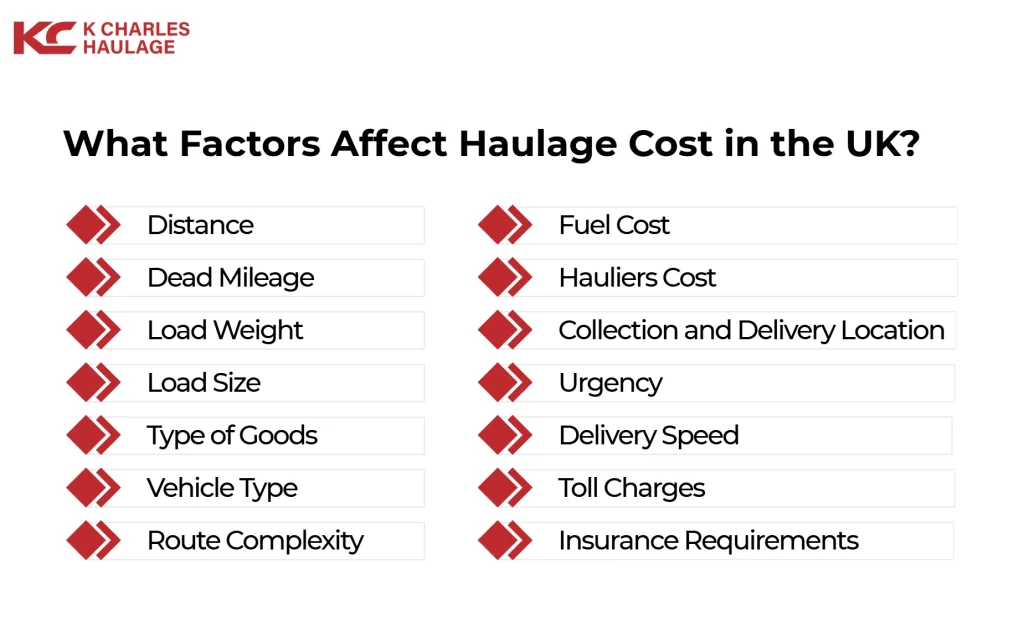
The factors affecting haulage costs in the UK include distance, dead mileage, load weight, load size, type of goods, vehicle type, route complexity, fuel costs, hauliers’ costs, collection and delivery locations, urgency, delivery speed, toll charges, and insurance requirements.
- Distance
The total mileage between your pickup point and destination sets the pricing baseline. It matters because every mile consumes diesel, driver hours, and vehicle lifespan, directly inflating your final bill. Longer transits naturally push rates up. General haulage rates scale between £1.50 and £3.00 per mile depending on the vehicle size. While the physical distance itself cannot be altered, you can bypass this premium by routing shipments through regional fulfillment hubs.
- Dead Mileage
Dead mileage refers to the journey segments where a truck runs completely empty, usually when returning from a delivery. It matters because empty vehicles still incur fuel and labor costs without generating immediate revenue, forcing carriers to absorb these losses into your base rate. Carriers frequently charge 50% to 70% of their standard per-mile rate for empty transit legs to cover their baseline operational losses. Eradicate this expense entirely by selecting hauliers who actively secure backloads along your transit corridor.
- Load Weight
Total mass determines how hard an engine must work, spiking fuel consumption and pushing vehicles toward legal gross weight limits. Heavy cargo demands intense mechanical effort, which heavily penalizes your per-mile pricing. Maximum payload transport can increase a truck’s base fuel consumption by up to 20% to 30% compared to running light. While you cannot alter the physical weight of your products, consolidating small shipments prevents paying for unutilized weight capacity.
- Load Size
The volume or pallet footprint of your goods dictates a trailer’s capacity. Even lightweight items become expensive if they fill a deck, blocking carriers from loading other profitable freight. You are effectively renting spatial volume, so larger sizes trigger higher bills. tandard UK haulage rates for less-than-truckload (LTL) volume are billed per pallet slot, averaging £50 to £120+ per pallet depending on transit distance. Lower this cost by using stackable packaging or dismantling items to shrink their volume.
- Type of Goods
Hazardous materials, fragile equipment, or temperature-sensitive cargo require specialized trailers, rigid compliance, and certified drivers. When freight demands refrigeration or ADR handling, operational risks and equipment fees spike your rate. This premium is non-negotiable, though switching to stable, non-hazardous alternative materials eliminates the extra fee entirely.
- Vehicle Type
Deploying an oversized 44-tonne truck for a tiny delivery creates massive, unnecessary overhead. Matching the vehicle perfectly to the payload ensures you only pay for the capacity you use. Running an articulated 44-tonne truck incurs higher base asset overheads compared to a 7.5-tonne rigid vehicle, creating a cost variance of roughly 40% to 60% in base vehicle charges. Eliminate this asset-related waste by auditing your haulier’s vehicle selection to ensure they deploy the smallest, most efficient truck possible.
- Route Complexity
Navigating narrow country lanes, tight urban zones, or steep terrain introduces significant logistical friction. These difficult paths slow travel times and increase vehicle wear, forcing hauliers to add a complexity premium for the extra labor involved. You can bypass this localized surcharge by shifting your delivery locations to accessible logistics parks located just outside restricted zones.
- Fuel Cost
Fuel prices act as the volatile engine behind all transport pricing, fluctuating daily based on global oil markets and UK fuel duties. Because diesel represents roughly a third of a truck’s total operating costs, sharp price spikes are directly passed to the customer via fuel surcharges. You cannot remove fuel costs from a diesel-powered journey, but choosing hauliers with modern, aerodynamic fleets or electric vehicles can insulate you from heavy surcharges.
- Hauliers Cost
This factor covers fixed business overheads including depot rent, compliance staff, and driver wages. Transport firms cannot survive without covering these baseline administrative expenses, which is why they are blended directly into your daily quote. Fixed overheads and driver wages form a core part of the haulier’s standing costs, which translates a base cost of £350 to £500+ per day just to keep a heavy vehicle on the road. Avoid these inflated overheads by choosing lean, digitally managed hauliers.
- Collection and Delivery Location
Transporting freight into London’s ULEZ, congested city centers, or remote island regions creates immediate financial hurdles. These areas impose strict entry fees, access windows, and traffic delays that hauliers pass directly to you. The tougher the destination is to reach, the higher the penalty. Eradicate this charge by moving drop-offs outside high-congestion boundaries.
- Urgency
Last-minute transport requests disrupt fixed driver schedules, forcing hauliers to rapidly reroute assets at a premium. When a carrier must drop scheduled work to accommodate your sudden timeline, you pay heavily for that convenience. This penalty can double standard rates. Same-day or emergency call-out requests frequently trigger a premium of 50% to 100% over standard, pre-booked shipping quotes. To remove the urgency premium completely, implement strict lead times and book your vehicles weeks ahead.
- Delivery Speed
Choosing express or next-day delivery options prevents carriers from combining your cargo with other shipments. Speed forces a vehicle to run directly to your drop-off, often under-capacity, dedicating all resources to your timeline. Fast transit inherently costs more because it destroys routing efficiency. Dedicated next-day express delivery options can cost 40% to 80% more than flexible, multi-day groupage alternatives. Remove this speed tax by opting for flexible, multi-day groupage networks.
- Toll Charges
Crossing routes like the Dartford Crossing or utilizing the M6 Toll incurs mandatory, non-negotiable statutory fees. These individual charges add up rapidly on long-haul UK journeys, with carriers passing the expense straight to your invoice. The impact is minor per crossing but noticeable over time. Heavy goods vehicles face statutory crossing fees ranging from £6.00 to over £30.00 per single pass on key UK toll routes like the M6 Toll or Dartford Crossing. Avoid this by instructing drivers to utilize toll-free alternative routes.
- Insurance Requirements
Standard Goods in Transit policies cover basic freight, but luxury items, electronics, or industrial machinery require extended liability protection. If cargo value exceeds standard limits, the carrier must purchase insurance extensions, adding that premium to your bill. UK haulage policies cover up to £1,300 per tonne under RHA conditions, meaning high-value loads requiring extended liability can add £50 to £250+ in dedicated insurance premiums. Eliminate this added cost by covering shipments under your own corporate marine cargo policy.
How Does Vehicle Type Affect Haulage Cost?
The cost for haulage transport changes according to vehicle type because every lorry, trailer, or van operates with different carrying capacity, fuel usage, maintenance cost, and load restrictions. Smaller transport vehicles usually provide lower haulage rates for lightweight pallet delivery and regional transport jobs, while larger HGV vehicles increase transportation cost due to higher fuel consumption, driver requirements, and specialist handling needs. Vehicle selection also affects delivery speed, volumetric weight capacity, and the type of goods a haulier can transport safely across UK road networks.
How Much Does Van Haulage Cost?
Van haulage ranges between £1.30 and £1.90 per loaded mile in the UK because transit vans operate with lower fuel consumption, reduced maintenance requirements, and smaller carrying capacity than larger HGV vehicles. This transport option works well for furniture delivery, retail stock movement, urgent documents, tools, and same-day pallet delivery within cities and regional routes where fast access matters.
How Much Does 7.5 Tonne Lorry Haulage Cost?
A 7.5 tonne lorry costs between £1.50 and £3.25 per mile, plus applicable VAT, due to its balance between payload capacity and urban delivery flexibility. These lorries regularly support pallet member networks, construction supply deliveries, and regional road freight services where businesses need more carrying space without using a full articulated truck.
How Much Does 18 Tonne Lorry Haulage Cost?
The cost for 18 tonne lorry haulage falls between £2.00 and £3.75 per mile, with minimum flat-rate charges of £200 to £375 for local drops under 50 miles because these vehicles carry significantly heavier commercial freight. An 18 tonne lorry commonly transports machinery, bulk pallet loads, manufacturing goods, and contract logistics shipments that require higher carrying capacity and stronger load distribution.
How Much Does Refrigerated Lorry Haulage Cost?
Refrigerated lorry haulage costs between £1.50 and £3.00 per loaded mile since temperature-controlled trailers require continuous cooling systems, fuel-powered refrigeration units, and specialist compliance procedures. Chilled transport services are widely used for pharmaceuticals, frozen products, dairy distribution, and food supply chain deliveries where consistent temperature management remains critical throughout transport.
How Much Does Curtain-Sider Lorry Haulage Cost?
Curtain-sider lorry haulage ranges from £1.50 to £3.50+ per mile depending on vehicle size, delivery distance, and freight weight because these trailers support faster side-loading and unloading operations. Curtain-side transport vehicles are commonly selected for palletised freight, warehouse distribution, construction materials, and commercial goods that require efficient forklift access during collection and delivery.
How Much Does Heavy Haulage Cost?
Heavy haulage in the UK costs between £2.50 and £5.00 per loaded mile because oversized freight often requires specialist trailers, escort vehicles, route surveys, and permit approvals before transport begins. Heavy haulage services are best suited for abnormal loads such as industrial machinery, transformers, plant equipment, and large infrastructure components moved across restricted UK road networks.
How Does Load Type Affect Haulage Cost?
The cost of haulage transport varies by load type because different goods require different vehicle types, handling procedures, delivery speeds, and carrying conditions. Standard pallet delivery and consolidated freight usually provide lower haulage costs, while specialist cargo, oversized loads, refrigerated goods, and dedicated transport services increase operational complexity. Load type also affects volumetric weight, delivery scheduling, insurance requirements, and route planning across UK road freight services.
How Much Does Full Load Haulage Cost?
Full-load haulage in the UK typically costs between £1.50 and £3.00 per mile because a single customer uses the entire trailer or transport vehicle’s capacity. Full loads suit bulk pallet delivery, manufacturing freight, retail stock movement, and contract logistics where businesses need direct delivery with fewer handling points.
How Much Does Part Load Haulage Cost?
Part-load haulage, also called LTL transport, generally ranges from £1.50 to £3.00 per loaded mile, since multiple consignments share the same trailer space and delivery route. This service works well for smaller freight volumes, regional pallet distribution, and businesses that do not require a dedicated lorry for transport.
How Much Does Pallet Haulage Cost?
Pallet haulage costs in the UK usually range from £35 to £150+, excluding VAT, depending on pallet size, delivery distance, and weight. Standard pallets cost less to transport than oversized pallets because they fit more efficiently within pallet member networks. Pallet haulage services are commonly used for warehouse distribution, retail deliveries, and commercial freight movement.
How Much Does Container Haulage Cost?
Container haulage commonly costs between £250 and £800+ per container because port collection charges, container size, and delivery distance all affect the final transportation cost. Businesses often use container haulage services for import freight, export logistics, shipping containers, and large-scale commercial goods arriving through UK ports.
How Much Does Vehicle Transport Cost?
Vehicle transport in the UK usually costs between £1 and £3 per mile for shorter trips, while long-distance transport often falls between £0.90 and £1.30 per mile. Total costs commonly range from £150 to £600, depending on vehicle size and transport method. Vehicle transport services are widely used for dealership transfers, online vehicle purchases, fleet relocations, and delivery of non-running cars.
How Much Does Fragile and Specialised Load Haulage Cost?
Fragile and specialised load haulage generally costs between £2.50 and £3.50 per mile for shorter distances under 50 miles, while longer hauls commonly range between £1.50 and £2.50 per mile. Higher rates apply because specialist handling, additional insurance cover, and careful load securing increase operational risk. These transport services are commonly used for medical equipment, glass products, precision machinery, and high-value commercial goods.
How Can You Calculate Haulage Cost in the UK?
A mileage price calculator UK estimate gives a useful starting point, but it cannot account for every route, load, site access condition, or return load option. For an accurate haulage quote, contact a UK haulier with the collection postcode, delivery postcode, load size, load weight, vehicle type, and delivery deadline.
Does the Haulage Cost Differ by Location?
Yes, haulage costs differ by location across the UK. Normally, haulage rates range from £1.50 to £3.00 per mile, but deliveries within London can increase to £2.50 to £4.50 per mile due to congestion, restricted access zones, waiting time, and delivery timed slots. Areas with free-flowing UK road networks and easy site access generally attract lower haulage rates because drivers can complete transport jobs more efficiently.
Location can also affect transportation cost through toll roads, ferry crossings, port collections, and remote rural routes. For example, delivering a pallet into central London often costs more than transporting the same load to a warehouse with unrestricted access and minimal traffic delays. As a result, the collection and delivery location remains a key factor in calculating haulage costs and per-mile rates.
UK Regional Cost Breakdown
- The Midlands (Birmingham, Coventry): £1.50 – £2.00 per mile. Central motorway access and efficient transport routes help keep rates competitive.
- North Scotland & Highlands (Inverness, Aberdeen): £2.50 – £3.50+ per mile. Remote locations and longer travel distances contribute to higher transport costs.
- South West England (Cornwall, Devon): £2.00 – £2.80 per mile. Extended routes and secondary road networks can increase journey times and operating expenses.
- Industrial North (Manchester, Leeds): £1.80 – £2.40 per mile. Strong freight demand and regular backload opportunities support cost-effective pricing.
How Does Dead Mileage Affect Final Haulage Cost?
Dead mileage affects the final haulage cost by increasing the operating expense of a transport vehicle without generating revenue from a paying load. It occurs when a lorry travels empty after completing a delivery, usually because no return load or backload is available. The haulier must still cover fuel, driver wages, and vehicle running costs, so these expenses are often reflected in the final haulage quote. For example, a lorry returning 100 miles empty will generally cost more to operate than one that secures a return load through a haulage exchange.
What Are Return Load Prices and How Do They Reduce Haulage Cost?
Return load prices are discounted haulage rates offered when a haulier secures freight for a vehicle that would otherwise return empty after completing a delivery. They reduce haulage costs by helping road haulage companies avoid dead mileage, which lowers fuel waste, driver costs, and vehicle operating expenses. Because the haulier already has a vehicle travelling along the route, return load pricing is often more competitive than booking a dedicated transport service. Businesses with flexible collection and delivery schedules commonly use return loads to save money on pallet delivery, commercial freight, and road freight services while still receiving reliable transport.
How Does Haulage Exchange Affect Haulage Prices?
Haulage exchange platforms affect haulage prices by helping UK hauliers match available transport jobs with empty vehicles already travelling similar routes. This process reduces dead mileage, improves load consolidation, and increases vehicle utilisation across the supply chain. For example, a road haulage company returning from Manchester to London can secure a backload through a haulage exchange system instead of travelling empty, which often lowers the final transport cost for both the haulier and customer.
How Can You Avoid Overpaying for Haulage in the UK?
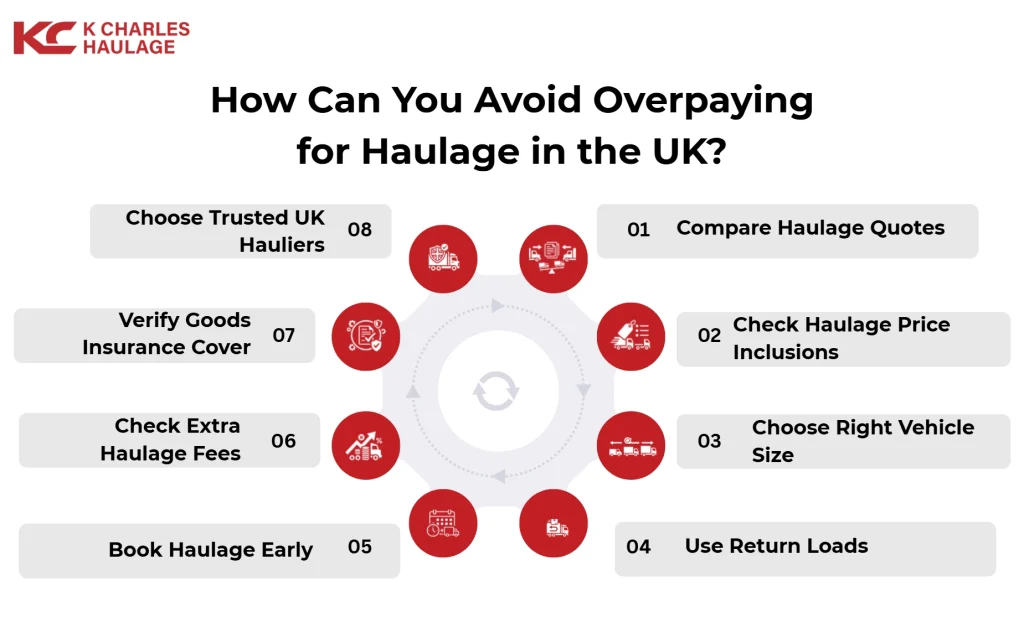
You can avoid overpaying for haulage in the UK by comparing haulage quotes, selecting the correct vehicle type, checking for additional delivery charges, and using return-load opportunities where possible. Haulage costs often increase because of unnecessary trailer space, urgent booking requests, hidden fees, or unsuitable transport services. Businesses that review haulage rates carefully and provide accurate load details usually receive more competitive pricing and better transport efficiency.
- Compare Haulage Quotes
Request multiple haulage quotes from UK hauliers before booking transport services. Different road haulage companies operate with different rate schedules, vehicle availability, and return load opportunities. For example, one haulier may price a pallet delivery at £90 while another quotes £125 for the same route and load weight.
- Check Haulage Price Inclusions
Review what the haulage quote actually includes before confirming the delivery. Some transportation costs exclude waiting time, toll charges, overnight charge, or specialist handling fees. A lower quote can become more expensive later if additional delivery charges appear after collection.
- Choose Right Vehicle Size
Select a transport vehicle that matches the actual load size and carrying capacity requirements. Paying for an oversized articulated truck when a smaller rigid vehicle could complete the haulage job increases unnecessary transport cost. A standard transit van may suit lightweight regional freight more efficiently.
- Use Return Loads
Book transport through return load or backload availability whenever delivery timing allows flexibility. Hauliers often reduce haulage rates per mile when they can avoid dead mileage after completing another delivery route. Backload transport commonly provides lower pricing for non-urgent freight movement.
- Book Haulage Early
Book transport through return load or backload availability whenever delivery timing allows flexibility. Hauliers often reduce haulage rates per mile when they can avoid dead mileage after completing another delivery route. Backload transport commonly provides lower pricing for non-urgent freight movement.
- Check Extra Haulage Fees
Ask whether the quote includes ferry crossings, toll roads, waiting time, or restricted access charges before transport begins. These additional costs commonly affect London haulage, port collections, and difficult site access deliveries. Clear pricing prevents unexpected increases in the final invoice.
- Verify Goods Insurance Cover
Confirm the level of insurance cover included within the haulage service before transporting valuable goods. Extended protection for fragile freight, specialist machinery, or high-value commercial loads can increase the final price. Checking cover early helps avoid duplicate insurance costs later.
- Choose Trusted UK Hauliers
Work with experienced UK hauliers that provide clear communication, accurate delivery scheduling, and transparent pricing structures. Reliable haulage companies reduce delays, failed deliveries, and damaged freight costs. Established road haulage operators often provide more consistent transport performance across long-term contracts.