Skip to content
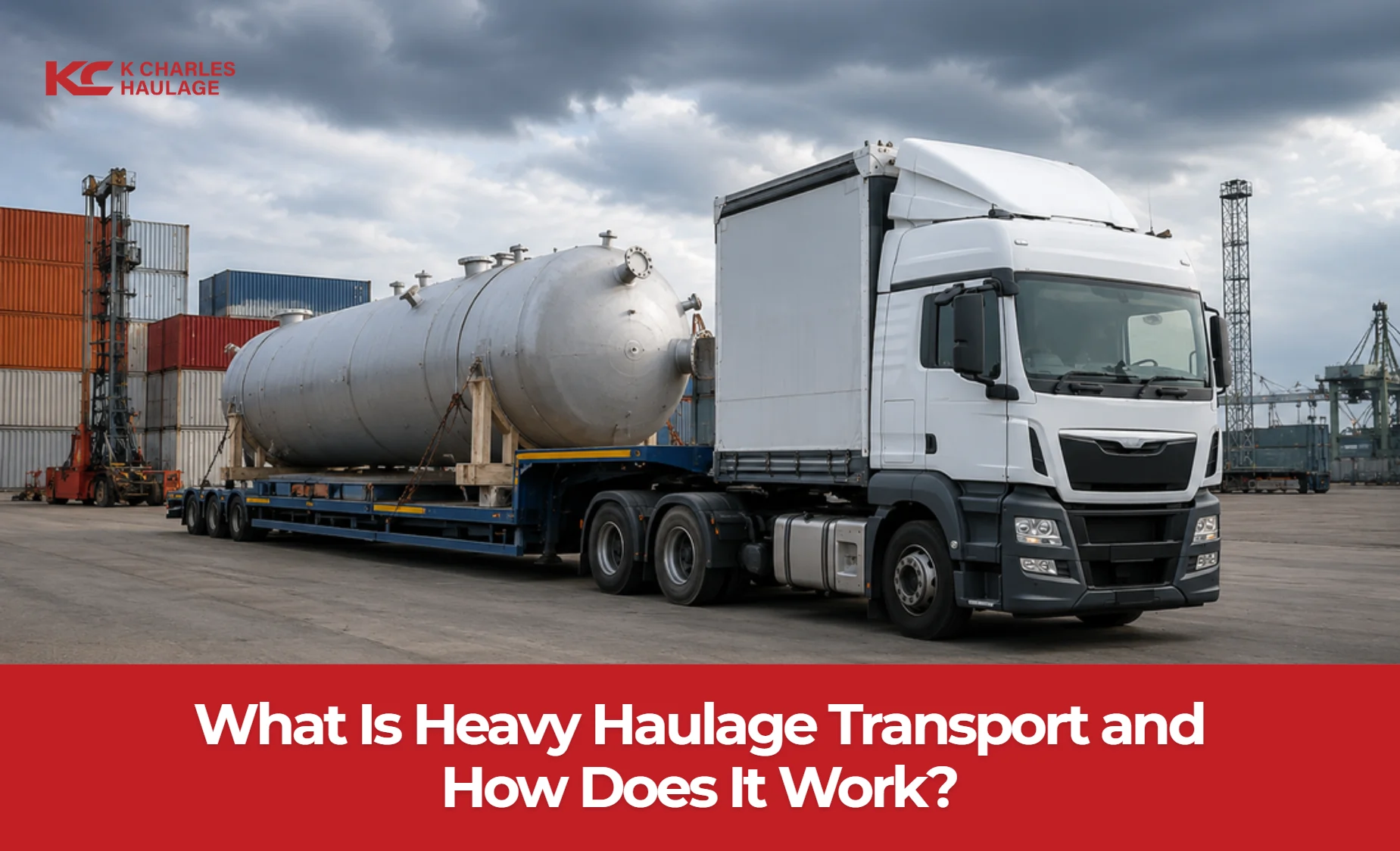
Heavy haulage is a specialist transport solution for oversized, overweight, and non-divisible cargo that exceeds the legal or operational limits of standard freight transport. Understanding the difference between oversized and overweight cargo, identifying when standard transport equipment becomes unsuitable, and recognising factors such as excessive weight, unusual dimensions, restricted loading access, or specialised lifting and securement requirements are essential before planning transport.
Construction and mining equipment, energy and power components, industrial infrastructure, and marine or aerospace cargo are among the loads that commonly require heavy haulage, using specialist tractors, trailers, and carefully selected vehicle configurations to transport them safely. Once the appropriate transport solution has been identified, heavy haul operations require cargo assessment, transport planning, route surveys, permit approvals, loading, securement, escort coordination, and continuous journey monitoring to ensure safe and compliant delivery.
Throughout the operation, delivery schedules, bridge and route assessments, permit conditions, regulatory requirements, safety risks, and risk control measures must be effectively managed. Finally, understanding the factors that influence heavy haulage costs and recognising when a shipment requires specialist heavy haul transport support informed transport planning.
How Is Heavy Haulage Different From Standard Freight Transport?
Heavy haulage transport moves oversized, overweight, or non-divisible cargo using specialized equipment, permits, and planned routes, whereas standard freight transport carries cargo within legal size and weight limits using conventional trucks and trailers. Standard freight follows routine transport procedures for faster and more economical deliveries while heavy haulage involves greater planning, regulatory compliance, and specialized handling to transport complex loads safely.
The table below compares the main differences between the two transport methods:
| Factor | Heavy Haulage Transport | Standard Freight Transport |
| Cargo Limits | Classed as “Oversize/Overweight” (OSOW) or “Superload” exceeding legal road dimensions. | Fits within standard legal weight and size limits (up to 44 tons gross weight). |
| Equipment | Multi-axle lowboys, modular heavy transporters, extendable flatbeds, step-decks, specialized dollies. | Standard dry vans, refrigerated trucks, box trucks, standard flatbeds, 20ft/40ft containers. |
| Route Planning | Requires route surveys, bridge checks, and permit-approved routes. | Uses regular road routes with minimal planning. |
| Permits & Escorts | Often requires oversize/overweight permits and escort vehicles. | Usually does not require special permits or escort vehicles. |
| Cost & Delivery Time | Higher cost and longer delivery due to planning, permits, and specialized handling. | Lower cost and faster delivery with standard transport operations. |
What Qualifies as a Heavy Haul Load?
A heavy haul load is any shipment that exceeds the legal limits for weight, width, height, length, axle load, equipment, or route requirements, making it unsuitable for standard freight transport. These loads often include oversized machinery, industrial equipment, power transformers, and large structural components that cannot be transported using conventional trucks and trailers.
Heavy haul thresholds include:
- Overweight: More than 44 tonnes
- Oversized Width: Wider than 8.5 feet (2.6 metres)
- Oversized Height: Higher than 13.5 feet (4.1 metres)
- Oversized Length: Longer than the applicable legal limit for the jurisdiction
What Is the Difference Between Oversized and Overweight Cargo?
Oversized cargo exceeds the legal limits for width, height, or length, whereas overweight cargo exceeds the legal gross vehicle weight or axle-load limits. Some shipments exceed both dimensional and weight limits, requiring specialised equipment, transport permits, route planning, and, where required, escort vehicles for safe and compliant transport.
Below are the differences between oversized and overweight cargo:
| Factor | Oversized Cargo | Overweight Cargo |
| Definition | Exceeds the legal limits for width, height, or length. | Exceeds the legal gross vehicle weight or axle-load limits. |
| Primary Concern | Road clearances, turning space, and transport dimensions. | Vehicle weight, axle loading, and infrastructure capacity. |
| Transport Requirements | Requires specialised trailers, route planning, and permits. | Requires specialised trailers, weight distribution, and permits. |
| Common Examples | Wind turbine blades, bridge beams, and prefabricated structures. | Power transformers, industrial reactors, and heavy construction equipment. |
| Combined Classification | A shipment may be oversized only or both oversized and overweight. | A shipment may be overweight only or both overweight and oversized. |
Why Are Heavy Haul Loads Often Non-Divisible?
Heavy haul loads are often non-divisible because separating them into smaller sections can reduce their structural strength, operational function, commercial value, or regulatory certification. Many industrial components, such as power transformers, pressure vessels, bridge beams, and large machinery, are designed and tested as complete units.
For this reason, transporting the cargo as a single piece helps preserve its integrity and ensures it performs as intended after delivery. Moving non-divisible loads also avoids costly reassembly, recertification, or repairs that could result from dismantling the equipment.
When Does Standard Equipment Become Unsuitable?
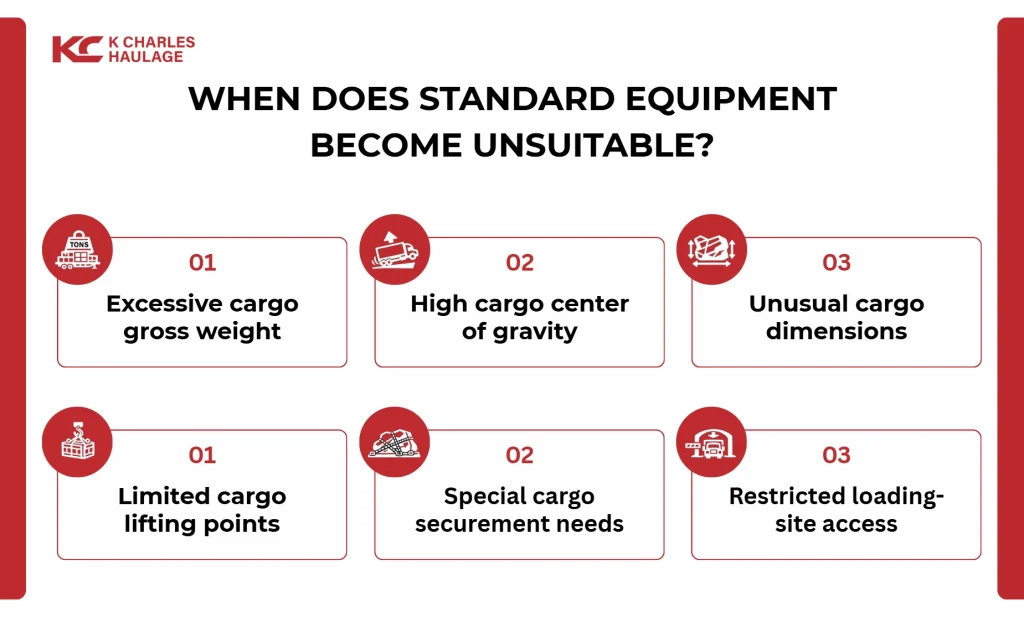
Standard equipment becomes unsuitable when cargo exceeds normal transport capabilities due to excessive gross weight, a high centre of gravity, unusual dimensions, limited lifting points, specialised securement requirements, or restricted loading-site access. In these situations, standard UK truck and trailer types, such as rigid trucks, articulated lorries, flatbed trailers, and curtain-side trailers, are often unsuitable, requiring specialised equipment like low loaders, step-frame trailers, or modular trailers to transport the load safely and in compliance with regulations.
6 key reasons when standard equipment becomes unsuitable are:
- Excessive cargo gross weight
Standard equipment becomes unsuitable when the gross weight of the cargo exceeds the legal carrying capacity of conventional trucks and trailers. In the UK, standard articulated lorries are commonly limited to a maximum gross vehicle weight of 44 tonnes under normal road conditions, although the actual cargo capacity varies by tractor unit, trailer type, and axle configuration.
- High cargo center of gravity
A high centre of gravity makes standard transport equipment unsuitable because it significantly reduces vehicle stability during transit. Tall or top-heavy loads are more likely to tip when cornering, braking, or travelling over uneven road surfaces.
- Unusual cargo dimensions
Standard equipment becomes unsuitable when cargo exceeds the legal limits for width, height, or length, preventing conventional trucks and trailers from transporting it safely. Oversized loads can obstruct traffic, exceed bridge clearances, and make it difficult to negotiate roundabouts, junctions, and narrow roads.
- Limited cargo lifting points
Cargo with limited or specially engineered lifting points cannot be handled safely using standard loading equipment as improper lifting can damage the load, compromise its structural integrity, or create safety hazards during loading and unloading.
- Special cargo securement needs
Standard straps and chains become unsuitable when cargo requires specialised securement to prevent movement during transport. Large industrial components often have irregular shapes, delicate surfaces, or uneven weight distribution that require engineered restraint systems.
- Restricted loading-site access
Restricted loading-site access makes standard equipment unsuitable because conventional trucks and trailers require sufficient space to manoeuvre, position, and load cargo safely. Narrow entrances, confined turning areas, weak ground conditions, and low overhead clearances can prevent conventional vehicles from reaching or positioning the load safely.
What Types of Cargo Require Heavy Haulage?
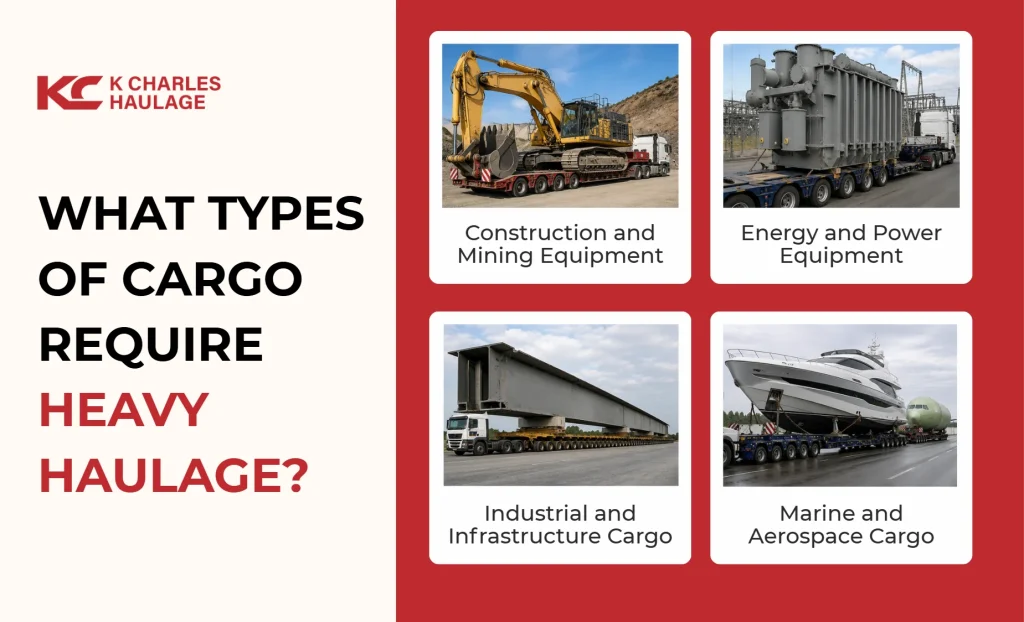
The types of cargo that require heavy haulage include construction and mining equipment, energy and power equipment, industrial and infrastructure cargo, and marine and aerospace cargo because their size, weight, or configuration exceeds the capabilities of standard transport equipment. These loads often require specialised trailers, transport permits, engineered route planning, and lifting solutions to ensure safe handling, regulatory compliance, and efficient delivery from origin to destination.
4 types of cargo required for heavy haulage are:
- Construction and Mining Equipment
Construction and mining equipment is one of the most common cargo types requiring heavy haulage because its size, weight, and non-divisible design exceed the limits of standard transport equipment. Machines such as excavators, bulldozers, mining dump trucks, wheel loaders, and drilling rigs are built for demanding operating conditions and cannot be dismantled easily for transport. Heavy haul operators use low loaders, modular trailers, and engineered loading methods to move this equipment safely between manufacturing facilities, project sites, and mining operations.
- Energy and Power Equipment
Energy and power equipment requires heavy haulage because many components are exceptionally heavy, oversized, and engineered as single units. Examples include power transformers, wind turbine components, generators, boilers, pressure vessels, and electrical substations. Separating these assets can affect their structural integrity or certification. Heavy haul transport uses specialised trailers, route surveys, and transport permits to move energy infrastructure safely while protecting both the equipment and the road network.
- Industrial and Infrastructure Cargo
Large structural components used in industrial facilities and infrastructure projects often require heavy haulage because they exceed the size and weight limits of conventional trucks and trailers. Industrial and infrastructure cargo includes bridge beams, precast concrete sections, steel structures, storage tanks, industrial machinery, and processing equipment. These loads require careful route planning, specialised trailers, and lifting equipment to ensure safe transport. Heavy haul operators use extendable trailers, modular transporters, and engineered handling methods to deliver these components safely to construction and industrial sites.
- Marine and Aerospace Cargo
Transporting oversized assets for the marine and aerospace sectors requires heavy haulage because these components are too large, heavy, or sensitive for standard transport equipment. Typical marine and aerospace cargo includes yacht hulls, ship sections, aircraft fuselages, aircraft wings, rocket components, and aerospace manufacturing equipment, all of which demand careful handling throughout the journey. To protect their structural integrity and high commercial value, operators use customised support frames, engineered securement systems, specialised trailers, and thoroughly planned transport routes that ensure safe and compliant delivery.
What Equipment Is Used for Heavy Haulage?
The equipment used for heavy haulage includes heavy haul tractors and specialised heavy haul trailers, which work together to transport oversized, overweight, and non-divisible cargo that exceeds the capabilities of standard transport equipment. The choice of equipment depends on the cargo’s weight, dimensions, centre of gravity, and transport requirements to ensure safe load distribution, regulatory compliance, and efficient movement throughout the journey.
2 types of equipment are used for heavy haulage:
- Heavy Haul Tractors
Heavy haul tractors are high-powered prime movers built to pull oversized and overweight loads. They feature reinforced chassis, high-torque engines, heavy-duty transmissions, and multiple drive axles for maximum traction, stability, and braking performance.
- Heavy Haul Trailers
Safe transport of oversized and overweight cargo depends on using heavy haul trailers that provide greater load capacity, stability, and weight distribution than conventional trailers. Common types include low loaders, step-frame, extendable, and modular trailers, each designed for specific cargo sizes and weights.
How Is the Right Heavy Haul Configuration Selected?
The right heavy haul configuration is selected by evaluating the cargo’s weight, height, width, length, centre of gravity, axle loading, ground clearance, loading method, and route restrictions. These factors determine the most suitable combination of heavy haul tractor, trailer, axle arrangement, and support equipment to transport the load safely, efficiently, and in compliance with UK transport regulations.
The key factors used to select a heavy haul configuration include:
- Cargo Weight: Defines the required tractor power, trailer capacity, axle configuration, and overall load distribution needed for safe and compliant transport.
- Cargo Height: Influences trailer selection by determining the overall transport height and clearance beneath bridges, overhead cables, and other overhead structures.
- Cargo Width: Affects the need for specialised trailers, escort vehicles, route planning, and additional safety measures for oversized loads.
- Cargo Length: Shapes trailer selection, deck length requirements, turning capability, and route planning for long or oversized cargo.
- Centre of Gravity: Impacts vehicle stability by influencing deck height, axle arrangement, and weight distribution during transport.
- Axle Loading: Controls how cargo weight is distributed across individual axles to comply with legal weight limits and protect road infrastructure.
- Ground Clearance: Ensures the trailer can safely travel over uneven roads, railway crossings, ramps, and site entrances without making ground contact.
- Loading Method: Dictates the trailer design and lifting equipment required to load and unload the cargo safely and efficiently.
- Route Restrictions: Guide vehicle configuration by accounting for bridge capacities, road widths, overhead clearances, turning radii, and other route limitations.
When Is a Custom Heavy Haul Configuration Required?
A custom heavy haul configuration is required when standard tractor and trailer combinations cannot safely transport a load due to its weight, dimensions, geometry, or route requirements. Loads that cannot be supported with standard axle arrangements, maintain adequate ground or overhead clearance, or satisfy permit conditions require a tailored transport solution. Operators select the appropriate tractor, trailer, axle configuration, and support equipment to distribute weight correctly, protect infrastructure, maintain stability, and ensure safe, compliant transport throughout the journey.
How Does the Heavy Haulage Process Work?
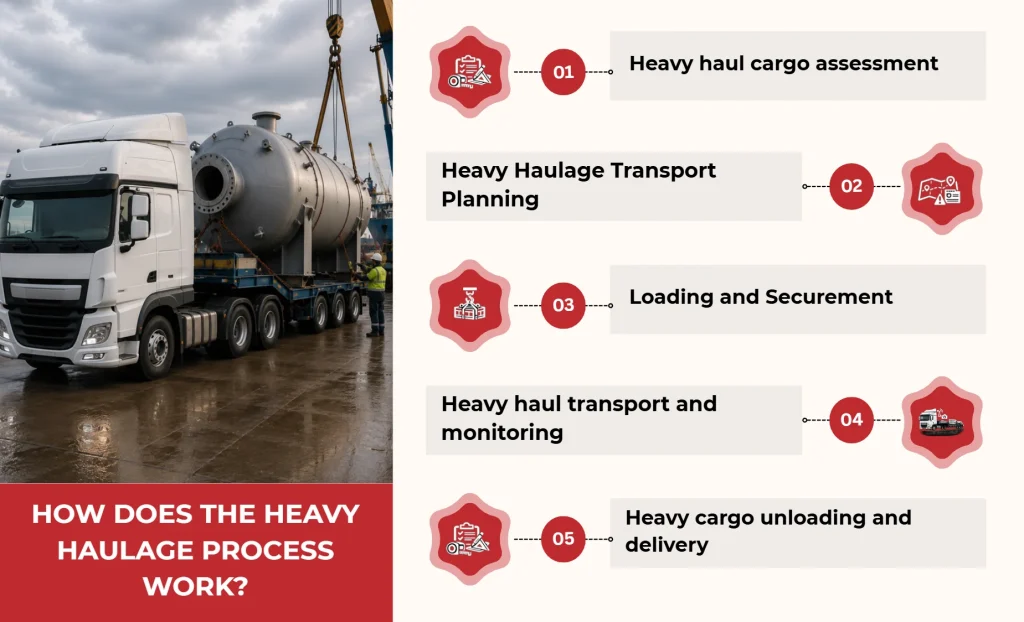
The heavy haulage process works through heavy haul cargo assessment, transport planning, loading and securement, heavy haul transport and monitoring, and heavy cargo unloading and delivery to ensure the load is moved safely, efficiently, and in compliance with transport regulations. Each haulage process is carefully planned and coordinated to select the appropriate equipment, minimise transport risks, protect the cargo and infrastructure, and ensure the shipment reaches its destination safely and on schedule.
Below are the 5 steps of how the heavy haulage process works:
- Heavy haul cargo assessment
The heavy haulage process begins with a heavy haul cargo assessment, where operators evaluate the cargo’s weight, dimensions, centre of gravity, lifting points, and transport requirements. This assessment determines the most suitable equipment, trailer configuration, permits, and handling methods needed to transport the load safely and efficiently.
- Heavy Haulage Transport Planning
Following the assessment, heavy haulage transport planning focuses on selecting the safest route, obtaining permits, conducting route surveys, and identifying bridge limits, overhead clearances, and other restrictions. Detailed planning ensures the transport operation complies with regulations while minimising delays and safety risks.
- Loading and Securement
Once planning is complete, the cargo is loaded and secured using suitable lifting equipment and engineered restraint systems. Loading teams position the load to achieve correct weight distribution and apply appropriate tie-down methods, supports, and cribbing to prevent movement throughout the journey.
- Heavy haul transport and monitoring
After loading, the cargo is transported under continuous monitoring to ensure safe movement from origin to destination. Transport teams monitor vehicle performance, cargo stability, weather conditions, and route progress while complying with permit conditions and coordinating escort vehicles where required.
- Heavy cargo unloading and delivery
The final stage involves heavy cargo unloading and delivery, where the load is carefully positioned using cranes, hydraulic systems, or other specialised equipment. Delivery teams inspect the cargo after unloading to confirm it has arrived safely before completing the handover at the destination.
How Long Does Heavy Haulage Transport Take?
Heavy haulage transport can take anywhere from a few hours for local movements to several weeks for complex long-distance or international shipments, depending on the project requirements. The overall timeframe is influenced by the cargo’s size and complexity, permit approvals, equipment availability, route conditions, escort requirements, operating windows, weather, loading, any required modifications, and unloading arrangements. Because every shipment has unique transport requirements, there is no fixed delivery timeframe, and each project is planned individually to ensure safe and compliant transport.
What Affects the Heavy Haulage Delivery Schedule?
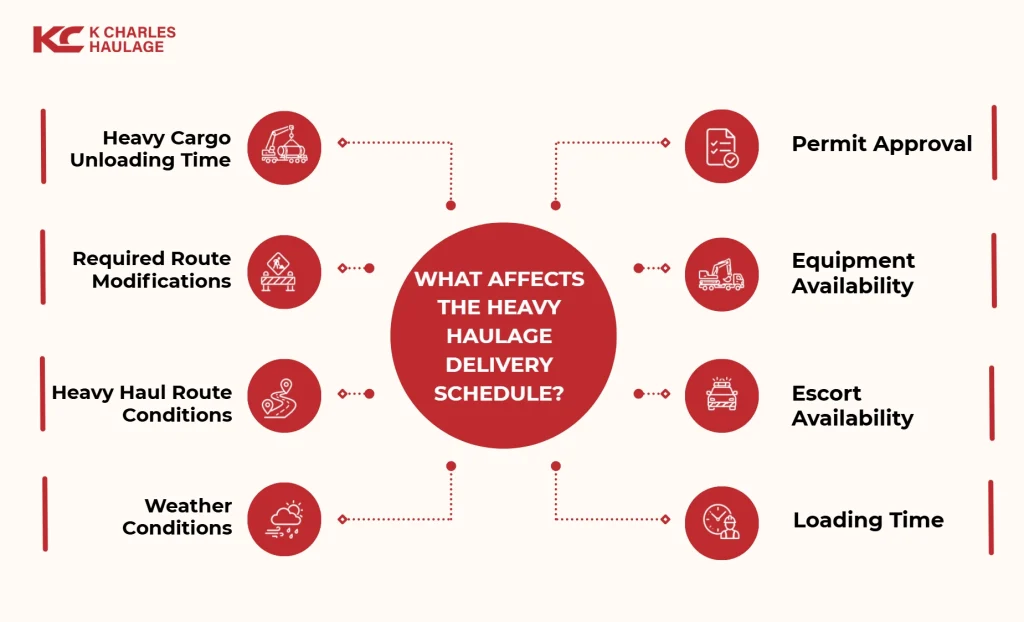
The heavy haulage delivery schedule is affected by permit approval, equipment availability, escort availability, loading time, adverse weather conditions, heavy haul route conditions, required route modifications, and heavy cargo unloading time. Each factor can influence the overall transport timeline by affecting when the shipment can depart, travel safely, and reach its destination, making careful planning essential for efficient and compliant heavy haul operations.
8 key factors that affect heavy haulage delivery schedule are:
- Permit Approval: Obtaining all required transport permits is necessary before an oversized or overweight load can begin its journey. Delays in permit approval can postpone departure and extend the overall delivery schedule.
- Equipment Availability: Access to the required tractors, trailers, and support vehicles is necessary before transport can start. Limited fleet availability or maintenance can delay project mobilisation.
- Escort Availability: Availability of authorised escort vehicles is required for many oversized loads to travel legally. Delays in arranging escorts can postpone the transport schedule.
- Loading Time: Specialised lifting equipment, securement procedures, and cargo positioning can increase the time required before transport begins. Longer loading operations may delay departure.
- Weather Conditions: Heavy rain, strong winds, snow, ice, and poor visibility can make loading and transport unsafe. Adverse weather may require temporary transport delays until conditions improve.
- Heavy Haul Route Conditions: Roadworks, bridge weight limits, traffic restrictions, narrow roads, and temporary closures can increase travel time or require route changes, extending the delivery schedule.
- Required Route Modifications: Temporary removal of road signs, barriers, or overhead utilities may be necessary before oversized loads can travel safely. These modifications can increase preparation time before transport begins.
- Heavy Cargo Unloading Time: Specialised lifting equipment, site readiness, and controlled handling procedures influence how quickly cargo can be unloaded. Longer unloading operations can extend the overall project timeline.
How Is a Heavy Haul Route Planned?
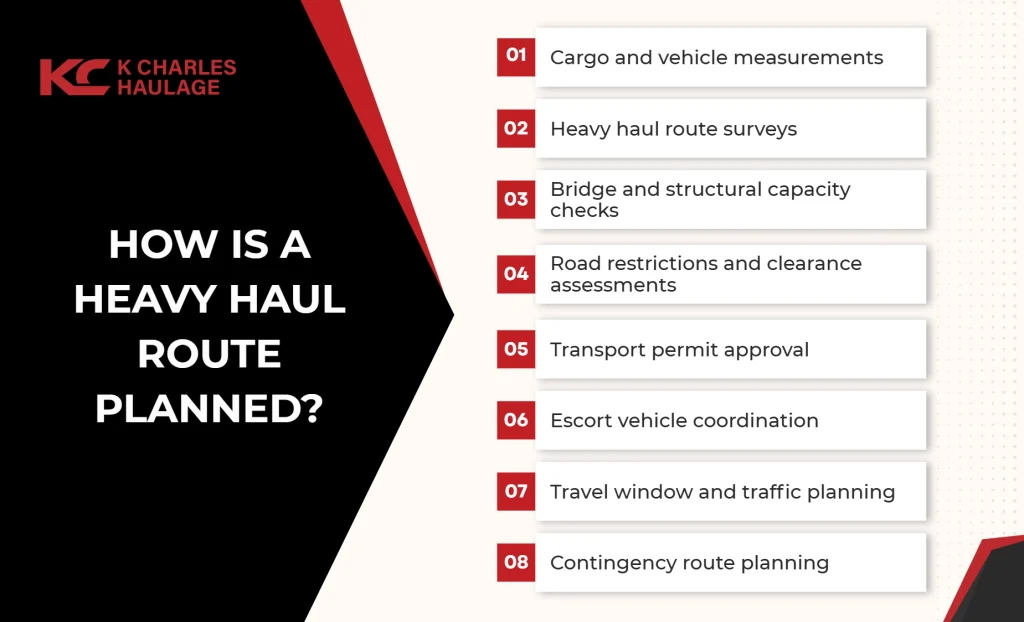
A heavy haul route is planned by assessing the cargo and vehicle dimensions, conducting detailed route surveys, verifying bridge and road capacities, identifying transport restrictions, obtaining permits, coordinating escort vehicles, selecting approved travel windows, and preparing contingency routes. Each stage helps ensure the load can travel safely, comply with transport regulations, minimise delays, and reach its destination without damaging infrastructure or compromising public safety.
Key steps in heavy haul route planning include:
- Cargo and vehicle measurements
- Heavy haul route surveys
- Bridge and structural capacity checks
- Road restrictions and clearance assessments
- Transport permit approval
- Escort vehicle coordination
- Travel window and traffic planning
- Contingency route planning
What Does a Heavy Haul Route Survey Check?
A heavy haul route survey checks bridge capacity, clearances, road dimensions, gradients, weight and height restrictions, low wires, rail crossings, roadworks, restricted zones, and traffic conditions to confirm the route is safe and suitable for transport. The survey helps identify potential obstacles in advance, allowing route adjustments, permit compliance, and safe movement of oversized or overweight cargo throughout the journey.
12 key factors heavy haulage route survey check are:
- Bridge Capacity: Bridge load ratings and structural capacity are assessed to confirm they can safely support the combined weight of the transport vehicle and cargo. Routes are modified if a bridge cannot accommodate the load.
- Bridge Clearance: Vertical clearances beneath bridges, overpasses, and similar structures are measured to ensure the loaded vehicle can pass safely. Insufficient clearance requires route or vehicle adjustments.
- Road Width: Available road width is evaluated to ensure oversized vehicles can travel safely without contacting roadside obstacles or adjacent traffic. Narrow sections may require an alternative route.
- Turning Radius: Corners, roundabouts, and intersections are assessed to confirm there is enough space for the transport vehicle to manoeuvre safely. Tight turns may require route changes or traffic management.
- Road Gradient: Steep inclines and declines are reviewed to determine whether they are suitable for the vehicle’s weight, braking performance, and stability. Challenging gradients may require alternative routes or specialised equipment.
- Weight Restrictions: Posted weight limits on roads and structures are compared with the combined gross vehicle weight to ensure legal compliance. Alternative routes or permits are arranged where necessary.
- Height Restrictions: Overhead structures, including bridges, tunnels, and gantries, are checked to verify sufficient clearance for the loaded vehicle. Any restrictions are addressed before transport begins.
- Low Wires: Power lines, communication cables, and street lighting are inspected to confirm they provide adequate clearance for the load. Utility adjustments may be required if clearance is insufficient.
- Rail Crossings: Railway crossings are assessed to ensure the vehicle can cross safely without grounding. Where risks exist, planners coordinate with railway authorities or select another route.
- Road Construction: Temporary roadworks, lane closures, detours, and construction zones are reviewed to identify potential access restrictions. Routes or transport schedules are adjusted to avoid delays.
- Restricted Zones: Residential areas, city centres, environmentally protected areas, and security-controlled locations are identified to ensure the route complies with local access restrictions.
- Traffic Conditions: Peak traffic, congestion, road incidents, and temporary traffic controls are reviewed to identify the safest and most efficient travel times for oversized loads.
How Are Heavy Haul Route Obstacles Managed?
Heavy haul route obstacles are managed through alternate routes, temporary road controls, utility adjustments, road modifications, lane closures, and restricted travel hours to ensure oversized or overweight loads can travel safely, comply with permit requirements, and minimise disruption throughout the journey. The appropriate management method depends on the type of obstacle, allowing transport planners to maintain route safety, protect infrastructure, and complete the delivery with minimal delays.
Heavy haul route obstacles are managed through the following ways:
- Alternate Routes: Alternative roads are selected when the planned route cannot safely or legally accommodate the oversized or overweight load. Each route is assessed to ensure it provides sufficient clearances, bridge capacity, turning space, and regulatory compliance.
- Temporary Road Controls: Traffic management measures, such as diversions, rolling roadblocks, temporary traffic signals, and controlled intersections, are implemented to allow oversized vehicles to move safely through challenging areas.
- Utility Adjustments: Overhead power lines, communication cables, and other utilities are temporarily raised, disconnected, or relocated to provide the necessary clearance for the load before being restored after transport.
- Road Modifications: Temporary infrastructure changes, including barrier removal, access widening, road strengthening, or bridge protection, are carried out to create enough space for safe transport.
- Lane Closures: One or more traffic lanes are temporarily closed to provide the additional space needed for oversized vehicles to navigate narrow roads, bridges, or intersections safely.
- Restricted Travel Hours: Heavy haul movements are scheduled during approved periods, such as overnight or outside peak traffic hours, to reduce congestion, improve safety, and comply with permit requirements.
How Are Bridges and Road Structures Assessed?
Bridges and road structures are assessed through engineering evaluations to determine whether they can safely support the combined weight and dimensions of an oversized or overweight load. Engineers review structural capacity, axle load distribution, crossing speed, lane position, vehicle spacing, and permit requirements before approving the planned route.
Each assessment identifies how the load will interact with the structure during the crossing, helping to minimise stress on bridges and pavements while maintaining safe operating conditions. The findings support regulatory compliance, protect public infrastructure, and ensure heavy haul transport can proceed safely without causing structural damage or unnecessary delays.
What Permits and Regulations Apply to Heavy Haulage?
Heavy haulage operations in the UK require a goods vehicle operator licence, Special Types General Order (STGO) categorisation, and, where applicable, oversize or overweight movement permits. The regulatory requirements depend on the vehicle’s weight, dimensions, axle configuration, and route, with larger or heavier loads subject to additional notifications, escort requirements, and transport restrictions.
Core Regulations and Categories
- Construction and Use (C&U) Regulations: Standard articulated lorries are generally limited to 44 tonnes gross vehicle weight.
- STGO Category 1: Vehicles up to 50,000 kg (50 tonnes).
- STGO Category 2: Vehicles up to 80,000 kg (80 tonnes).
- STGO Category 3: Vehicles exceeding 80,000 kg (80 tonnes).
- Department for Transport Special Order: Required for loads exceeding STGO limits.
Permits, Notices, and Escort Requirements
- Advance Notice: Loads wider than 3 metres generally require at least 2 full working days’ notice to highway and bridge authorities.
- Escort Vehicles: Loads between 3.5 metres and over 5 metres wide require certified attendants or pilot/escort vehicles, depending on the dimensions.
- Required Documentation: Operators must maintain a valid goods vehicle operator licence, bill of lading, route risk assessment, and appropriate cargo insurance before transport begins.
What Conditions Can a Heavy Haul Permit Set?
A heavy haul permit can set conditions such as approved routes, travel hours, speed limits, escort requirements, warning signs, weather restrictions, and bridge crossing instructions to ensure oversized or overweight loads are transported safely and in compliance with regulatory requirements. These conditions are determined by road authorities based on the load’s dimensions, weight, route characteristics, and potential risks, helping protect public infrastructure, maintain road safety, and minimise disruption throughout the journey.
7 conditions a heavy haul permit can set are:
- Approved Route: The permit specifies the exact route the transport vehicle must follow to ensure it complies with bridge capacities, road dimensions, and infrastructure limitations.
- Travel Hours: Specific operating hours, such as daytime, overnight, or off-peak periods, are assigned to minimise traffic disruption and improve transport safety.
- Speed Limits: Reduced speed limits may be imposed to improve vehicle stability and reduce stress on bridges and other infrastructure during transport.
- Escort Requirements: Police or accredited escort vehicles may be required to manage traffic and improve safety along the approved route, depending on the load dimensions.
- Warning Signs: Safety signs, warning lights, and flags may be required to alert other road users to the presence of an oversized or overweight vehicle.
- Weather Restrictions: Travel may be prohibited during adverse weather conditions, such as high winds, heavy rain, snow, flooding, or poor visibility, to maintain safe operating conditions.
- Bridge Crossing Instructions: Special crossing requirements, including reduced speeds, designated lanes, vehicle spacing, or single-vehicle crossings, may be specified to protect bridge structures.
Which Heavy Haul Regulations Must Be Followed?
Heavy haul regulations cover gross vehicle weight limits, axle weight limits, vehicle and cargo dimensions, cargo securement, vehicle and driver requirements, and inspection duties to ensure oversized or overweight loads are transported safely and legally. Following these regulations helps protect public infrastructure, maintain road safety, and ensure compliance throughout the transport journey.
9 heavy haul regulations that must be followed are:
- Gross Vehicle Weight Limits: The combined weight of the vehicle and cargo must comply with applicable C&U or STGO weight limits. Loads exceeding these limits require the appropriate permits and approvals.
- Axle Weight Limits: Weight must be distributed across each axle within the legal axle load limits to protect road infrastructure and maintain vehicle stability.
- Vehicle and Cargo Width Limits: Oversized loads must comply with legal width thresholds, with wider loads requiring additional permits, escort vehicles, or traffic management measures.
- Total Loaded Height Limits: The combined height of the vehicle and cargo must be checked against bridge and overhead clearances to ensure the route can be travelled safely.
- Vehicle and Cargo Length Limits: Longer loads must comply with legal length limits and may require permits, route planning, and escort vehicles to navigate safely.
- Cargo Securement Rules: All loads must be securely restrained using suitable chains, straps, or other approved equipment to prevent movement during transport.
- Vehicle Requirements: Transport vehicles must meet all applicable safety, braking, trailer, tyre, and load-carrying requirements before operating on public roads.
- Driver Requirements: Drivers must hold the appropriate licence, comply with drivers’ hours regulations, and understand the procedures for transporting abnormal loads.
- Inspection Duties: Regular inspections of the vehicle, trailer, and cargo must be carried out before and during transport to maintain safety and regulatory compliance.
How Do Heavy Haul Rules Vary by Jurisdiction?
Heavy haul rules vary across the UK because legal limits, permit types, permit fees, notification periods, escort thresholds, travel windows, equipment requirements, and approval processes are determined by different authorities. While the Construction and Use (C&U) Regulations and the Special Types General Order (STGO) provide the national framework, Scotland, Northern Ireland, local highway authorities, and police forces apply their own requirements for permits, operating conditions, and route approvals.
Route-specific conditions can also differ between authorities. Local highway authorities may impose bridge restrictions, specify escort vehicles, restrict travel during peak periods or special events, and require authority-specific permit fees and consultation periods for permits such as VR1 or BE16 Special Orders, where applicable, before approving a movement. Operators must comply with the requirements of every authority along the planned route to ensure legal compliance and avoid transport delays.
When Are Escort Vehicles Required?
Escort vehicles are required when cargo dimensions, weight, route conditions, or permit requirements exceed the thresholds set by the relevant UK authorities. Requirements depend on the load’s width, length, height, and weight, as well as route hazards, traffic conditions, bridge restrictions, and the conditions specified under STGO, VR1 permits, or BE16 Special Orders. Police or private escorts may also be required depending on the type of movement and jurisdiction.
Once the route assessment is complete, the escort requirements are determined by the relevant highway authority or police force. They evaluate factors such as narrow roads, low bridges, sharp bends, peak traffic periods, and public safety risks before specifying the number and type of escort vehicles required. The Transport Team must comply with these permit conditions throughout the journey to ensure safe and lawful transport.
What Types of Escort Support May Be Required?
Escort support may include lead escorts, rear escorts, multiple pilot cars, police escorts, and utility escorts, depending on the load, route, permit conditions, and identified hazards. Lead escorts travel ahead of the load to identify obstacles, warn oncoming traffic, and communicate upcoming hazards. Rear escorts follow behind to alert approaching drivers, manage overtaking traffic, and improve visibility for long or slow-moving vehicles.
Multiple pilot cars improve traffic management and communication, police escorts provide traffic control where public safety requires it, and utility escorts coordinate with utility providers to manage overhead power lines, communication cables, and other infrastructure that could restrict the safe passage of the load.
How Is Heavy Cargo Loaded and Secured Safely?
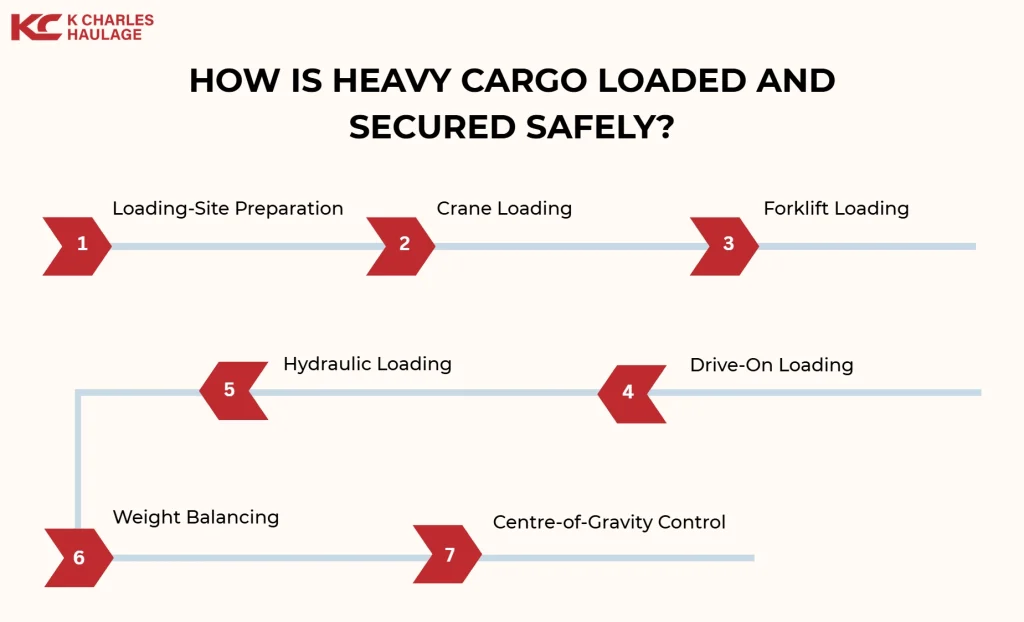
Heavy cargo is loaded and secured safely through loading-site preparation, appropriate loading methods, weight balancing, and centre-of-gravity control to maintain load stability, protect equipment, and ensure safe transport. These measures reduce the risk of cargo movement, equipment failure, and loading-related accidents while supporting safe handling throughout the lifting, loading, and transport process.
Heavy cargo is loaded and secured safely in the following ways :
- Loading-Site Preparation: Ground conditions, access routes, lifting areas, and overhead clearances are assessed to create a safe environment before loading begins. Barriers and exclusion zones may also be established to protect workers and equipment.
- Crane Loading: Cranes are used to lift heavy cargo that cannot be handled by conventional equipment. The crane capacity, lifting points, and rigging are matched to the load to ensure safe and controlled lifting.
- Forklift Loading: Forklifts are used to load cargo that can be safely handled from ground level. Proper fork positioning and operation within the forklift’s rated capacity help maintain stability and prevent load movement.
- Hydraulic Loading: Hydraulic jacks, skidding systems, or platform trailers provide controlled lifting and positioning for exceptionally heavy or sensitive cargo. This method improves placement accuracy while reducing stress on the load.
- Drive-On Loading: Self-propelled machinery is driven directly onto the trailer using ramps or low-loader trailers. Once positioned correctly, the equipment is secured before transport begins.
- Weight Balancing: Cargo is positioned to distribute weight evenly across the vehicle and trailer, improving stability, braking performance, and compliance with axle weight limits.
- Centre-of-Gravity Control: The load is positioned to keep its centre of gravity low and close to the vehicle’s centreline, reducing the risk of tipping or load movement during transport.
How Is Securement Checked During Transport?
Securement is checked during transport by inspecting chains, straps, tie-downs, blocks, braces, anchor points, and restraint systems before departure and at regular intervals throughout the journey. These inspections confirm that all securing equipment remains correctly positioned, properly tensioned, and capable of keeping the load stable under changing road and weather conditions.
During each inspection, the securement system is checked for loosening, load movement, wear, or damage that could affect cargo stability. If chains or straps lose tension, restraint components become damaged, or the load shifts, corrective action is taken immediately by re-tensioning, repositioning, repairing, or replacing the affected securement equipment before the journey continues.
What Are the Main Heavy Haulage Safety Risks?
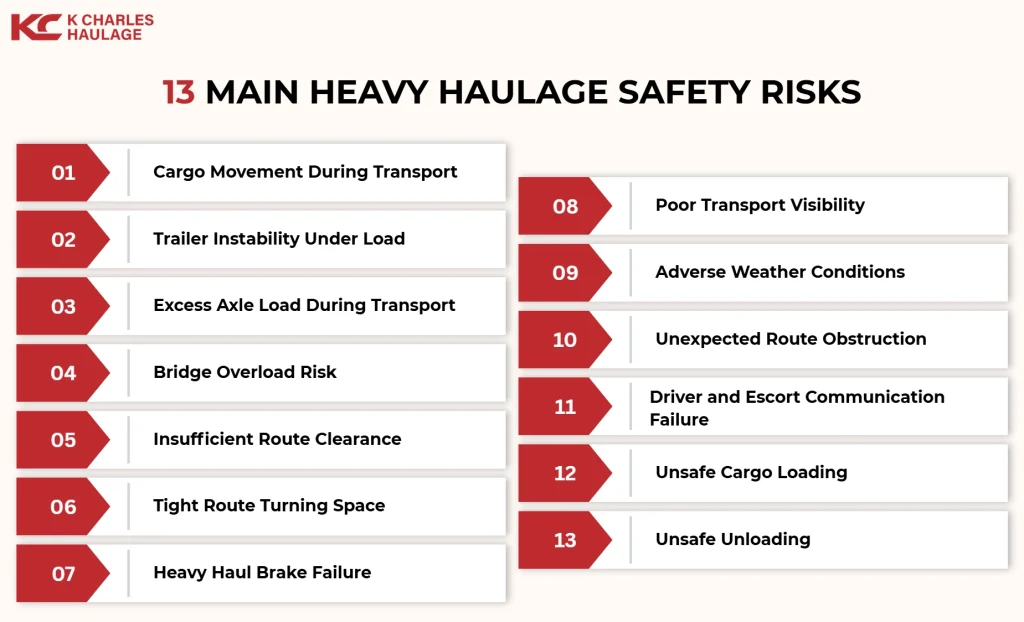
The main heavy haulage safety risks include cargo movement, trailer instability, axle and bridge overloading, route clearance and turning restrictions, brake failure, poor visibility, adverse weather, route obstructions, communication failures, and unsafe loading or unloading. These risks can affect load stability, vehicle control, public safety, and infrastructure, making careful planning, regulatory compliance, and continuous risk management essential throughout the transport operation.
13 main heavy haulage safety risks include:
- Cargo Movement During Transport: Inadequate load restraint, sudden braking, or uneven roads can cause cargo to shift, reducing vehicle stability and increasing the risk of collisions or rollovers.
- Trailer Instability Under Load: Uneven weight distribution can reduce steering response, braking performance, and vehicle stability, especially when cornering or travelling on uneven roads.
- Excess Axle Load During Transport: Exceeding legal axle weight limits places excessive stress on the vehicle and road infrastructure while increasing the risk of tyre, suspension, and stability issues.
- Bridge Overload Risk: Transporting loads across bridges that cannot safely support the combined vehicle and cargo weight can damage infrastructure and create serious safety hazards.
- Insufficient Route Clearance: Inadequate clearance beneath bridges, overhead cables, roadside structures, or vegetation can result in collisions, cargo damage, and transport delays.
- Tight Route Turning Space: Limited space at junctions, roundabouts, and narrow roads can restrict vehicle manoeuvrability and increase the risk of striking surrounding infrastructure or traffic.
- Heavy Haul Brake Failure: Mechanical faults, brake overheating, or excessive vehicle weight can reduce braking performance and increase stopping distances during transport.
- Poor Transport Visibility: Darkness, fog, heavy rain, or oversized cargo can reduce visibility, making it more difficult to identify hazards and navigate safely.
- Adverse Weather Conditions: Heavy rain, snow, ice, strong winds, and poor visibility can reduce traction, stability, and overall transport safety.
- Unexpected Route Obstruction: Roadworks, accidents, fallen trees, or other unexpected obstacles can disrupt the planned route and require immediate route changes or transport delays.
- Driver and Escort Communication Failure: Poor communication between drivers and escort vehicles can delay hazard reporting, traffic coordination, and route adjustments, increasing operational risks.
- Unsafe Cargo Loading: Incorrect lifting, positioning, or load securement can reduce stability and increase the risk of cargo movement during transport.
- Unsafe Unloading: Improper unloading procedures, unstable ground, or unsuitable lifting methods can create safety hazards and increase the risk of equipment damage or injury.
How Are Heavy Haul Risks Controlled?
Heavy haul risks are controlled through risk assessment, route surveys, equipment inspections, driver competence, escort coordination, cargo securement checks, weather monitoring, journey monitoring, and emergency planning to maintain safe, compliant, and efficient transport operations. These measures help identify potential hazards before and during the journey, reducing the likelihood of accidents, delays, cargo damage, and regulatory non-compliance.
Below are the key factors that heavy haul risks are controlled:
- Heavy Haul Risk Assessment: Potential hazards related to the load, vehicle, route, weather, and lifting operations are identified before transport begins to implement appropriate safety controls.
- Route Survey: Bridges, tunnels, road widths, overhead clearances, gradients, and temporary restrictions are assessed to identify hazards and confirm the route is suitable for the load.
- Equipment Inspection: Vehicles, trailers, braking systems, tyres, hydraulic equipment, and load restraint devices are inspected before transport to identify mechanical defects and prevent equipment failure.
- Driver Competence: Experienced and qualified drivers help reduce operational risks by following permit conditions, managing oversized loads safely, and responding effectively to changing road conditions.
- Escort Coordination: Effective communication between drivers, escort vehicles, and traffic authorities helps manage traffic, improve manoeuvrability, and maintain public safety throughout the journey.
- Cargo Securement Checks: Chains, straps, binders, anchor points, and other restraint systems are regularly inspected to ensure the cargo remains stable during transport.
- Transport Weather Monitoring: Weather forecasts and real-time conditions are continuously monitored to identify adverse weather that could affect transport safety or require schedule adjustments.
- Heavy Haul Journey Monitoring: Vehicle performance, cargo stability, route progress, traffic conditions, and driver communications are monitored throughout the journey to identify and address potential issues quickly.
- Heavy Haul Emergency Planning: Emergency response procedures are established in advance to manage vehicle breakdowns, cargo movement, road closures, severe weather, and other unexpected incidents safely.
How Much Does Heavy Haulage Cost?
Heavy haulage costs in the UK range between £2.50 and £5.00 per loaded mile because transporting oversized freight often requires specialist trailers, escort vehicles, route surveys, and permit approvals before the journey begins. Industrial machinery, transformers, plant equipment, and large infrastructure components are among the most common abnormal loads, while UK heavy haulage costs vary according to the transport requirements, route complexity, and support services involved.
What Factors Affect Heavy Haulage Cost?
Heavy haulage costs are influenced by the load requirements, transport complexity, operational resources, and regulatory obligations involved in moving abnormal loads. Cargo weight, cargo dimensions, transport distance, trailer type, axle configuration, permit fees, escort costs, route surveys, engineering work, loading, unloading, fuel, labour, insurance, and any road modifications all contribute to UK heavy haulage costs, with the final price depending on the combination of services required for each transport project.
How Should You Choose a Heavy Haulage Company?
Choosing a heavy haulage company requires evaluating its ability to transport abnormal loads safely, legally, and efficiently using the appropriate expertise, equipment, and operational support. Experience with similar cargo, specialist trailer capability, safety record, operator licences, haulage insurance cover, permit knowledge, route-planning ability, engineering support, escort coordination, clear communication, and a proven track record of delivering comparable projects all help determine whether the company can successfully manage complex heavy haul transport operations.
Does Your Cargo Need Heavy Haulage Transport?
Yes, your cargo needs heavy haulage transport if its weight, dimensions, or handling requirements exceed the legal limits or operating capabilities of standard transport equipment. Cargo that requires specialist trailers, controlled lifting and securement, permit approvals, route planning, escort vehicles, restricted-access management, or a heavy equipment haulage service is transported using heavy haulage methods. Reviewing these requirements helps determine the most suitable transport solution, and the relevant commercial page provides the next resource for assessing your shipment requirements.