Skip to content
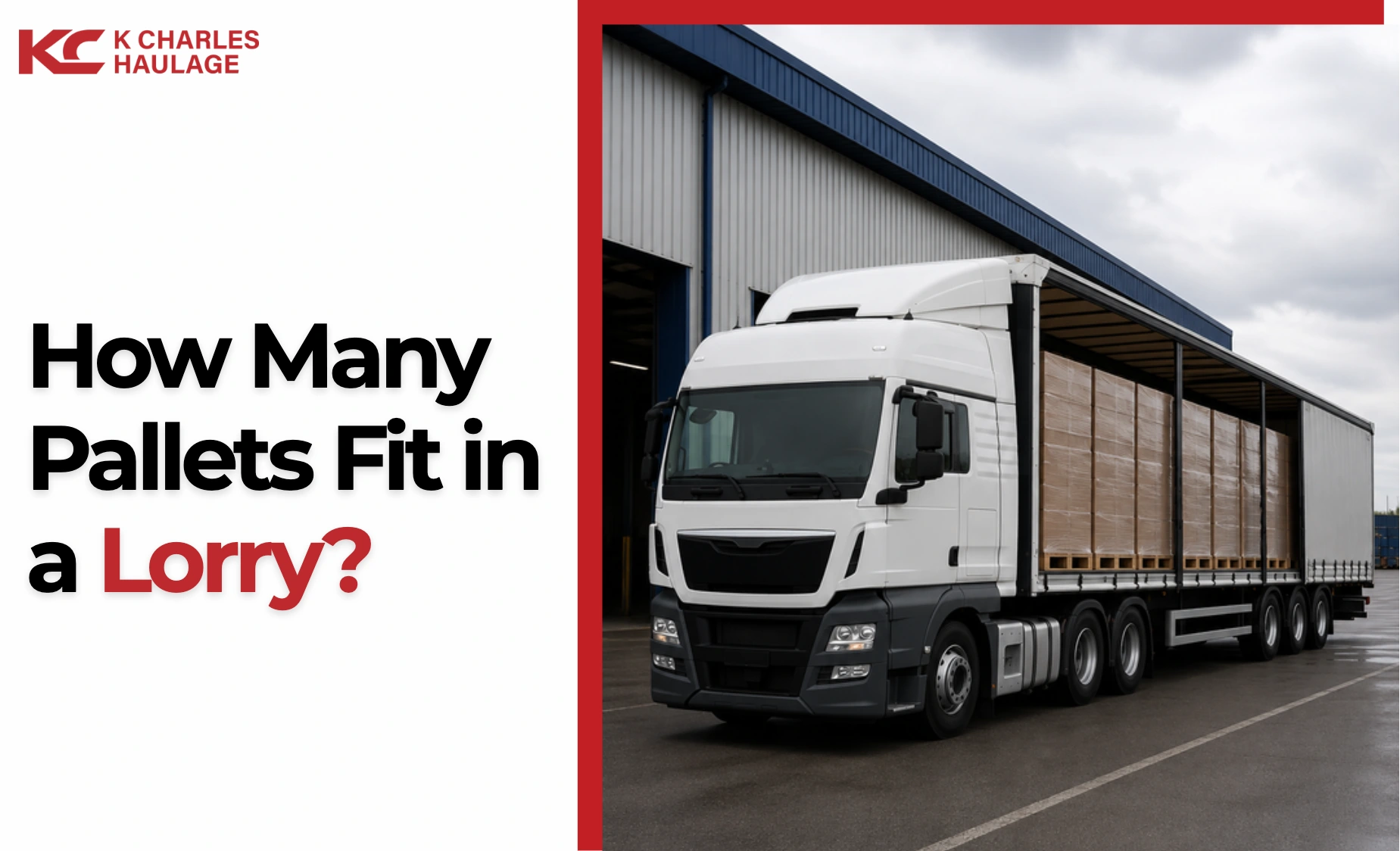
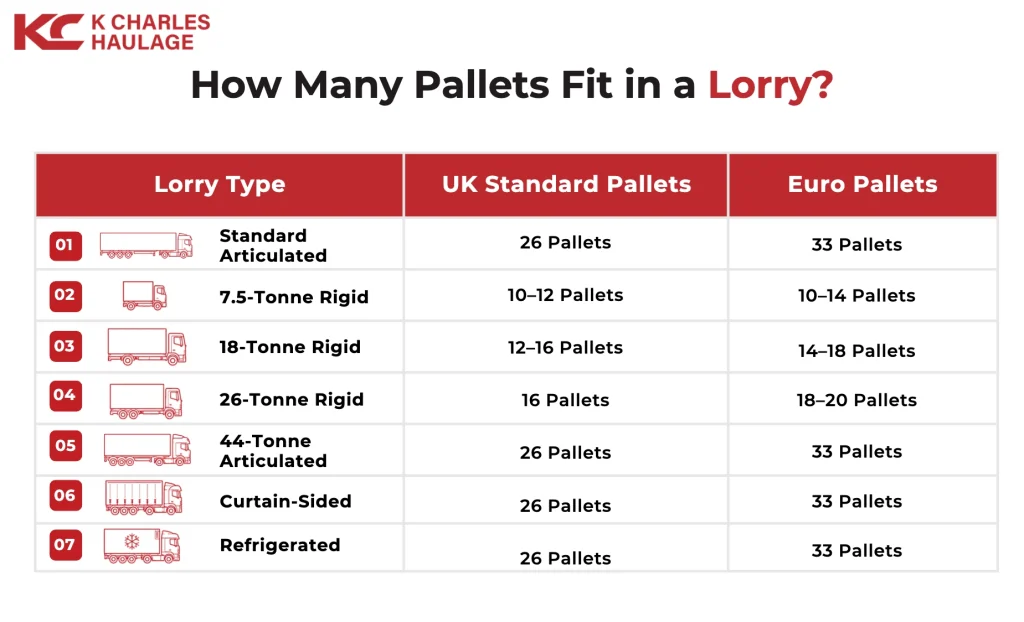
A standard articulated lorry (13.6-metre articulated lorry) can fit up to 26 UK standard pallets or 33 Euro pallets, while a 7.5-tonne rigid lorry carries around 10 to 12 UK standard pallets or 10 to 14 Euro pallets. An 18-tonne rigid lorry accommodates around 12 to 16 pallets, and a 26-tonne rigid lorry carries around 16 UK standard pallets or 18 to 20 Euro pallets. A 44-tonne articulated lorry, curtain-sided lorry, and refrigerated lorry can transport up to 26 UK standard pallets or 33 Euro pallets, depending on the trailer design, pallet size, and loading arrangement.
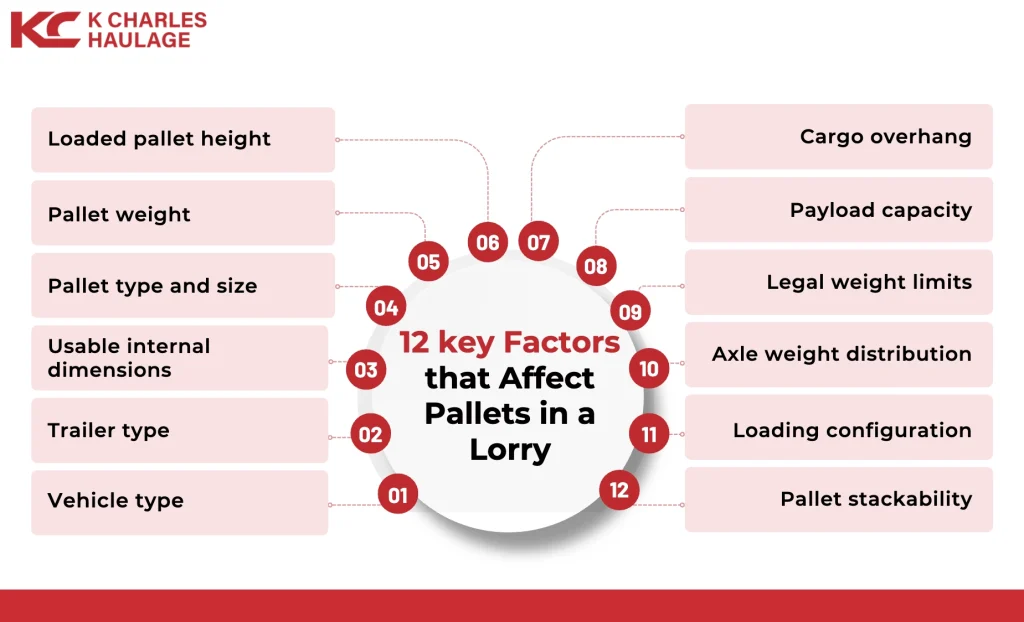
The final number of pallets a lorry can transport is also affected by factors such as usable internal dimensions, pallet size, pallet weight, loaded height, cargo overhang, payload capacity, legal weight limits, axle weight distribution, loading configuration, and pallet stackability. To calculate pallet capacity accurately, measure the usable floor length and width, identify pallet dimensions, check pallet orientation, calculate available pallet spaces, assess linear metre requirements where applicable, and confirm payload and legal weight limits before selecting the correct vehicle.
How Many Pallets Fit in a Standard Articulated Lorry?
A standard truck or standard articulated lorry with a 13.6-metre trailer can carry 26 UK standard pallets (120 cm x 100 cm) or 33 Euro pallets (120 cm x 80 cm) when loaded in a single-floor layer. The trailer provides around 13.6 metres of internal length, 2.45 to 2.5 metres of internal width, and 2.7 to 2.9 metres of internal height for pallet loading. A full truckload (FTL) shipment typically utilises the entire trailer capacity.
The term 40ft lorry can create confusion because vehicle and trailer dimensions vary. A 40ft trailer does not always have the same internal length, width, height, or pallet capacity as a standard 13.6-metre articulated trailer. Pallet capacity should be calculated using the usable internal dimensions and the pallet arrangement, rather than the external trailer length alone.
How Many Pallets Fit in a 7.5-Tonne Rigid Lorry?
A 7.5-tonne rigid lorry can fit between 10 and 12 UK standard pallets or 10 and 14 Euro pallets, depending on the vehicle body layout and available loading space. It usually provides an internal loading length of 5.5 to 6.0 meters, with an internal width of approximately 2.4 meters and an internal height of around 2.3 to 2.5 meters.
The actual pallet capacity also depends on the vehicle’s payload capacity and legal weight limits. A 7.5-tonne rigid lorry has a maximum gross weight of 7.5 tonnes, with a cargo payload capacity of approximately 2,300kg to 2,800kg after accounting for the vehicle body weight. It suits smaller palletised shipments and regional deliveries where a lower pallet count is required, rather than the larger capacity offered by an articulated lorry.
How Many Pallets Fit in an 18-Tonne Rigid Lorry?
An 18-tonne rigid lorry can carry around 12 to 16 pallets on a single deck, depending on the pallet type, body length, and loading arrangement. It can accommodate around 12 to 14 UK standard pallets or 14 to 18 Euro pallets when floor-loaded. The vehicle provides an internal loading length of 7.0 to 9.5 metres, an internal width of 2.4 to 2.45 metres, and an internal height of 2.3 to 2.6 metres.
The final pallet quantity also depends on the payload capacity, which is around 9,000kg to 10,000kg. Heavy cargo can reduce the number of usable pallets before all physical pallet spaces are filled. When goods are stackable, and height limits allow, a double-deck configuration can carry 26 or more pallets while remaining within legal weight restrictions.
How Many Pallets Fit in a 26-Tonne Rigid Lorry?
A 26-tonne rigid lorry can carry around 16 UK standard pallets, with capacity increasing to approximately 18 to 20 Euro pallets depending on the vehicle body length and loading arrangement. The lorry provides an internal loading length of around 8.5 to 9.5 metres, an internal width of approximately 2.45 to 2.5 metres, and an internal height of around 2.6 to 2.7 metres, a suitable option for regional distribution, retail deliveries, and commercial freight movements that require more capacity than smaller rigid vehicles.
The actual pallet capacity is also determined by the vehicle’s payload limit and cargo characteristics. A 26-tonne rigid lorry can carry a payload of approximately 14,000kg to 15,000kg, meaning heavy cargo may reach the weight limit before all available pallet spaces are occupied. Pallet type also affects capacity, as UK standard pallets require more floor space than smaller Euro pallets, which can change the total number of pallets transported.
How Many Pallets Fit in a 44-Tonne Articulated Lorry?
A 44-tonne articulated lorry can transport up to 26 UK standard pallets or 33 Euro pallets when pallets are arranged in a single, evenly distributed layer. The trailer offers around 13.6 metres of internal length, 2.5 metres of internal width, and 2.7 metres of 2.7 metres, allowing it to accommodate high-volume palletised freight.
For large-scale transport requirements, a 44-tonne articulated lorry provides the capacity needed for full truckload (FTL) movements, long-distance haulage, and commercial shipments. Its payload capacity is approximately 24 to 27 tonnes, depending on the tractor unit and trailer combination. This vehicle type is commonly used for full truckload (FTL) transport, long-distance haulage, and large commercial deliveries where businesses need to move high volumes of pallets efficiently.
How Many Pallets Fit in a Curtain-Sided Lorry?
A curtain-sided articulated lorry can carry up to 26 UK standard pallets or 33 Euro pallets in a single-layer loading arrangement. A full-size curtain-side trailer provides an internal length of around 13.6 meters, an internal width of 2.40 meters, and an internal height of 2.65 to 2.85 meters, allowing efficient loading of large palletised shipments.
Beyond pallet space, the vehicle’s weight capacity also determines the final load it can transport. A curtain-sided artic has an approximate gross vehicle weight of 44 tonnes, with payload capacity depending on the trailer type. A UK trailer can carry around 28 tonnes, while a Euroliner configuration provides a payload of approximately 24.5 tonnes. These vehicles are commonly used for full truckload (FTL) movements, general haulage, retail stock, FMCG goods, packaging, and construction materials where large pallet volumes and flexible loading access are required.
How Many Pallets Fit in a Refrigerated Lorry?
A refrigerated transport trailer with a 13.6-metre body can carry up to 26 UK standard pallets or 33 Euro pallets when loaded in a single-layer arrangement, depending on pallet size and available loading space. The refrigerated trailer provides an internal length of around 13.6 meters, an internal width of 2.40 meters, and an internal height of 2.65 to 2.85 meters for temperature-controlled palletised freight.
Along with available pallet space, the trailer’s payload capacity also affects the final load quantity. Refrigerated lorries are commonly used for food, dairy products, pharmaceuticals, frozen goods, and other temperature-sensitive shipments that require controlled transport conditions. A refrigerated artic usually provides a payload capacity of around 22 to 25 tonnes, depending on the vehicle specification. The final pallet capacity depends on pallet dimensions, cargo weight, refrigeration equipment, and payload restrictions.
What Factors Change How Many Pallets Fit in a Lorry?
The number of pallets that fit in a lorry changes based on the vehicle type, trailer type, usable internal dimensions, pallet type and size, pallet weight, loaded pallet height, cargo overhang, payload capacity, legal weight limits, axle weight distribution, loading configuration, and pallet stackability. These factors determine whether the available floor space can be fully used and whether the load remains within safe operating limits, as physical pallet spaces do not always equal the final transport capacity.
12 key factors that affect pallets in a lorry are:
- Vehicle type
Vehicle type affects pallet capacity by changing the available floor area, payload capacity, and loading configuration. Rigid lorries have a fixed body design for smaller and medium shipments, while articulated lorries use a tractor unit and trailer to provide larger cargo space. Specialist vehicles, such as refrigerated and curtain-sided lorries, use different trailer designs that influence usable dimensions and load arrangements.
- Trailer type
When a shipment requires more pallet space or a different loading method, the trailer type becomes an important factor in determining usable capacity. Single-deck trailers provide standard floor loading space, while double-deck trailers increase capacity by using vertical space where pallet height and weight allow. Curtain-sided, refrigerated, and longer semi-trailers also affect capacity through their internal dimensions, specialist equipment, and available loading areas.
- Usable internal dimensions
Usable internal dimensions affect pallet capacity because the available internal length, width, and height determine how many pallets can be positioned inside a lorry. External vehicle measurements do not define loading capacity, as internal space can be reduced by wheel arches, side linings, refrigeration equipment, tail-lift structures, and other internal obstructions. These limitations affect pallet arrangement, usable floor space, and the final number of pallets that can be safely loaded.
- Pallet type and size
If the pallet type and size change, the total pallet capacity of a lorry can also change because different footprints affect how pallets fit across each row and within the available trailer space. A UK standard pallet measures 1200mm × 1000mm, while a Euro pallet measures 1200mm × 800mm, allowing more efficient use of loading width. A standard UK pallet arrangement can usually fit around 26 pallets in a truck, while a lorry can accommodate up to 33 Euro pallets depending on the trailer dimensions and loading configuration.
- Pallet weight
Pallet weight plays an important role in determining the final number of pallets a lorry can transport, as heavier loads may reach the vehicle’s allowable carrying limit before all physical pallet spaces are occupied. Pallet weight affects payload capacity separately from pallet dimensions, meaning available floor space does not always represent the maximum usable pallet capacity.
- Loaded pallet height
Loaded pallet height affects pallet capacity because the total height of the pallet and goods must remain within the lorry’s internal clearance. For example, a pallet with a total loaded height of 1.8 metres may allow double stacking inside a trailer with sufficient internal height, while a pallet loaded to 2.4 metres may require single-layer transport because there is not enough clearance for another pallet above it.
- Cargo overhang
When a pallet carries goods that extend beyond its edges, such as long timber, pipes, or machinery components, the cargo overhang can reduce the available loading space inside a lorry. These extended goods need extra length or width clearance, which can prevent pallets from being arranged in normal side-by-side or row formations. As a result, cargo overhang reduces usable floor space and can decrease the total number of pallets that can be loaded inside the trailer.
- Payload capacity
Payload capacity affects pallet loading because it defines the total cargo weight a vehicle can legally carry. A lorry can have sufficient physical pallet spaces, but heavy goods can reach the payload limit before all spaces are occupied. Therefore, payload capacity is separate from the number of pallet positions, as the final load depends on both available space and the total cargo weight.
- Legal weight limits
When a lorry reaches its permitted gross vehicle weight, legal weight limits can restrict pallet capacity even if floor space remains available. Pallet size and cargo weight determine whether the available pallet spaces can be fully used within the vehicle’s legal weight and axle limits. This means a vehicle can carry fewer pallets when the shipment contains heavier goods.
- Axle weight distribution
If pallet size and weight placement are not considered during loading, axle weight distribution can affect a lorry’s safe pallet capacity. Pallet positioning changes how cargo weight is spread across the axles, meaning a vehicle can remain within its total payload limit while still exceeding an individual axle weight restriction. Proper load distribution ensures the vehicle stays within legal operating limits.
- Loading configuration
Since pallet arrangements can vary inside a lorry, the loading configuration affects how efficiently the available floor space is used. Straight loading, rotated pallet positions, and different row arrangements can change the number of pallet spaces by altering how pallets fit within the trailer dimensions. The correct loading method helps maximise available space while maintaining safe weight distribution and stable cargo positioning.
- Pallet stackability
Pallet stackability affects lorry capacity because it determines whether pallets can be loaded in a single layer or stacked vertically. Double-stacked loading is only possible when the cargo has sufficient strength, pallet stability, suitable loaded height, and weight distribution to support additional layers. If pallets are unstable, too tall, or too heavy, the load must remain single-layered, reducing the available pallet capacity.
How Do You Calculate How Many Pallets Fit in a Lorry?
To calculate how many pallets fit in a lorry, measure the usable space, check pallet dimensions and arrangement, calculate pallet spaces, assess height and stackability, and confirm payload and legal weight limits. This ensures the planned pallet quantity matches the vehicle’s available capacity and safe loading requirements.
Below are the 7 steps to calculate how many pallets fit in a lorry:
- Step 1: Measure the Usable Internal Floor Length and Width
Check the internal trailer length and width rather than external vehicle measurements, while accounting for any space lost due to internal obstructions. These measurements define the available floor area for positioning pallets.
- Step 2: Identify the Pallet Dimensions
Confirm the pallet footprint, such as a UK standard pallet (1200mm × 1000mm) or a Euro pallet (1200mm × 800mm), as pallet size affects the available pallet spaces. Different pallet dimensions change how pallets fit across the trailer width and along the loading length.
- Step 3: Check Pallet Orientation and Pallets per Row
Determine whether pallets fit best in a straight or rotated position, and calculate how many pallets can be placed in each row. The correct orientation can improve floor space utilisation and increase the number of available pallet positions.
- Step 4: Calculate the Available Pallet Spaces
Multiply the number of rows by pallets per row to determine the physical pallet capacity before weight restrictions are applied. This calculation provides the maximum number of pallets that can fit based on floor space alone.
- Step 5: Calculate Capacity Using Linear Metres Where Applicable
Use linear metre (LDM) calculations when planning mixed freight or comparing how much trailer floor space a shipment occupies. This method helps transport planners measure cargo space when pallets do not fully use standard loading patterns.
- Step 6: Check Loaded Pallet Height and Stackability
Confirm that the combined height of pallets and goods allows single-layer, double-stacked, or double-deck loading where suitable. The cargo’s strength, pallet stability, and total loaded height determine whether vertical space can be used safely.
- Step 7: Check Payload and Legal Weight Limits
Verify the total cargo weight, payload capacity, and legal weight restrictions to ensure the calculated pallet quantity can be transported safely. A lorry can have unused pallet spaces but still require a lower pallet count if the cargo weight exceeds permitted limits.
How Do You Choose the Right Lorry for Your Pallet Load?
Choosing the right lorry for a pallet load depends on the pallet count, pallet dimensions, total shipment weight, load height, and delivery requirements such as access restrictions, loading method, and unloading facilities. A suitable pallet haulage service can match the shipment with the correct vehicle type, helping businesses avoid capacity issues, weight restrictions, and unsuitable vehicle selection while ensuring safe and efficient pallet transport.