Skip to content
Haulage services encompass a variety of types tailored to different cargo and operational needs, ranging from general haulage of everyday goods to specialised transport of refrigerated, hazardous, and heavy loads. The main types of haulage services include general, refrigerated, container, hazardous, plant, heavy, waste, vehicle, abnormal load, and machinery haulage. These services are designed to accommodate different cargo types, handling requirements, and transportation conditions.
Similarly, haulage by load type includes Full Truck Load (FTL), Less Than Truck Load (LTL), Partial Truck Load (PTL), groupage haulage, pallet haulage, parcel haulage, and oversized load haulage, each suited to different shipment volumes and freight capacities.
To support these services, a range of specialised haulage trucks is available, including articulated trucks, rigid trucks, refrigerated trucks, curtain-sided trucks, flatbed trucks, low loader trucks, panel vans, tanker trucks, tipper trucks, box trucks, and HIAB trucks. Choosing the right option depends on factors such as the goods being transported, load size, delivery distance, transport requirements, regulations, and vehicle suitability.
What Are the Main Types of Haulage Services?
The main types of haulage services are general haulage, refrigerated delivery, container transport, hazardous freight haulage, plant haulage, heavy haulage, waste haulage, vehicle haulage, abnormal load transport, and machinery haulage. These haulage services are designed to meet different transportation requirements based on the type, size, weight, and handling needs of the goods being moved.
The 10 main types of haulage services are:
- General haulage
- Refrigerated delivery
- Container transport
- Hazardous freight haulage
- Plant haulage
- Heavy haulage
- Waste haulage
- Vehicle haulage
- Abnormal loads
- Machinery Haulage
General haulage
General haulage is a type of haulage service used to move a wide variety of standard goods that do not require specialised vehicles, equipment, or handling conditions. It is one of the most common forms of haulage, supporting the day-to-day movement of freight across supply chains. Common cargo includes packaged products, retail stock, building materials such as bricks and timber, and consumer goods. Vehicles such as articulated lorries and box trailers are commonly used because they can accommodate a range of load sizes and freight types. This makes general haulage a flexible and practical solution for businesses transporting everyday goods between locations.
Refrigerated delivery
Refrigerated delivery is a haulage service that transports temperature-sensitive goods in refrigerated vehicles designed to maintain controlled temperature conditions throughout transit. It is commonly used for products that are sensitive to temperature fluctuations, including fresh food, dairy products, pharmaceuticals, vaccines, and certain chemicals. Refrigerated trucks use insulated trailers and refrigeration units to keep cargo within specified temperature ranges, helping preserve product quality and safety. As a result, refrigerated delivery plays an important role in supply chains that require strict temperature control and regulatory compliance for perishable or sensitive goods.
Container transport
Container transport is a type of haulage service that moves goods in standardised shipping containers designed for efficient handling, storage, and transportation. It is widely used to transport large volumes of cargo across domestic and international supply chains, particularly within intermodal transport networks, where containers move between ships, trains, and road vehicles. Common goods transported in containers include electronics, textiles, consumer products, and manufactured goods. Container lorries are used to carry these containers by road, enabling smooth transfers between different transport modes. This makes container transport an efficient and reliable solution for businesses moving bulk freight across multiple transportation networks.
Hazardous freight haulage
Hazardous freight haulage is a specialised transport service for moving dangerous goods that require strict safety controls and regulatory compliance during transit. This type of haulage service covers materials such as flammable liquids, toxic chemicals, corrosive substances, and radioactive materials that can pose risks to people, property, and the environment. Specialised vehicles, safety equipment, and trained drivers are required to ensure these goods are transported safely and in accordance with legal requirements. As a result, hazardous freight haulage plays a critical role in protecting public safety while supporting industries that rely on the movement of regulated materials.
Plant haulage
Plant haulage is a type of haulage service used to move heavy machinery and equipment required for construction, industrial, and agricultural operations. Common loads include excavators, cranes, bulldozers, loaders, and other large equipment that cannot be transported using standard haulage vehicles. Low loaders, flatbed trailers, and articulated lorries are commonly used because they can accommodate heavy and oversized machinery. Special loading, securing, and weight-distribution procedures are essential to ensure safe transportation and compliance with road regulations. This makes plant haulage an important service for industries that need to move heavy equipment efficiently between sites and projects.
Heavy haulage
Heavy haulage refers to the transport of oversized or exceptionally heavy loads that exceed the limits of standard road haulage vehicles. Common examples of this type of haulage include industrial machinery, transformers, turbines, large steel structures, bridge sections, and oversized construction equipment. Moving these loads often requires specialised trailers, route planning, and permits to comply with road transport regulations. Due to the dimensions and weight involved, transport operators must carefully coordinate loading procedures, travel routes, and safety measures before the journey begins. For this reason, heavy haulage plays an essential role in supporting infrastructure, construction, manufacturing, and large-scale engineering projects that depend on moving exceptionally large or heavy cargo.
Waste haulage
Waste haulage is a type of haulage service that focuses on transporting waste materials from collection sites to recycling, treatment, or disposal facilities. It commonly handles construction waste, commercial waste, industrial by-products, and general refuse generated by businesses and construction projects. Vehicles such as skip lorries and tipper trucks are widely used because they can efficiently transport bulky or loose waste materials. Environmental compliance is a key requirement, ensuring waste is handled, transported, and disposed of in accordance with legal regulations. This type of haulage service supports responsible waste management while helping businesses meet their environmental obligations.
Vehicle haulage
Vehicle haulage is the transportation of cars, vans, trucks, motorcycles, and other vehicles from one location to another using specialised vehicle carriers. This type of haulage service is commonly used by vehicle manufacturers, dealerships, auction houses, rental companies, and private owners who need vehicles moved safely over short or long distances. Specialised transporters and car-carrying trailers are used to load, secure, and protect vehicles during transit, helping ensure safe and efficient delivery. As a result, vehicle haulage plays an important role in distributing vehicles across commercial, industrial, and consumer markets.
Abnormal loads
Abnormal loads are a type of haulage service that involves transporting cargo exceeding the legal size, width, length, height, or weight limits for standard road transport. These loads commonly include oversized machinery, construction equipment, wind turbine blades, industrial tanks, and other large structures that cannot be moved using conventional haulage vehicles. Specialised equipment such as multi-axle trailers and extendable flatbeds is often required to transport these loads safely. In addition, operators must obtain permits and carry out detailed route planning to comply with transport regulations and avoid obstacles such as low bridges or restricted roads.
Machinery Haulage
Machinery haulage is the transportation of industrial, agricultural, and construction machinery using specialised vehicles designed to carry heavy or oversized equipment. This type of haulage service is commonly used to transport excavators, tractors, bulldozers, cranes, and other machinery used in construction, farming, and industrial operations. Due to the size, weight, and complexity of these loads, careful loading, securing, and route planning are essential to ensure safe transportation. Professional haulage operators use specialised equipment and handling procedures to comply with road safety regulations and protect machinery during transit.
What Are The Different Types of Haulage by Load Type?
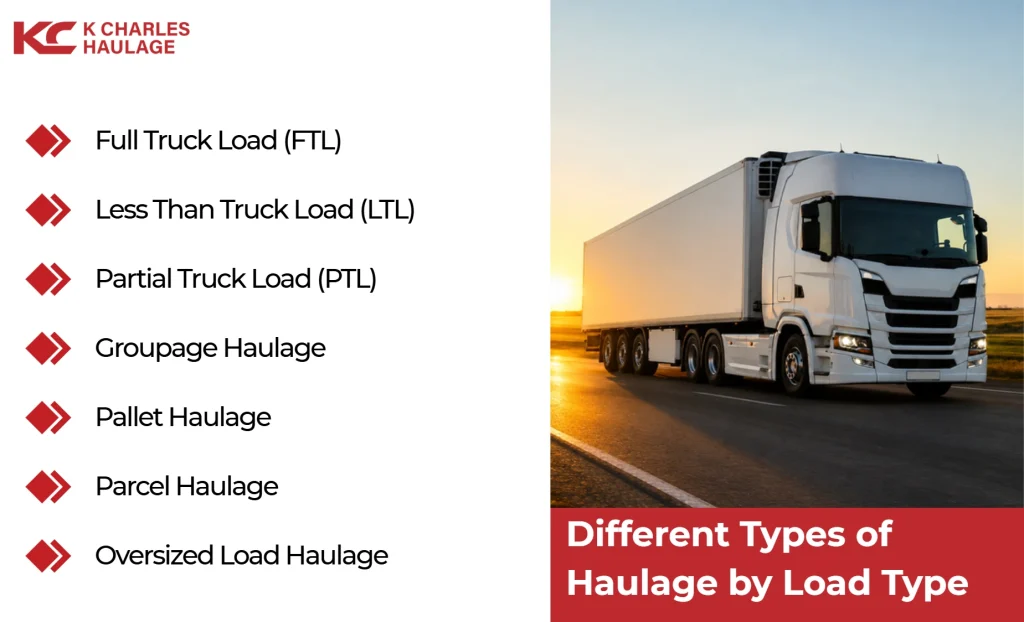
The different types of haulage by load type include Full Truck Load (FTL), Less Than Truck Load (LTL), Partial Truck Load (PTL), Groupage Haulage, Pallet Haulage, Parcel Haulage, and Oversized Load Haulage. These haulage options are designed to accommodate different shipment sizes, load volumes, and transportation requirements.
Here are the different types of haulage by load type:
- Full Truck Load (FTL)
- Less Than Truck Load (LTL)
- Partial Truck Load (PTL)
- Groupage Haulage
- Pallet Haulage
- Parcel Haulage
- Oversized Load Haulage
Full Truck Load (FTL)
Full Truck Load (FTL) is a haulage service in which a single shipment is transported using an entire truck dedicated to one customer’s freight. The shipment travels directly from the pickup location to the destination without sharing trailer space with other cargo, reducing handling and minimising the risk of damage. Because the freight remains on the same vehicle throughout transit, FTL offers greater shipment control, faster delivery times, and improved reliability. It is commonly used for large freight volumes, bulk goods, construction materials, retail inventory, and manufacturing products that require substantial trailer capacity and efficient transportation. As a result, FTL is widely used across commercial supply chains.
Less Than Truck Load (LTL)
Less-than-truckload (LTL) haulage is a type of haulage service designed for shipments that do not fill an entire truck. Instead of dedicating a vehicle to a single customer, LTL consolidates smaller shipments from multiple businesses into a single truckload, allowing each shipper to pay only for the space their freight occupies. Common examples include palletised retail goods, boxed products, and small commercial consignments. LTL is widely used within supply chains that require regular freight movement without the volume needed for a full truckload. This makes LTL a flexible and practical transport solution for businesses managing smaller shipment volumes while maintaining efficient freight distribution.
Partial Truck Load (PTL)
Partial Truck Load (PTL) is a type of haulage service designed for shipments that are too large for Less Than Truck Load (LTL) transport but do not require an entire truck. PTL allows businesses to transport medium-sized freight while sharing vehicle capacity with a limited number of other shipments. Commonly used by retail, manufacturing, and food distribution businesses, PTL provides a balance between transportation efficiency and shipment control. Because fewer shipments share the vehicle, PTL often involves less handling and fewer delivery stops than LTL transport. PTL is a practical option for businesses moving medium-volume freight that requires more space and faster transit than standard LTL services without the commitment of a full truckload.
Groupage Haulage
Groupage haulage is a haulage service that combines smaller consignments from multiple customers into a single truckload for transportation. It is commonly used by businesses that ship goods regularly but do not have enough freight to fill an entire vehicle. Products such as palletised goods, retail stock, packaged items, and commercial freight are consolidated at a distribution hub before being transported together. By sharing trailer space among multiple shipments, groupage haulage helps maximise vehicle utilisation, reduce transportation costs, minimise unused capacity, and improve overall efficiency. As a result, it provides a cost-effective and flexible solution for businesses moving smaller freight volumes.
Pallet Haulage
Pallet haulage is a haulage service that transports goods secured on standardised pallets to improve the efficiency of handling, storage, and transportation. It is widely used for moving retail stock, packaged foods, beverages, electronics, consumer goods, and other freight that can be safely stacked and secured on pallets. By keeping products stable and organised, pallet haulage simplifies loading and unloading processes while reducing the risk of damage during transit. The standardised pallet format also allows goods to be transported efficiently across different vehicle types and distribution networks. As a result, pallet haulage provides a reliable and scalable transport solution for businesses that require consistent freight handling and efficient supply chain operations.
Parcel Haulage
Parcel haulage is a type of haulage service that focuses on transporting individual parcels and small packages through local, regional, and national delivery networks. It is commonly used by e-commerce retailers, wholesalers, and businesses that require frequent deliveries of smaller consignments. Unlike pallet haulage or groupage services, parcel haulage is designed for lightweight shipments that require faster processing and more frequent delivery schedules. Vehicles such as panel vans and small trucks are typically used to support efficient collection and distribution. In addition, real-time tracking systems allow businesses and customers to monitor parcel movements throughout the delivery process, supporting reliable and transparent shipment management.
Oversized Load Haulage
Oversized load haulage is a type of haulage service used to transport cargo that exceeds standard size, width, height, length, or weight limits for road transport. It is commonly required for large construction machinery, industrial equipment, structural components, and other abnormal loads that cannot be moved using conventional haulage vehicles. Due to the dimensions and characteristics of these loads, specialised trailers, route planning, and safety procedures are often necessary to ensure secure transportation. Transport operators must also comply with permit requirements and route restrictions when moving oversized cargo. As a result, oversized load haulage provides a specialised transport solution for exceptionally large or heavy freight.
What Are The Different Types of Haulage Trucks?
The different types of haulage trucks include articulated trucks, rigid trucks, refrigerated trucks, curtain-sided trucks, flatbed trucks, low loader trucks, panel vans, tanker trucks, tipper trucks, box trucks, and HIAB trucks. These vehicles are designed to transport different types of cargo based on load size, weight, handling requirements, and transportation conditions.
Different types of haulage trucks are:
- Articulated Trucks
Articulated trucks are haulage vehicles consisting of a cab and a detachable trailer connected by a pivot joint. This haulage truck design allows the cab and trailer to move independently, improving manoeuvrability while maintaining a high carrying capacity. Articulated trucks are commonly used for long-distance freight, container transport, retail distribution, and bulk cargo movements. Their ability to transport large loads efficiently makes them one of the most widely used vehicles in commercial haulage.
- Rigid Trucks
Rigid trucks are haulage vehicles built on a fixed chassis, in which the cab and cargo area form a single unit. They are commonly used for local and regional deliveries, transporting retail goods, construction materials, and general freight. The compact structure improves handling in urban areas and locations with restricted access. For this reason, rigid trucks are often chosen for deliveries that require frequent stops and efficient route navigation.
- Refrigerated Trucks
Refrigerated trucks are specialised haulage vehicles equipped with temperature-controlled systems for transporting perishable and temperature-sensitive goods. They are widely used for fresh produce, dairy products, pharmaceuticals, and frozen foods that require consistent temperature conditions during transit. Insulated trailers and refrigeration units help maintain product quality and safety standards. This capability makes refrigerated trucks a key component of cold-chain logistics operations.
- Curtain-Sided Trucks
Curtain-sided trucks are haulage vehicles fitted with flexible side curtains that can be opened to provide easy access to cargo. This type of haulage truck is used to transport palletised goods, manufactured products, machinery, and building materials. The curtain system allows for faster loading and unloading while protecting freight from exposure to the weather. As a result, curtain-sided trucks support efficient freight handling across a wide range of industries.
- Flatbed Trucks
Flatbed trucks are haulage vehicles designed with an open loading platform for transporting oversized or irregularly shaped cargo. Common loads include steel beams, construction materials, industrial equipment, and large machinery that cannot fit inside enclosed trailers. The open design allows loading from multiple angles using cranes or forklifts. This flexibility makes flatbed trucks particularly valuable for construction and industrial transport operations.
- Low Loader Trucks
Low loader trucks are specialised haulage vehicles featuring a lowered deck designed to transport tall, heavy, or oversized equipment. They are frequently used to move excavators, bulldozers, cranes, and other industrial machinery that exceed standard transport dimensions. The low deck height improves stability and allows larger equipment to travel within legal road limits. Consequently, low loaders play a central role in heavy haulage and machinery transportation.
- Panel Vans
Panel vans are compact enclosed haulage vehicles used to transport parcels, small consignments, and time-sensitive deliveries. Their secure cargo area protects goods from theft and weather while supporting quick loading and unloading. Businesses involved in courier services, e-commerce fulfilment, and last-mile logistics frequently rely on panel vans. Their practicality and manoeuvrability make them well-suited to urban delivery environments.
- Tanker Trucks
Tanker trucks are specialised haulage vehicles designed to transport liquids, gases, and bulk powders in sealed tanks. They are widely used in the fuel, chemical, agricultural, and food industries to move products that require secure containment. Safety systems and specialist tank construction help prevent leaks, contamination, and product loss during transit. These features ensure the safe transportation of sensitive liquid and gaseous cargo.
- Tipper Trucks
Tipper trucks are haulage vehicles equipped with hydraulic systems that raise the cargo bed to unload bulk materials. It is commonly used to transport aggregates, sand, gravel, soil, demolition waste, and construction materials. The tipping mechanism allows materials to be discharged quickly without manual unloading. This functionality helps improve efficiency on construction, infrastructure, and waste management projects.
- Box Trucks
Box trucks are enclosed haulage vehicles designed to transport goods within a secure, weather-protected cargo area. They are commonly used for retail stock, packaged food products, electronics, furniture, and commercial freight. The enclosed body helps shield cargo from external conditions while supporting organised load management. Their enclosed design makes them a dependable option for transporting goods that require additional protection.
- HIAB Trucks
HIAB trucks are haulage vehicles fitted with hydraulic cranes that enable cargo to be loaded and unloaded directly from the vehicle. This type of haulage truck is commonly used for transporting construction materials, machinery, containers, and heavy equipment to locations without fixed lifting facilities. By combining transport and lifting functions, HIAB trucks reduce the need for additional loading equipment on site. This integrated capability provides greater flexibility for handling heavy or awkward loads during delivery operations.
What Factors Determine the Type of Haulage Needed?
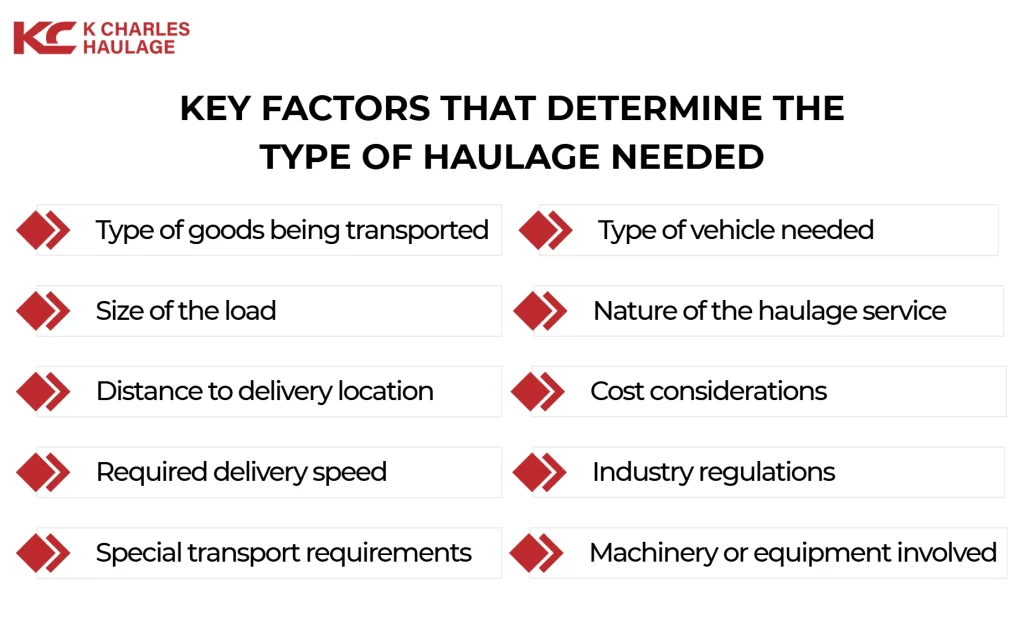
The factors that determine the type of haulage needed include the goods being transported, load size, delivery distance, required delivery speed, special transport requirements, vehicle type, service requirements, cost considerations, industry regulations, and any machinery or equipment involved. Together, these factors help businesses select the most suitable haulage solution for transporting goods safely, efficiently, and in compliance with operational requirements.
Key factors that determine the type of haulage needed are:
- Type of goods being transported: Different goods, such as perishable food, hazardous chemicals, construction materials, and heavy machinery, require specialised haulage services to ensure safe and compliant transportation. Refrigerated goods require temperature-controlled vehicles, while hazardous materials often require specialist haulage and regulatory compliance.
- Size of the load: Smaller shipments are moved through parcel, groupage, or LTL services, whereas larger loads often require FTL, heavy haulage, or abnormal load transport. Loads ranging from small parcels to oversized industrial equipment require different haulage methods depending on the required space and vehicle capacity.
- Distance to delivery location: Local transport uses rigid trucks or panel vans, while national and international routes often require articulated vehicles and larger transport networks. Short local deliveries and long-distance freight movements often require different haulage solutions to maintain efficiency and delivery reliability.
- Required delivery speed: Urgent deliveries often require dedicated haulage services, whereas standard freight can be transported through consolidated transport networks. The required delivery timeframe influences vehicle allocation, route planning, and the level of transport priority given to the shipment.
- Special transport requirements: Goods requiring temperature control, secure handling, compliance with hazardous materials regulations, or transport of abnormal loads often require specialised haulage services. These requirements influence both vehicle selection and the operational procedures used during transportation.
- Type of vehicle needed: The dimensions, weight, and handling requirements of a load determine the type of vehicle needed for transportation. Refrigerated trucks, low loaders, tankers, flatbeds, and articulated lorries are selected based on the specific characteristics of the freight.
- Nature of the haulage service: Transporting general freight requires different haulage arrangements than moving machinery, containers, vehicles, or oversized cargo. The purpose of the transport operation helps determine the most appropriate haulage service and equipment.
- Cost considerations: Different haulage services offer varying levels of capacity, handling, and vehicle dedication, making cost an important factor in transport planning. Businesses often balance budget requirements against shipment size, delivery expectations, and service levels when selecting a haulage option.
- Industry regulations: Industries such as waste management, food distribution, chemical transport, and heavy engineering must comply with regulations that influence haulage selection. These requirements can determine the vehicles, permits, safety procedures, and certifications needed for transportation.
- Machinery or equipment involved: Equipment such as excavators, cranes, tractors, and industrial machinery often requires specialist haulage due to its size, weight, or loading requirements. Moving this type of equipment involves low loaders, heavy haulage vehicles, permits, and detailed route planning.
How Do You Choose the Right Type of Haulage For You?
To choose the right type of haulage, match the haulage service to the cargo type, load size, delivery speed, special handling needs, and regulatory requirements. Perishable goods require refrigerated trucks, hazardous materials require compliant transport by trained drivers, and oversized or heavy goods require specialist vehicles such as low loaders or articulated lorries.
Key processes to choose the right type of haulage for you include:
- Identify the goods being transported to determine whether you need general, refrigerated, hazardous, heavy, or specialist haulage.
- Assess the shipment size and volume to decide between full-load, part-load, groupage, pallet, or parcel haulage services.
- Consider delivery deadlines and select express, same-day, or standard haulage based on the required delivery speed.
- Review any special transport requirements, such as temperature control, secure handling, abnormal load transport, or compliance with hazardous goods regulations.
- Choose the appropriate vehicle type based on the cargo’s dimensions, weight, and handling requirements.
- Confirm regulatory and operational requirements to ensure the selected fully insured and compliant haulage service meets relevant industry standards, contractual obligations, and transport regulations.
How Do Regulations Affect Haulage Services?
Regulations affect haulage services by determining how goods are transported, which vehicles can be used, and the safety standards operators must follow. Different types of haulage are subject to specific legal requirements based on the nature of the cargo being transported. For example, refrigerated haulage must comply with temperature-control regulations, hazardous freight transport requires strict safety procedures, and heavy haulage often needs permits for oversized or overweight loads. Compliance helps ensure safe, legal, and efficient operations while reducing the risk of delays, penalties, and service disruptions.