Skip to content
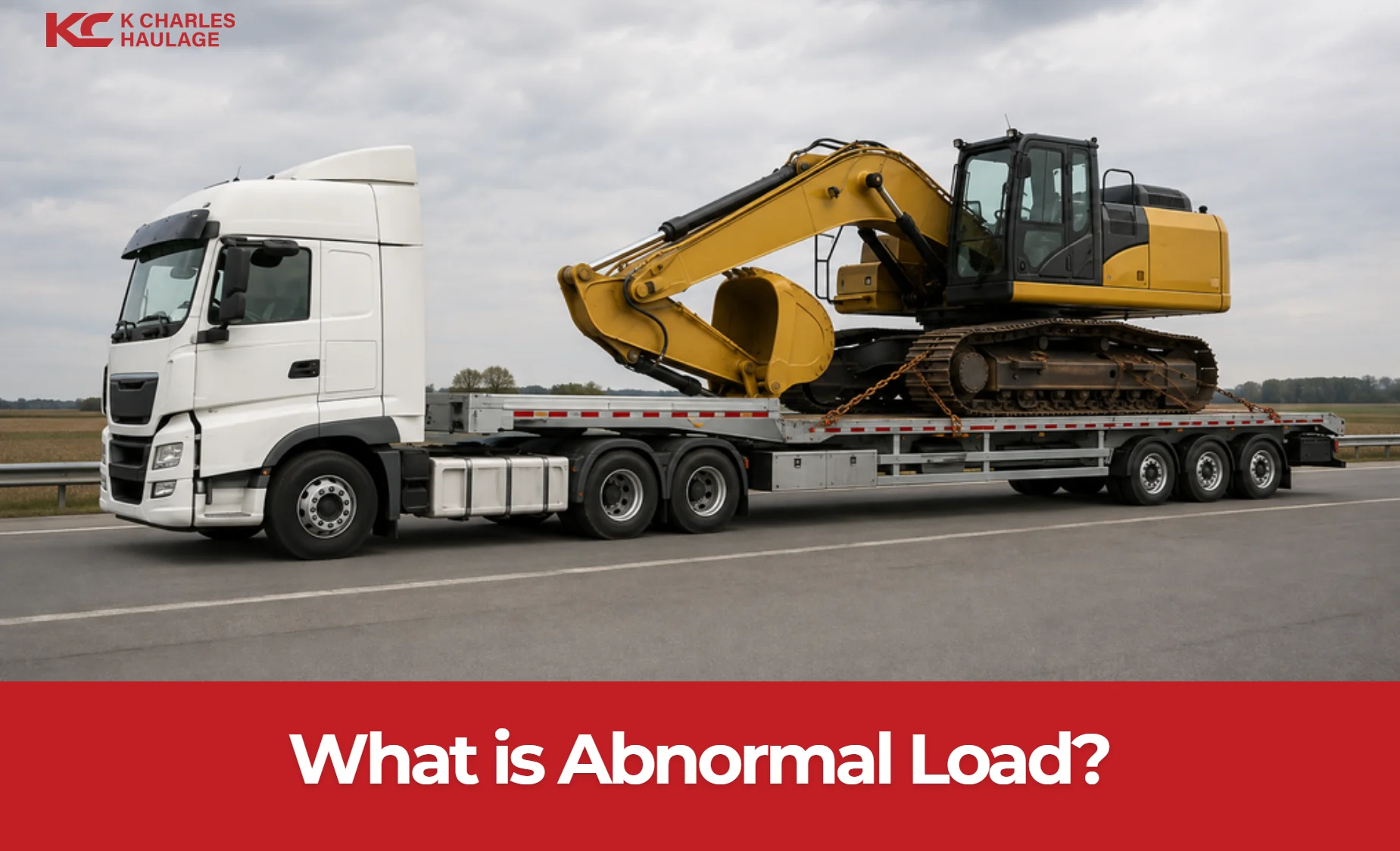
An abnormal load is a vehicle or cargo that exceeds standard UK road limits, such as 44 tonnes gross weight, 2.9 metres in width, 18.65 metres in rigid length, or specified axle-weight limits, and is generally indivisible. Depending on these measurements, movements operate under the Construction and Use Regulations, STGO framework, VR1 authorisation or a Special Order.
Before transporting an abnormal load, operators must measure the load, select a suitable vehicle, and plan a route around bridge capacities, height restrictions, weight limits, roadworks, and narrow sections. Relevant police forces, highway authorities and structure owners must then receive the required notice, with ESDAL supporting route planning, notifications and movement records.
For an abnormal load to travel safely and within applicable requirements, its transport setup must account for the cargo’s weight, dimensions and load distribution. Specialist trailers such as low-loaders, extendable, modular and multi-axle trailers support different load types, whilst rated restraints secure the cargo. Required markings, lighting, attendants and escorts support safe movement, and STGO rules set applicable weight, speed and notification requirements.
What is Abnormal Indivisible Load?
An Abnormal Indivisible Load (AIL) refers to cargo or a vehicle that exceeds standard UK road weight or size limits and cannot reasonably be separated into smaller parts without causing damage or incurring high costs. Typical loads include transformers, industrial machinery, bridge components and large construction equipment.
Moving an AIL on UK roads requires advance notification to relevant authorities, careful route planning and suitable transport vehicles. Depending on the load’s weight and dimensions, operators may also need to consider bridge capacities, road restrictions and escort arrangements to support safe transportation and protect surrounding road infrastructure.
What is Considered a Wide Load?
A wide load is a vehicle or load that exceeds the standard maximum width permitted for normal road use. In the UK, a load is generally treated as abnormal when the vehicle carrying it is more than 2.9 metres wide. Examples include large construction machinery, prefabricated structures, industrial equipment and agricultural machinery.
Transporting a wide load may require advance notification to the police and relevant highway or bridge authorities. Operators must also plan a suitable route and consider road widths, bridges, overhead restrictions and other infrastructure to support safe movement on UK roads.
What Are the Size and Weight Thresholds for an Abnormal Load in The UK?
The size and weight thresholds for an abnormal load in the UK are more than 44 tonnes in gross weight, 10 tonnes per non-driving axle, 11.5 tonnes per driving axle, 2.9 metres in width, or 18.65 metres in rigid length, whilst no general statutory height threshold applies. Exceeding any of these limits can mean the load is subject to specific abnormal load transport, notification and route-planning requirements.
| Characteristic | Abnormal Load Threshold | What It Means |
| Gross vehicle weight | More than 44,000 kg (44 tonnes) | The vehicle’s gross weight exceeds the normal threshold. |
| Non-driving axle load | More than 10,000 kg (10 tonnes) | A single non-driving axle exceeds the specified limit. |
| Driving axle load | More than 11,500 kg (11.5 tonnes) | A single driving axle exceeds the specified limit. |
| Width | More than 2.9 metres | The vehicle or load exceeds the abnormal-load width threshold. |
| Rigid length | More than 18.65 metres | The vehicle/load exceeds the specified rigid-length threshold. |
| Height | No general statutory overall-height limit | Height must still be assessed against bridges, overhead structures, and route restrictions. |
| Indivisibility | Load cannot reasonably be divided for transport | This is what makes an abnormal load an Abnormal Indivisible Load (AIL) when the relevant dimensional/weight rules apply. |
What Is the Difference Between a Wide Load, Oversize Load and Abnormal Load?
A wide load exceeds the standard legal width for road use, whereas an oversize load exceeds normal dimensional limits such as width, length or height, and an abnormal load exceeds specified UK limits for weight, axle load, width or length and typically involves an indivisible load. These classifications help determine the transport rules, route planning and authority notification requirements that apply to a particular load.
| Term | Meaning | Main Focus | Common Examples | Key Difference |
| Wide Load | Cargo exceeding legal width limits. | Load width | Machinery, construction equipment | Specifically exceeds width limits. |
| Oversize Load | Cargo exceeding legal size or weight limits. | Width, height, length, or weight | Heavy equipment, tanks, cranes | Covers all oversized dimensions. |
| Abnormal Load | Cargo requiring special permits and transport planning. | Size, weight, or special handling | Transformers, bridge sections | Needs advanced planning and restrictions. |
- Oversized Load
An oversized load is a vehicle or cargo that exceeds standard dimensional limits permitted for normal road transport, typically exceeding 2.9 metres in width, 18.65 metres in rigid length, or 4.3 metres (approx. 14 feet 3 inches) in height. Examples include prefabricated structures, large industrial machinery, and construction components. Its main defining value is physical dimensions rather than weight alone. Transport operators must assess the load’s dimensions against road widths, low bridges, overhead structures, and other physical restrictions when planning a suitable route.
- Wide Load
A vehicle or cargo that exceeds 2.9 metres in width is a wide load under the UK abnormal-load framework. Its main defining value is width, and specific regulatory requirements can apply depending on its overall dimensions. Wide-load transport typically requires careful route planning, suitable marker boards and advance notification where required, particularly when narrow roads, bridges, street furniture or parked vehicles could restrict safe passage.
- Abnormal Load
An abnormal load is an indivisible load that exceeds specified UK limits for weight, axle load, width, or rigid length. Key statutory thresholds include more than 44 tonnes gross weight, 10 tonnes on a non-driving axle, 11.5 tonnes on a driving axle, more than 2.9 metres wide, or more than 18.65 metres rigid length. Its main defining feature is regulated size or weight, which triggers mandatory notification, route planning, and specific escort requirements.
What Laws and Regulations Apply to Abnormal Loads in the UK?
The main UK laws and regulations governing abnormal loads are the Road Vehicles (Construction and Use) Regulations 1986, the Road Vehicles (Authorisation of Special Types) (General) Order 2003 (STGO), and, for movements outside these provisions, Special Orders issued under Section 44 of the Road Traffic Act 1988. Together, these rules set the requirements for vehicle limits, operating conditions, notifications, route planning, and authorisations when transporting abnormal loads on UK roads.
How Do the Construction and Use Regulations Apply to Abnormal Loads?
The Road Vehicles (Construction and Use) Regulations 1986 set standards for vehicle dimensions, weights, and construction. They set the baseline legal limits that regular traffic must follow. For abnormal loads, C&U rules define the threshold where standard compliance ends. Compliance requires operators to stay within these standard legal parameters unless an exemption applies. This affects transport by establishing that any load exceeding these limits cannot move under standard rules, forcing operators to prove the load is an indivisible load (cannot be split without undue expense or risk) and transition to specialised regulatory frameworks like STGO.
When Do the STGO Regulations Apply to Abnormal Loads
The STGO regulations apply to abnormal loads when an indivisible vehicle or load exceeds standard C&U limits, such as widths over 2.9 metres or gross weights exceeding 44 tonnes, whilst remaining within predefined STGO weight tiers (Categories 1, 2, and 3 up to 150 tonnes). Compliance requires strict adherence to specific axle weights, vehicle speeds, mandatory warning markers, and advance notification via the ESDAL system, along with providing indemnities for road damage. This affects transport by legally permitting heavy or large movements without a bespoke government permit, provided operators give mandatory notice (typically 2 to 5 clear working days) to police, highway, and bridge authorities.
When Is a Special Order Required for an Abnormal Load
A Special Order under Section 44 of the Road Traffic Act 1988 is required when an indivisible load exceeds the maximum thresholds permitted under STGO regulations (gross weights over 150 tonnes, widths over 6.1 metres, or rigid lengths over 30 metres). Compliance demands an extensive application process directly with the Department for Transport, rigorous route surveys, and formal bridge assessments. This affects transport by introducing significant lead times (often several weeks), mandatory structural reviews, and the absolute requirement for specialised traffic management, private escort vehicles, or police support before movement can commence.
What Are The Notification Rules for Abnormal Load Transport in the UK?
The notification rules for abnormal load transport in the UK require operators to provide advance notice to the relevant police, highway, and structure authorities based on the load’s weight, dimensions, vehicle category, and planned route. This notification allows authorities to assess route suitability, traffic considerations, restrictions, and potential impacts on bridges or other structures before the abnormal load moves.
When Must the Police Be Notified About an Abnormal Load?
Police notification is generally required for abnormal load movements exceeding thresholds such as more than 2.9 metres in width, more than 18.65 metres in rigid length, or higher weight categories requiring police notice, including movements over 80,000 kg gross weight. Operators must notify the police based on the load’s dimensions, weight, vehicle category, and route requirements. This allows police authorities to review traffic considerations and coordinate any necessary traffic management measures for the planned movement.
When Must Highway Authorities Be Notified About an Abnormal Load?
Highway authorities must be notified when a vehicle or load exceeds abnormal load thresholds, including more than 44,000 kg gross weight, more than 2.9 metres wide, or more than 18.65 metres in rigid length. These notifications allow highway authorities to assess route suitability, road restrictions, and infrastructure considerations before the abnormal load movement takes place.
When Must Bridge and Structure Owners Be Notified?
Bridge and structure authorities must be notified for abnormal loads exceeding limits such as 44,000 kg gross weight, 2.9 metres width, or 18.65 metres rigid length when the planned route affects relevant structures. Notification allows responsible authorities to assess bridges, viaducts, and other structures along the route to determine whether they can accommodate the proposed movement.
What is The Notice Period For Abnormal Load Movement?
The notice period for abnormal load movement in the UK depends on the load’s weight, width, length, and whether it operates under Construction and Use (C&U), STGO, VR1 authorisation, or a Special Order. These notice periods give police, highway authorities, and bridge authorities enough time to assess route suitability, structural considerations, traffic impacts, and any required conditions before the abnormal load movement takes place.
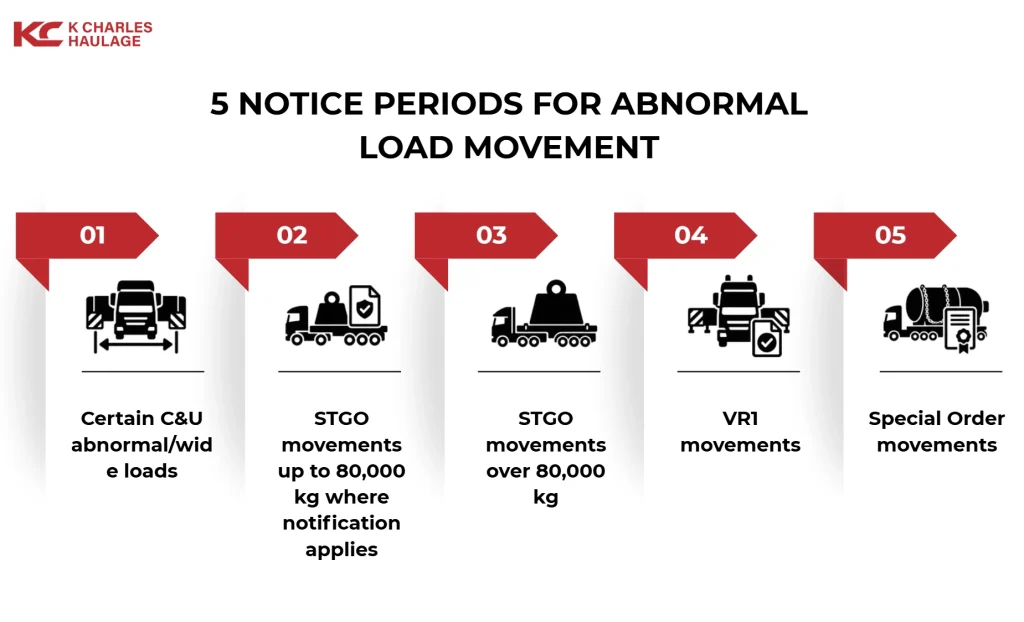
Below are the 5 notice periods for abnormal load movement:
- Certain C&U abnormal/wide loads
For certain loads exceeding C&U limits, such as vehicles wider than 2.9 metres up to 4.3 metres or certain long and overhanging loads, operators must provide the police with at least 2 clear working days’ notice before transport. The notification allows the police to review the proposed movement, including route conditions, traffic considerations, and any operational requirements linked to the abnormal load. The exact requirement depends on the vehicle dimensions, load projections, and movement characteristics.
- STGO movements up to 80,000 kg where notification applies
For STGO movements exceeding normal C&U limits up to and including 80,000 kg gross weight, operators must provide highway and bridge authorities with at least 2 clear working days’ notice, along with the required indemnity. This notification enables relevant authorities to assess whether the proposed route can accommodate the vehicle weight, bridge loading requirements, and other route restrictions before the movement occurs. Police notification may also apply depending on the vehicle’s width, length, or other dimensions.
- STGO movements over 80,000 kg
For heavier STGO movements exceeding 80,000 kg and up to 150,000 kg gross weight, operators must provide highway and bridge authorities with at least 5 clear working days’ notice and provide the required indemnity, while police notification requires at least 2 clear working days’ notice. The longer notice period allows authorities to assess heavier loading requirements, including bridge capacity, axle loading, route restrictions, and movement conditions before approval.
- VR1 movements
For abnormal loads wider than 5 metres and up to 6.1 metres, operators require a VR1 authorisation before the movement can proceed. The VR1 process requires early submission because the route and movement details need assessment, while police notification still requires at least 2 clear working days’ notice before transport. Planning ahead allows the relevant authorities to review the proposed route and confirm whether the movement meets the required conditions.
- Special Order movements
For movements exceeding STGO limits, such as loads over 150,000 kg gross weight, more than 16,500 kg per axle, wider than 6.1 metres, or exceeding 30 metres rigid length, a Special Order may be required. Once authorised, operators must provide police with at least 5 clear working days’ notice and highway and bridge authorities with 5 clear working days’ notice together with the required indemnity. Submit Special Order applications well in advance, with National Highways recommending around 10 weeks to allow sufficient time for route assessments and consultations with relevant authorities.
When Does an Abnormal Load Require Attendants or Escort Vehicles?
An abnormal load may require attendants or escort vehicles when it exceeds specific size limits, such as loads wider than 3.5 metres requiring attendants under certain STGO conditions, or movements wider than 5 metres requiring additional authorisation and escort considerations. Escort requirements depend on the load dimensions, vehicle category, route conditions, and the level of traffic management needed for the movement. Larger movements, including loads exceeding 5 metres wide or other exceptional dimensions, may require additional support through private escorts or police involvement depending on the route assessment.
Who Decides Whether Police or Private Escort Is Required?
Police escort decisions are generally based on abnormal loads exceeding certain thresholds, such as exceptional width movements over 5 metres, routes with significant traffic impact, or movements requiring additional control measures. The relevant police authority assesses the load dimensions, route conditions, traffic risks, and movement requirements before determining whether police support is needed. Operators usually arrange private escort vehicles when additional warning, visibility, or traffic support is required without a police escort.
What Requirements Apply to Abnormal Load Escort Vehicles?
Abnormal load escort vehicles supporting movements such as loads wider than 5 metres or exceptional-width loads up to 6.1 metres must meet requirements for visibility, warning, and communication equipment. Escort vehicles should provide clear warning to other road users and maintain communication with the abnormal-load vehicle where reasonably practicable. Requirements may include suitable visibility equipment, warning beacons, conspicuous markings, and reliable communication systems.
Key requirements include:
- At least four wheels
- Suitable mirrors to provide adequate visibility
- Amber warning beacons
- Conspicuous vehicle markings
- Reliable radio communication with the abnormal-load driver
- Operation according to National Highways self-escorting guidance
What Marking is Required for Abnormal Loads?
The marking requirements for abnormal loads include conspicuous signs, marker boards and warning equipment that make the vehicle and load clearly visible to other road users. Depending on the load’s dimensions and configuration, operators may need to display “LONG VEHICLE” signage, side or rear marker boards, amber warning beacons and projection markers where the load extends beyond the vehicle. The specific marking required depends on the load’s width, length, front or rear projections and overall vehicle configuration.
What Lighting is Required for Abnormal Loads?
Lighting requirements for abnormal loads include suitable lamps and warning beacons that make the vehicle, load, and any projections visible to other road users. Depending on the load configuration, operators may need to use amber warning beacons, front and rear lamps, side marker lamps and lights on projecting loads. Lighting must remain clearly visible during movement, particularly at night or in poor visibility, so other road users can identify the abnormal load’s width, length and projections.
What is the Speed Limit whilst Transporting Abnormal Loads?
The speed limits for transporting abnormal loads in the UK depend on the STGO weight category, including Category 1 vehicles up to 50,000 kg, Category 2 vehicles up to 80,000 kg, and Category 3 vehicles up to 150,000 kg gross weight. Heavier STGO categories operate under lower speed restrictions because increased weight affects vehicle handling, braking distance, and movement control. The applicable speed limit depends on the STGO category and the type of road being used.
| STGO Category | Maximum Gross Weight | Motorways | Dual Carriageways | Other Roads |
| Category 1 | Up to 50,000 kg | 60 mph | 50 mph | 40 mph |
| Category 2 | Up to 80,000 kg | 40 mph | 35 mph | 30 mph |
| Category 3 | Up to 150,000 kg | 30 mph | 30 mph | 20 mph |
Note: Speed limits can also depend on the specific authorisation, vehicle configuration, and movement conditions, so operators must follow the limits stated under the applicable STGO category and any additional requirements attached to the movement.
What Documents Are Required for an Abnormal Load Transport?
The documents required for abnormal load transport can include an Abnormal Load Notice, STGO movement details, Special Order or VR1 authorisation, written approvals, route and movement information, load dimensions and weights, load-securing records, and standard HGV paperwork. These documents give authorities and operators the information needed to verify legal compliance, assess the planned route, and confirm that the abnormal load can be transported under the applicable requirements.
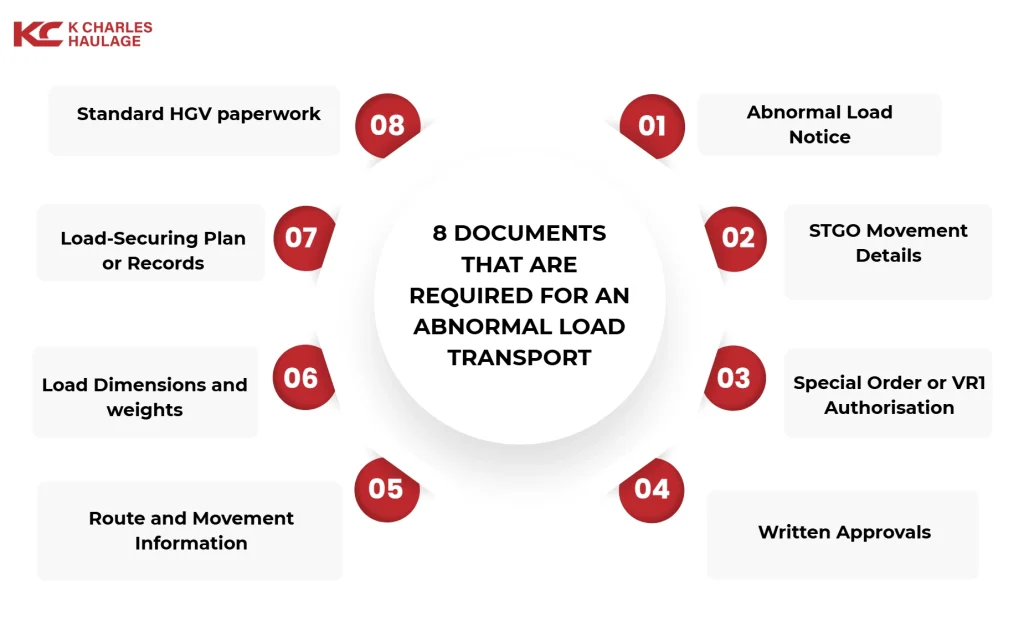
8 documents that are required for an abnormal load transport are:
- Abnormal Load Notice
An Abnormal Load Notice records the planned abnormal load movement and provides relevant authorities, such as the police, highway authorities and bridge owners, with details of the movement date, vehicle configuration and proposed route. Systems such as ESDAL can generate notices. Hauliers should retain the applicable notification and related responses during transport as evidence that they completed the required advance notification process.
- STGO Movement Details
When an abnormal load is transported under the STGO framework, the movement details identify whether it falls within Category 1, Category 2 or Category 3. The records specify the vehicle configuration, gross weight, axle distribution and load classification, allowing enforcement authorities to confirm that the movement remains within the applicable STGO weight and configuration limits. Operators should keep these details available during transport to show the abnormal load is moving under the correct STGO category and conditions.
- Special Order or VR1 Authorisation
A Special Order or VR1 authorisation permits abnormal load movements that fall outside applicable standard movement limits or require specific authorisation. The document can contain the approved route, movement conditions and structural requirements that apply to the journey. Keeping the relevant authorisation with the transport documentation allows the operator to demonstrate that the movement has received the required approval.
- Written Approvals
Written approvals record permissions, consents or conditions issued by relevant highway authorities, bridge owners or local authorities along the proposed route. These documents can confirm that particular structures or sections of the route have been assessed for the abnormal load. Operators can use these records to show that they addressed identified route restrictions and structural requirements before transport.
- Route and Movement Information
For an abnormal load movement, route and movement information sets out the planned journey, including the roads and structures the vehicle is expected to use. It can identify bridge capacities, height restrictions, narrow sections, holding areas, road furniture and escort requirements along the route. Drivers use this information to follow the assessed route and avoid roads, bridges or other structures that may not safely accommodate the load.
- Load Dimensions and weights
Load dimension and weight records provide the measurements needed to assess and manage the abnormal load movement. They can include the cargo’s width, height, overall length, gross vehicle weight and individual axle loads. Authorities and transport teams use these figures to compare the vehicle and load against applicable limits, bridge capacities, clearances and other restrictions along the planned route.
- Load-Securing Plan or Records
For the safe transportation of an abnormal load, a load-securing plan or record explains how the cargo is secured to the transporting vehicle or trailer. It documents lashing arrangements, anchor points, restraint methods and weight distribution used to secure the load. These records help operators and drivers confirm that suitable restraints are in place to reduce cargo movement during braking, turning and other normal driving conditions.
- Standard HGV paperwork
Standard HGV paperwork covers the commercial, vehicle and driver documentation applicable to the heavy goods vehicle movement. Depending on the operation, records can include operator licensing documentation, consignment notes, insurance documents and driver qualification records. These documents establish the operator’s, vehicle’s, and driver’s legal status, along with the abnormal-load-specific paperwork required for the journey.
What Penalties Can Apply to Non-Compliant Abnormal Load Movements?
Penalties for non-compliant abnormal load movements can include vehicle prohibition or immobilisation, fixed or court fines, loss of STGO exemptions, Traffic Commissioner action, and prosecution for incorrect details or movement without a required Special Order. These penalties can prevent the vehicle from continuing its journey and expose the operator to further regulatory or legal action until compliance is restored.
8 penalties that are applied to non-compliant abnormal load movements are:
- Immediate Vehicle Prohibition
An immediate vehicle prohibition prevents an abnormal-load vehicle from continuing its journey until a safety or compliance issue has been resolved. It is issued when a vehicle is overloaded, unsafe, or creates an immediate road safety risk. The prohibition itself is an enforcement action and does not carry a separate standard fine. However, separate penalties, fines, or prosecution may apply for the underlying offence that caused the prohibition. The operator may also face additional costs, such as recovery, unloading, or delay expenses.
- Fixed Penalties
If an abnormal load vehicle is found to exceed permitted weight limits during a roadside inspection, a fixed penalty may apply based on the specific weight offence, including the level of excess weight and whether the breach involves axle, gross, or train weight limits. Under DVSA enforcement policy, an overload of less than 10% can result in a £100 penalty, 10% to under 15% can result in £200, and 15% or more can result in £300. The vehicle may also be prevented from continuing its journey until the excess weight is removed and the vehicle complies with legal weight limits.
- Court Fines
A court fine can apply where an abnormal-load offence is too serious or unsuitable for disposal through a fixed penalty. Serious overloading, multiple offences or other significant regulatory breaches can result in prosecution. There is no single fixed amount, as the court sets the financial penalty based on the offence, applicable legislation, and the circumstances of the case.
- Loss of STGO Exemptions
Failure to comply with STGO conditions can mean the vehicle cannot rely on STGO exemptions for that movement. This may create additional offences relating to weight, dimensions, route compliance, or authorisation requirements. While there is no standalone fine for losing STGO status, breaches may result in enforcement action, including applicable roadside penalties for overloading, vehicle prohibition, prosecution for serious offences, or Traffic Commissioner action.
- Traffic Commissioner Action
Serious or repeated compliance failures can result in regulatory action by the Traffic Commissioner against the operator and transport manager. Actions may include restrictions, suspension, or revocation of an Operator’s Licence, along with potential professional disqualification of transport managers. These measures can limit an operator’s ability to continue operating HGVs legally and affect its transport operations.
- Prosecution for Incorrect Movement Details
Providing incorrect or misleading information for an abnormal load notification may result in enforcement action where the information affects compliance, safety, or the legality of the movement. This can include issues related to declared weight, axle distribution, dimensions, or route details submitted through systems such as ESDAL. Depending on the severity of the breach, consequences may include fines, legal costs, vehicle prohibition, or other regulatory action affecting the operator’s compliance record.
- Prosecution for Operating Without the Required Special Order
Operating an abnormal load beyond STGO limits, such as exceeding 150 tonnes gross weight or 6.1 metres in width, without the required Department for Transport Special Order can result in enforcement action and prosecution. Penalties may include court fines, legal costs, and further regulatory action against the operator. Serious breaches may also affect the operator’s ability to continue compliant abnormal load operations.
- Immobilisation Until Compliance Is Restored
A vehicle may be prevented from continuing its journey where compliance issues remain unresolved, including certain prohibition situations or unauthorised abnormal load movements. This action can result in DVSA release fees, storage charges, and additional logistical costs required to correct the compliance issue before the vehicle can resume operation.
What Are the STGO Categories for Abnormal Loads?
The STGO categories for abnormal loads are Category 1, Category 2, and Category 3, which classify abnormal load movements by maximum gross vehicle weight and axle-loading limits. Each category sets specific operating conditions, including permitted weights, axle loads and speed limits, that operators must follow during transportation.
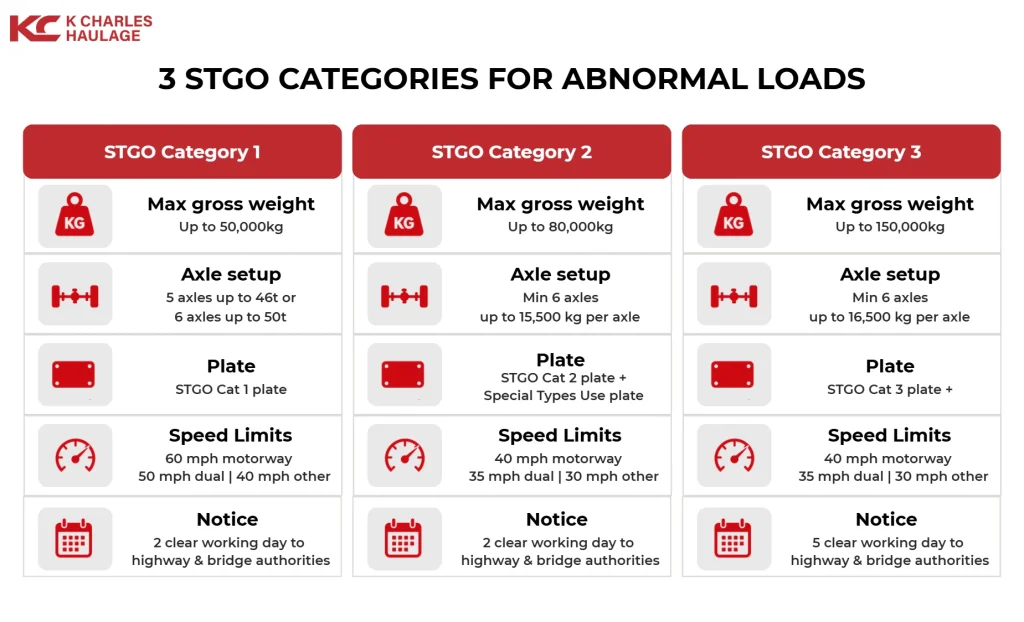
3 STGO categories for abnormal loads are:
- STGO Category 1
STGO Category 1 covers abnormal load vehicles weighing up to 50 tonnes, using at least 5 axles up to 46 tonnes or 6 axles up to 50 tonnes. Vehicles display an STGO Cat 1 plate and can travel at up to 60 mph on motorways, 50 mph on dual carriageways and 40 mph on other roads. Highway and bridge authorities require at least 2 clear working days’ notice.
- Max gross weight: Up to 50,000 kg (50 tonnes).
- Axle/vehicle setup: Requires a minimum of 5 axles (up to 46,000 kg) or 6 axles (up to 50,000 kg). Must display a clear “STGO Cat 1” front plate.
- Speed limits: Maximum 60 mph on motorways, 50 mph on dual carriageways, and 40 mph on all other roads.
- Notice required: Minimum of 2 clear working days’ notice to highway and bridge authorities.
- STGO Category 2
STGO Category 2 applies to abnormal load vehicles with a gross weight of up to 80 tonnes, operating on at least 6 axles, with individual axle loads typically limited to 12.5 tonnes. The vehicle carries an STGO Cat 2 plate and a Special Types Use weight plate. Permitted speeds are 40 mph on motorways, 35 mph on dual carriageways and 30 mph on other roads.
- Max gross weight: Up to 80,000 kg (80 tonnes).
- Axle/vehicle setup: Requires at least 6 axles, with strict individual axle weight limits (typically max 12,500 kg per axle). Must display an “STGO Cat 2” front plate alongside a “Special Types Use” manufacturer weight plate.
- Speed limits: Maximum 40 mph on motorways, 35 mph on dual carriageways, and 30 mph on all other roads.
- Notice required: Minimum of 2 clear working days’ notice to highway and bridge authorities.
- STGO Category 3
STGO Category 3 covers heavier abnormal load vehicles weighing up to 150 tonnes, using at least 6 axles with individual axle weights up to 16.5 tonnes. Vehicles display an STGO Cat 3 plate and Special Types Use weight plate. Maximum speeds are 40 mph on motorways, 35 mph on dual carriageways and 30 mph on other roads.
- Max gross weight: Up to 150,000 kg (150 tonnes).
- Axle/vehicle setup: Requires a minimum of 6 axles, with a maximum individual axle weight of 16,500 kg. Must display an “STGO Cat 3” plate and a “Special Types Use” manufacturer weight plate.
- Speed limits: Maximum 40 mph on motorways, 35 mph on dual carriageways, and 30 mph on all other roads.
- Notice required: Minimum of 5 clear working days’ notice to highway and bridge authorities, alongside 2 clear working days’ notice to the police.
What is ESDAL?
ESDAL (Electronic Service Delivery for Abnormal Loads) is the UK’s centralised online platform used by hauliers, police forces, highway authorities and bridge owners to plan, submit and manage abnormal load movements. Hauliers enter transport details such as load dimensions, weight, vehicle configuration and proposed route, allowing affected authorities to be identified and notified. ESDAL also provides mapping tools for identifying potential route restrictions, supports road damage indemnity processes and creates a compliance audit trail that helps operators demonstrate that required statutory notice periods have been met before transportation
What is ESDAL Used For?
ESDAL is used to manage and coordinate abnormal load movements across the UK by submitting notifications, planning routes and identifying affected authorities and structures. It also helps operators record vehicle configurations, manage movement records and authority contacts, and support VR1 and Special Order applications where applicable.
7 uses of ESDAL are:
- Submitting abnormal-load notifications to the relevant police, highway and bridge authorities.
- Planning and saving abnormal-load routes for proposed movements.
- Identifying the authorities and structures affected by a route so the correct organisations can be notified.
- Recording vehicle and trailer configurations for use in abnormal-load movements.
- Managing abnormal-load movement records, including draft, submitted and saved notifications.
- Managing abnormal-load authority contacts and sending notifications to selected contacts.
- Supporting applications for exceptional movements, including VR1 and Special Order applications where applicable.
Is ESDAL Required for Every Abnormal Load?
No, ESDAL is not required for every abnormal load movement. It is generally used when an operator needs to notify police, highway authorities, or bridge owners, or plan an abnormal load route, or manage applications such as VR1 and Special Orders. ESDAL is not required when the movement does not trigger statutory notification requirements or when the relevant authority accepts notification through another permitted method.
How Should an Abnormal Load Movement Be Planned?
Plan an abnormal load movement by confirming the load dimensions and weight, vehicle configuration, compliant route, road restrictions, authority notifications, escort requirements, and safety checks before departure. This planning helps identify route, structural and traffic constraints before transport begins and supports a safe, compliant movement.
The following are the 7 key steps for planning an abnormal load movement:
- Confirm load dimensions and weight: Measure and record the load’s width, height, length, gross weight and axle loads accurately. Use these values to identify the applicable abnormal load requirements and regulatory framework.
- Choose suitable vehicle configuration: Select a tractor, trailer and axle configuration that can safely carry the load and distribute its weight correctly. Confirm that the configuration meets the applicable STGO category and axle limits.
- Plan a compliant transport route: Choose a route that accommodates the load’s weight, width, height and length. Check bridge capacities, overhead clearances, narrow roads and junction geometry before confirming the route.
- Check restrictions and roadworks: Review the route for roadworks, closures, weight limits, height restrictions and temporary traffic controls. Check the route again before departure to identify any new restrictions that could affect the movement.
- Notify all relevant authorities: Identify the police, highway authorities and bridge or structure owners that require notification. Submit accurate load, vehicle, route and movement details within the applicable notice periods.
- Complete risk and escort checks: Assess the route and movement for traffic, structural and manoeuvring risks. Determine whether attendants, private escort vehicles, traffic management or police support are required.
- Verify safety before departure: Check the vehicle, load restraints, lights, marker boards, warning beacons, documentation and escort arrangements before departure. Confirm that all required notifications and authorisations are valid before starting the abnormal load movement.
What Should Be Done if the Planned Route Becomes Unavailable?
If the planned abnormal load route becomes unavailable, operators should reassess the route, select a compliant alternative, update ESDAL, renotify affected authorities and confirm approval before continuing the movement. This process ensures the revised route suits the load’s weight and dimensions and avoids structural or road restrictions.
Below are the key ways to follow when a planned abnormal load route becomes unavailable:
- Stop and reassess the route: Stop the planned movement and identify why the original route is no longer available. Assess how the closure, obstruction, or restriction affects the abnormal load before selecting another route.
- Check alternative compliant routes: Identify an alternative route that can accommodate the load’s weight, width, height and length. Check bridges, road widths, clearances and junctions to confirm the alternative is suitable.
- Review new route restrictions: Check the revised route for weight limits, height restrictions, roadworks, closures and structural constraints. Confirm that no restriction prevents the abnormal load from travelling safely along the new route.
- Notify affected authorities again: Identify the police, highway authorities and bridge or structure owners affected by the revised route. Send updated movement information within the required notice periods before proceeding with transportation.
- Update ESDAL movement details: Update the ESDAL movement record with the revised route and any changed journey information. Make sure the submitted details accurately reflect the route the abnormal load will follow.
- Confirm revised movement approval: Confirm that all required notifications, responses and authorisations for the revised movement are complete. Continue the abnormal load journey only after the new route has been cleared for the planned movement.
What Vehicles and Trailers Are Used to Transport Abnormal Loads?
Vehicles used to transport abnormal loads include heavy haulage tractor units, low-loader transport vehicles, specialist multi-axle vehicles, extendable transport combinations, modular transport systems, and load-specific trailer configurations. These vehicles support safe weight distribution, load stability, and compliant abnormal load transport.
Below are the vehicles that are used to transport abnormal loads:
- Heavy haulage tractor units
Heavy haulage tractor units provide high pulling capacity, reinforced chassis construction and powerful braking systems for abnormal load transport. Their high towing capacity makes them suitable for moving heavy industrial machinery, transformers, generators and other high-weight loads, often alongside specialist multi-axle trailers for controlled weight distribution.
- Low-loader transport vehicles
When tall or heavy equipment must pass beneath bridges or overhead restrictions, low-loader transport vehicles provide a low deck height that reduces the overall transport height and supports easier loading. They are commonly used for excavators, bulldozers, cranes, agricultural machinery and other tall construction equipment.
- Specialist multi-axle vehicles
Specialist multi-axle vehicles distribute heavy loads across several axles to manage individual axle weights and reduce concentrated pressure on roads and structures. Common applications include transporting transformers, industrial plant and heavy engineering equipment where controlled weight distribution is required.
- Extendable transport combinations
For unusually long cargo that cannot fit on standard-length trailers, extendable transport combinations provide an adjustable deck that extends to accommodate the load. Loads commonly moved with this configuration include wind turbine blades, structural beams, bridge components, long steel sections and prefabricated structures.
- Modular transport systems
Modular transport systems use interconnected axle modules that can be configured to match the load’s weight, dimensions, and required weight distribution. These systems suit very heavy transformers, generators, industrial vessels, and major infrastructure components where conventional trailers cannot provide sufficient carrying capacity.
- Load-specific trailer configurations
Load-specific trailer configurations are selected or configured around the particular dimensions, weight, and support points of an abnormal load. This configuration accommodates long loads such as wind turbine blades, structural beams, bridge components, steel sections, and prefabricated structures whilst providing the required support across their length.
What Types of Trailers Are Used for Abnormal Loads?
The types of trailers used for abnormal loads include low-loader, step-frame, extendable, modular, multi-axle, and hydraulic platform trailers. Each trailer configuration accommodates specific load characteristics, such as heavy weight, excessive length, increased height or specialised weight-distribution requirements.
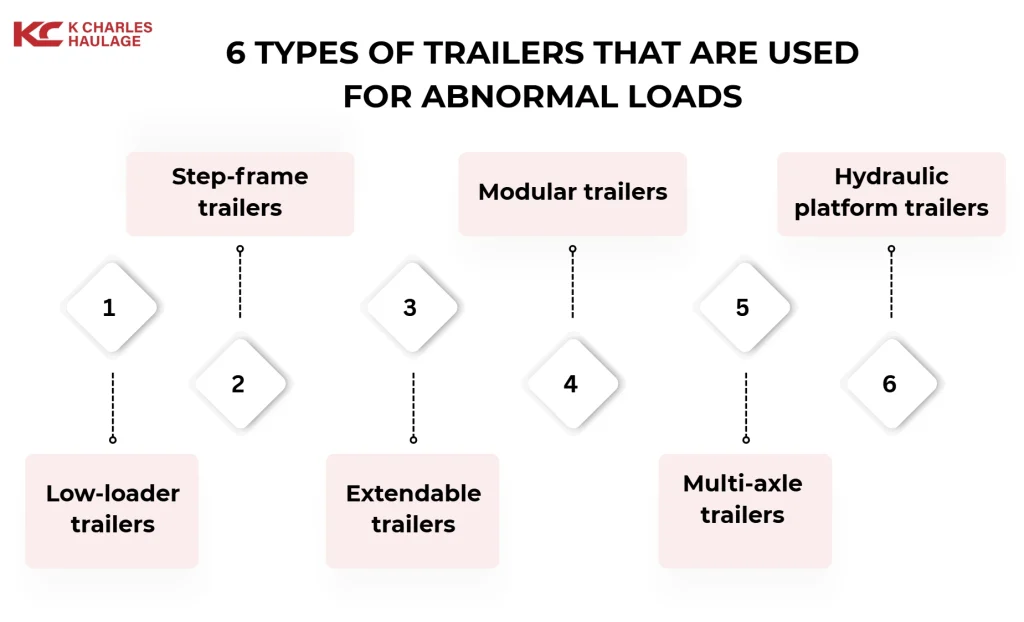
6 types of trailers that are used for abnormal loads are:
- Low-loader trailers: Reducing the overall transport height is the main function of a low-loader trailer, with its deck positioned closer to the road. This design provides clearance for excavators, bulldozers, cranes, and other tall machinery.
- Step-frame trailers: For tall or bulky abnormal loads, a step-frame trailer uses a lowered main deck to reduce the overall transport height. Its stepped configuration provides increased height clearance and suitable loading space for machinery, plant, and industrial equipment.
- Extendable trailers: When cargo extends beyond conventional trailer dimensions, an extendable trailer can increase its deck length to match the load. The adjustable structure accommodates wind turbine blades, structural beams, steel sections, and other long components that require continuous support.
- Modular trailers: Exceptionally heavy loads can require several trailer modules to be connected into one transport platform. This flexible arrangement provides the carrying capacity and weight distribution needed for transformers, generators, industrial vessels, and infrastructure components.
- Multi-axle trailers: When heavy cargo requires weight to be spread across multiple contact points, a multi-axle trailer distributes the load over several axles. This setup accommodates transformers, heavy machinery, and industrial equipment whilst controlling individual axle loads on roads and structures.
- Hydraulic platform trailers: Hydraulic platform trailers are designed for heavy and irregular abnormal loads that require precise height and load-position control. Their hydraulic suspension provides deck levelling, height adjustment and controlled weight distribution for transformers, industrial modules and heavy engineering equipment.
How to Choose Vehicle for an Abnormal Load?
To choose a vehicle for an abnormal load, match the weight, axle limits, trailer dimensions, and loading points, and check route clearances, weight restrictions, and the required axle configuration. This ensures the selected vehicle can carry and distribute the load safely whilst remaining suitable for the planned transport route.
8 key ways to choose a vehicle for an abnormal load are:
- Match gross weight to capacity: Calculate the total gross weight of the vehicle and abnormal load, then select a vehicle and trailer with sufficient carrying capacity. Keep the planned weight within the applicable vehicle and STGO limits.
- Match axle loads to limits: Measure how the load will be distributed across individual axles before selecting the vehicle. Confirm that each axle remains within the permitted load limit for the applicable vehicle configuration.
- Match trailer length to load: Check the load’s total length and support requirements, then choose a trailer that can accommodate it. Use an extendable or specialist trailer where standard trailer length is insufficient.
- Match trailer width to load: Compare the load width with the trailer deck and support points before transportation. Select a configuration that provides suitable support and accommodates the load’s width safely.
- Check route height clearance: Calculate the combined height of the loaded vehicle and cargo before finalising the vehicle choice. Compare this measurement with bridges, tunnels and other overhead restrictions along the planned route.
- Check route weight restrictions: Review bridge capacities, road weight limits and structural restrictions across the proposed route. Choose a vehicle configuration that distributes the load within the limits of affected roads and structures.
- Select suitable axle configuration: Choose the number, spacing and arrangement of axles according to the load’s gross weight and weight distribution. Use additional axles where required to control individual axle loads and distribute weight across the vehicle.
- Verify secure loading points: Inspect the vehicle and trailer for suitable anchor points and load-support positions before loading. Confirm that the cargo can be restrained securely against movement during braking, turning, and normal transport conditions.
How Should an Abnormal Load Be Secured for Transport?
Secure an abnormal load by calculating the required restraint forces, using rated securing equipment and anchor points, preventing movement in all directions, protecting straps from sharp edges, and rechecking all restraints before departure. This process helps maintain load stability during braking, turning, and acceleration, reducing the risk of cargo movement or loss during transport.
8 key ways abnormal load can be secured for transport are:
- Calculate required restraint forces: Calculate the restraint forces needed for the abnormal load based on its weight, dimensions, and expected transport forces. Use these calculations to determine the required number, type and capacity of restraints.
- Use rated securing equipment: Use chains, straps, tensioners and other securing equipment with a rated capacity suitable for the load. Check each item for wear, damage or defects before securing the cargo.
- Secure against forward movement: Position and restrain the load to prevent forward movement during braking or sudden deceleration. Use suitable blocking, chains or other rated restraints according to the load and vehicle configuration.
- Secure against sideways movement: Apply suitable restraints that prevent the load from sliding or shifting sideways during cornering and manoeuvring. Position restraints on both sides of the load and secure them using methods such as side straps, chains, tensioning devices, blocking, or supports that create firm contact with the load.
- Secure against rearward movement: Select appropriate restraints such as chains, straps, clamps, blocking, or supports based on the load type, weight, and dimensions. Position the load correctly on the trailer and secure it to prevent movement in any direction, including sliding, rolling, tipping, or shifting during transport.
- Protect straps from sharp edges: Place edge protectors or suitable protective material between securing straps and sharp load surfaces. This prevents cutting and abrasion that could reduce the strength of the restraint during transport.
- Check securing points are rated: Confirm that anchor points have sufficient lashing capacity (LC) for the restraint forces. Use manufacturer-approved or EN 12640-compliant securing points, commonly rated at 2,000 daN or 4,000 daN. Avoid damaged or unsuitable attachment points.
- Recheck restraints before departure: Inspect all chains, straps, tensioners, anchor points and load positions before the vehicle departs. Retighten or reposition any restraint that is loose, damaged or incorrectly fitted before starting the abnormal load movement.
How Do You Choose an Abnormal Load Haulage Company?
To choose an abnormal load haulage company, assess its experience with similar loads, STGO and Special Order knowledge, ESDAL capability, route planning, specialist vehicles and trailers, escort coordination, load securing, insurance, compliance records and coverage across the required UK route. A reliable heavy haulage service should provide the specialist equipment and expertise needed to manage abnormal loads across the required UK route.
Below are the key considerations whilst choosing an abnormal load haulage company:
- Experience with abnormal and indivisible loads: Look for a haulage company with proven experience transporting abnormal and indivisible loads. Review previous movements involving heavy machinery, industrial equipment or other specialist cargo to confirm practical capability.
- Knowledge of STGO and Special Order requirements: Check that the provider understands STGO categories, movement conditions and Special Order requirements. Strong regulatory knowledge helps the operator identify which rules and authorisations apply to the planned load.
- ESDAL and authority notification capability: Confirm that the haulage company can manage ESDAL submissions and abnormal load notifications correctly. It should coordinate with relevant police forces, highway authorities and bridge owners within the required notice periods.
- Route planning experience: Assess the provider’s ability to plan routes around bridge capacities, height restrictions, narrow roads and other constraints. Experienced route planning helps identify potential obstacles before the abnormal load movement begins.
- Suitable heavy haulage vehicles and trailers: Review whether the operator has vehicles and trailers suited to the load’s weight and dimensions. Suitable equipment can include low-loaders, multi-axle trailers, extendable trailers and modular transport systems.
- Escort and attendant coordination: Determine whether the company can arrange attendants, private escort vehicles and other required movement support. The provider should coordinate escort arrangements based on the load, route, and applicable requirements.
- Load securing capability: Examine how the operator calculates restraint requirements and secures abnormal cargo. Suitable rated chains, straps, anchor points and restraint methods should match the load and vehicle configuration.
- Insurance and compliance records: Request evidence of appropriate insurance and transport compliance records before appointing the company. Review these records to confirm that the operator can undertake the planned movement within applicable requirements.
- Experience with similar load dimensions and weights: Compare the planned cargo with loads the company has transported previously. Experience with similar dimensions and weights provides stronger evidence that the operator has suitable equipment and practical handling knowledge.
- Coverage across the required UK route: Confirm that the provider can operate across the complete UK route required for the movement. Check that its operational coverage supports route planning, authority coordination and transport from the collection point to the destination.