Skip to content
A backload is the process of loading an empty or partially full transport truck on its return journey with a secondary load, allowing customers to share available truck space that is already traveling in the required direction. It works by using available space on a truck’s return journey to transport a secondary load, helping customers reduce transport costs while improving vehicle utilization. It is widely used by homeowners, businesses, and moving companies, with options including internal, external, full-load, part-load, courier, haulage, domestic, and international backloads to suit different shipment sizes and transport requirements.
The benefits of backloads include lower shipping costs, fewer empty vehicle miles, better truck utilization, reduced fuel consumption, and greater delivery flexibility. They are best suited for non-urgent shipments with flexible schedules but are not ideal for urgent deliveries, dedicated vehicles, specialized freight, or routes without return capacity. Before booking, consider delivery timing, return-load availability, route, shipment size, handling requirements, vehicle compatibility, carrier reliability, insurance, total cost, and tracking visibility.
How Does a Backload Work?
A backload works by using the available space on a truck that is already returning from a completed delivery. Instead of travelling empty, the truck carries a secondary load along the same route. This process helps businesses and customers reduce transport costs by 30% to 60%, improve vehicle utilisation, and reduce unnecessary empty miles.
Below are the key steps for how backload works:
- Book a backload by selecting a transport service with a truck already travelling along your required route. This allows you to access available capacity at a lower price than a dedicated move.
- Load your items into the available space on a truck, where the shipment may occupy the full vehicle or only the space required for your goods.
- Share truck space with other customers when the vehicle carries multiple shipments. This helps distribute transport costs and can reduce moving expenses by 30% to 60%.
- Transport the load on the truck’s planned return journey without changing its existing route, improving fleet utilisation and reducing empty miles.
- Receive the delivery at the destination, complete the move, help the transport business maximise vehicle efficiency, and offer customers a cost-effective transport solution.
Who Uses Backloading Services?
Backloading services are used by homeowners, businesses, moving companies, students, online sellers, and trade professionals who want to transport goods at a lower cost by using available space on a truck already travelling in the same direction. This transport option is particularly suitable for customers with flexible delivery schedules, as it helps reduce transport costs while minimising empty return trips.
Below are the individuals who use backloading services:
- Homeowners and renters moving houses or apartments, especially for interstate or long-distance relocations.
- Businesses transporting inventory, office furniture, equipment, or commercial goods between cities or distribution centres.
- Moving companies consolidating customer shipments to maximise truck capacity and improve fleet efficiency.
- Furniture and appliance buyers requiring delivery of large items from retailers, warehouses, or private sellers.
- Online sellers shipping bulky products, such as furniture, gym equipment, or household goods, purchased through online marketplaces.
- Students and individuals relocating for work or education with a smaller load and flexible moving dates.
- Trade professionals, including builders and contractors, transporting tools, machinery, or construction materials between job sites.
What Are The Types of Backload?
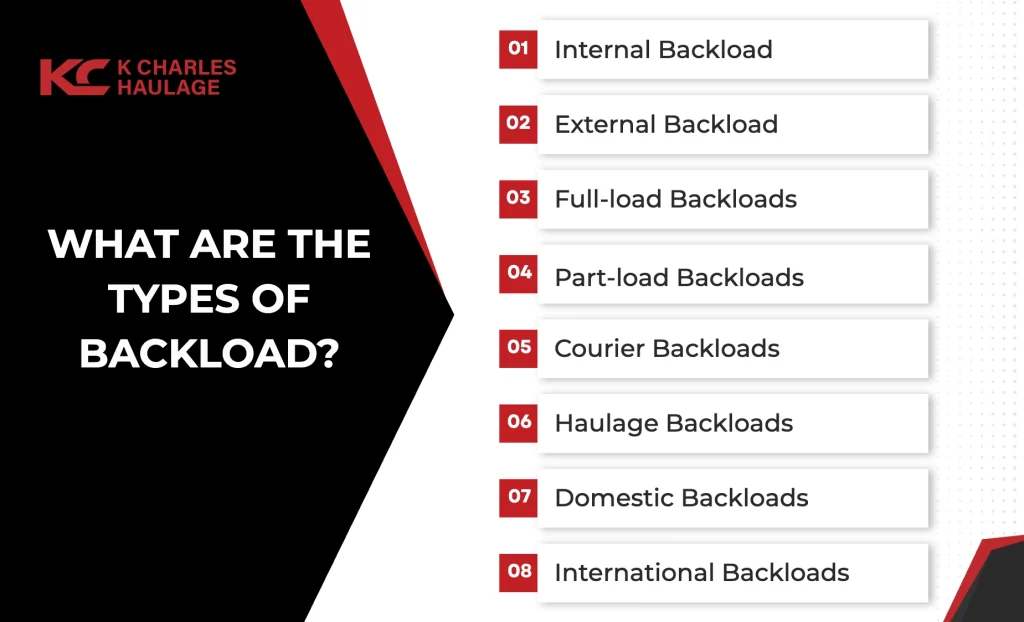
The types of backload include internal backloads, external backloads, full-load backloads, part-load backloads, courier backloads, haulage backloads, domestic backloads, and international backloads, with each option designed to meet different transport routes, shipment sizes, and logistics requirements. Choosing the right type depends on the shipment’s load size, weight, delivery distance, cargo characteristics, handling requirements, and whether it requires dedicated, shared, local, regional, national, or international transport.
8 types of backload are:
- Internal Backload
An internal backload is used when a transport company moves another load using its own trucks after completing an existing delivery. Instead of returning with an empty vehicle, the business schedules another shipment along the return route to maximise fleet utilisation. This approach helps reduce fuel costs, improve vehicle productivity, and minimise empty miles while making better use of transport resources and operational capacity.
- External Backload
Businesses often arrange an external backload by accepting freight from another customer after completing their original delivery. This allows transport providers to generate additional revenue from the return journey while offering customers a more affordable shipping option. External backloads are commonly arranged through direct bookings or freight exchange platforms that match available truck space with compatible transport requirements, improving overall logistics efficiency.
- Full-load Backloads
Large shipments are best suited for a full-load backload, where one customer uses the entire available truck capacity on the vehicle’s return trip. This option is commonly chosen for full household relocations, commercial freight, or large machinery that cannot be combined with other shipments. A full-load backload provides greater control over handling while still delivering significant savings compared with booking a dedicated one-way transport service.
- Part-load Backloads
Smaller shipments can benefit from a part-load backload, where several customers share available space on the same truck. Each customer pays only for the portion of the vehicle their goods occupy, making this option highly cost-effective for furniture, household items, and smaller commercial freight. Part-load backloads help improve truck utilisation while reducing transport expenses and unnecessary empty return journeys.
- Courier Backloads
Courier backloads are a cost-effective transport option for smaller parcels and lightweight freight using delivery vehicles that already have available return capacity. This approach helps courier businesses improve vehicle utilisation while reducing empty return trips and operating costs. Courier backloads are commonly used for e-commerce orders, business documents, spare parts, and small commercial shipments that follow established delivery routes and do not require dedicated transport.
- Haulage Backloads
Commercial freight is frequently transported through a haulage backload, where trucks returning from completed jobs carry additional cargo such as construction materials, machinery, palletised goods, or industrial equipment. This transport method helps haulage companies reduce empty miles and improve fleet productivity while offering businesses lower freight costs. It is widely used across manufacturing, construction, agriculture, and wholesale supply chains.
- Domestic Backloads
Goods moved within the same country are commonly transported through a domestic backload, whether the journey is local, regional, or interstate. Households, businesses, and moving companies use this option to reduce relocation and freight costs by utilising available truck space on existing routes. Domestic backloads provide a practical solution for furniture removals, office relocations, retail deliveries, and general freight transport across Australia.
- International Backloads
Cross-border freight can be transported through an international backload, where available vehicle or container capacity is used for shipments travelling between countries. This option supports international household relocations, commercial exports, and imported goods while helping logistics providers improve transport efficiency. International backloads often involve coordinated road, sea, or rail networks and require customs documentation, regulatory compliance, and carefully planned delivery schedules.
What Are the Benefits of Using Backloads?
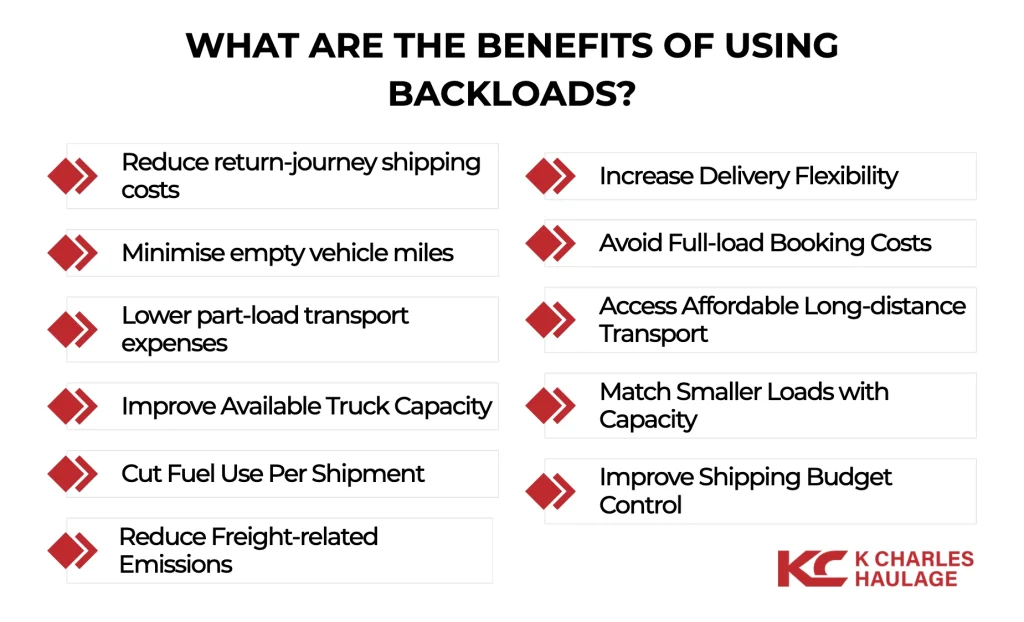
The benefits of using backloads include lower shipping costs, fewer empty vehicle miles, better truck capacity utilisation, greater delivery flexibility, lower fuel consumption, reduced emissions, and more affordable transport for full and part-load shipments. These advantages help individuals and businesses transport goods more efficiently while making better use of existing vehicle capacity and reducing overall logistics costs.
11 key benefits of using backloads are:
- Reduce return-journey shipping costs
Reducing return-journey shipping costs is one of the biggest benefits of using a backload because customers pay for available truck space instead of funding an empty return trip. Transport providers spread operating costs across multiple shipments, making backloads a more economical option. This approach is particularly valuable for long-distance moves and interstate freight where transport expenses are typically higher.
- Minimise empty vehicle miles
By carrying a secondary load on the return journey, backloads minimise empty vehicle miles and improve transport efficiency. Backloads maximise vehicle utilisation by carrying return loads instead of travelling empty, reducing operating costs, unnecessary journeys, and road congestion while providing more cost-effective freight services. A national truck-hailing study found that improving load factors and reducing empty trips could lower road freight emissions by 9%–24% by 2035 and 23%–31% by 2060 compared with business-as-usual. (source. Science Direct)
- Lower part-load transport expenses
By using shared truck capacity, backloads can reduce part-load transport costs by around 40%–60% compared with dedicated haulage on suitable UK routes. Charges are based only on the space occupied instead of the cost of an entire vehicle. Consequently, furniture deliveries, household moves, and commercial freight become more affordable without reducing transport reliability.
- Improve Available Truck Capacity
With better use of unused cargo space, backloads improve available truck capacity on returning vehicles. Filling available space increases vehicle productivity and creates additional revenue opportunities for transport providers. Better fleet utilisation also reduces wasted capacity while improving overall logistics efficiency.
- Cut Fuel Use Per Shipment
By transporting multiple shipments on a single trip, backloads cut fuel use per shipment and improve operational efficiency. Fuel consumption is distributed across several customers rather than one dedicated load. Consequently, transport providers lower operating costs while customers benefit from more economical freight services.
- Reduce Freight-related Emissions
Through fewer empty return trips, backloads reduce freight-related emissions across transport operations. Better vehicle utilisation decreases unnecessary fuel consumption and limits greenhouse gas emissions generated per shipment. Along with environmental benefits, businesses can improve logistics efficiency without increasing the number of vehicles on the road.
- Increase Delivery Flexibility
For customers with flexible moving schedules, backloads increase delivery flexibility by matching shipments with existing transport routes. Pickup and delivery dates are arranged around available return capacity rather than dedicated departures. In return, customers often secure lower freight rates while maintaining dependable transport services.
- Avoid Full-load Booking Costs
Instead of hiring an entire vehicle, backloads help customers avoid full-load booking costs by providing access to available truck space. Customers pay only for the capacity required to transport their goods, making smaller moves and partial freight shipments significantly more economical. The result is lower transport expenses without sacrificing professional handling.
- Access Affordable Long-distance Transport
Using trucks that are already travelling toward the destination, backloads provide affordable long-distance transport for residential and commercial shipments. Existing transport routes reduce the overall cost of freight by eliminating unnecessary empty return journeys. Consequently, interstate relocations and regional deliveries become more accessible for budget-conscious customers.
- Match Smaller Loads with Capacity
By matching smaller shipments with available truck capacity, backloads make better use of existing transport resources. Combining compatible freight prevents valuable cargo space from remaining unused during return trips. Both customers and transport providers benefit from lower costs, higher vehicle utilisation, and improved logistics efficiency.
- Improve Shipping Budget Control
With lower and more predictable transport costs, backloads improve shipping budget control for households and businesses. Backloads can reduce transport costs by around 40%–60% compared with dedicated haulage on suitable UK routes, making shipping expenses more predictable. Reduced freight charges make it easier to estimate moving or logistics expenses before booking transport. Greater pricing certainty also supports better financial planning while maintaining reliable delivery services.
When Should You Use a Backload?
You should use a backload when your shipment is non-urgent, your delivery schedule is flexible, and you want to reduce transport costs by utilising available return capacity for smaller, palletised, or commercial freight. By using available space on a return trip, businesses can lower freight expenses while maintaining efficient delivery operations.
In the cases below, you should use a backload:
- When you want to save money on transport costs
If you want to reduce transport costs by 30% to 60%, a backload is an effective option because it uses available truck space on a return journey. Instead of paying for a dedicated vehicle, you share transport capacity with other shipments travelling in the same direction. This makes backloading a practical choice for residential moves, commercial deliveries, and long-distance transport.
- When your delivery schedule is flexible
For shipments that do not require a fixed delivery date, a backload offers greater flexibility while reducing transport costs. Transport providers schedule the shipment based on available return capacity rather than dispatching a dedicated truck. Customers with flexible pickup and delivery windows can often access lower freight rates without compromising the safety or reliability of their goods.
- When you are shipping smaller, moderate, or part loads
When transporting smaller, moderate, or part loads, a backload allows you to pay only for the truck space your shipment occupies. Sharing available vehicle capacity eliminates the need to hire an entire truck, making transport more economical. This option is well suited for furniture, household goods, office equipment, and smaller commercial freight.
- When your goods are non-urgent
For non-urgent shipments, a backload provides a cost-effective alternative to dedicated transport services. Since deliveries are matched with existing return routes, transit times may depend on vehicle availability rather than immediate dispatch. Customers who can accommodate flexible delivery schedules often benefit from lower freight charges and efficient transport planning.
- When you are transporting palletised or commercial freight
Businesses transporting palletised or commercial freight can use a backload to reduce logistics costs while utilising existing transport routes. Compatible freight is loaded onto returning vehicles with available capacity, allowing companies to move goods efficiently without paying for exclusive truck use. This approach is widely used across retail, manufacturing, and wholesale distribution.
- When you can ship during off-peak periods
Shipping during off-peak periods increases the likelihood of securing a suitable backload at a competitive price. Transport providers often have greater return capacity outside busy moving seasons, allowing shipments to be matched more easily with existing routes. Greater availability can lead to lower freight costs and more efficient transport scheduling.
- When your route has regular traffic and available return capacity
A backload works best when your destination is located on a transport route with regular truck movements and available return capacity. Frequent freight activity creates more opportunities to match your shipment with an existing journey. As a result, customers often experience lower costs, improved vehicle availability, and shorter waiting times for transport.
- When you want to reduce empty journeys and improve transport efficiency
When your shipment can be matched with a truck already travelling along the required route, using a backload helps reduce empty journeys and improve transport efficiency. Rather than sending another vehicle, carriers maximise available capacity on return trips, lowering operating costs while providing customers with a more economical transport solution.
When Is a Backload Not Suitable?
A backload is not suitable when your shipment requires urgent delivery, a fixed schedule, a dedicated vehicle, special handling, or when no suitable return journey is available, as these situations require greater transport certainty, flexibility, and control than shared return-capacity transport can provide. In these cases, booking a dedicated transport service is often the better option because it provides guaranteed scheduling, direct routing, and handling tailored to the shipment’s specific requirements.
In the cases below, you should not use a backload:
- When Your Delivery Has a Strict Deadline
If your delivery must arrive by a specific date or time, a backload may not be the right choice because schedules depend on a truck’s return journey. Any changes to the original transport route can affect pickup or delivery times. A dedicated transport service provides greater scheduling certainty for time-critical shipments.
- When Immediate or Same-day Transport Is Required
For immediate or same-day transport, a backload is generally unsuitable as available return capacity may not be immediately available. Backloads are arranged around existing truck schedules rather than urgent customer requests. Dedicated transport offers faster dispatch and direct delivery when time is the highest priority.
- When No Suitable Return Journey Is Available
If no truck is returning along your required route, a backload cannot be arranged. Since this transport method relies on available return capacity, limited vehicle availability may prevent your shipment from being matched. In such situations, booking a dedicated freight service ensures your goods can still be transported.
- When Your Shipment Requires a Dedicated Vehicle
Shipments that require exclusive use of a vehicle are not suitable for backloading because truck space is typically shared with other freight. Dedicated transport provides complete control over loading, routing, and delivery, making it a better option for large household moves, oversized equipment, or exclusive commercial freight.
- When Transporting High-value or Highly Sensitive Goods
High-value or highly sensitive goods are often better suited to dedicated transport than backloading. Valuable items, confidential equipment, or fragile products may require additional security, limited handling, or exclusive vehicle access. Choosing a dedicated service reduces the risk associated with shared transport arrangements.
- When Your Freight Needs Special Handling or Time-controlled Delivery
When your freight requires temperature control, fragile-item handling, hazardous material compliance, or a guaranteed delivery time, a backload may not be suitable. Since backloads operate around existing return routes, they cannot always provide the dedicated handling or strict scheduling these shipments require.
- When Route or Scheduling Flexibility Is Not Possible
If your shipment cannot accommodate changes to the transport route or delivery schedule, a backload is not the best option. Backloads depend on existing truck movements and available return capacity, which can vary. Dedicated transport provides fixed collection times, direct routing, and greater control over the entire delivery process.
Are Backloads Suitable for Your Business?
Yes, backloads are suitable for your business if you have flexible delivery schedules, transport non-urgent freight, and want to reduce shipping costs by using available truck capacity on return journeys. They are particularly beneficial for businesses shipping palletised goods, part loads, retail stock, construction materials, office equipment, and other commercial freight that does not require a dedicated vehicle or time-critical delivery.
Backloads can reduce transport costs by up to 40%–60% on suitable UK routes while maintaining reliable delivery. They also improve vehicle utilisation, minimise empty return journeys, support more sustainable freight operations, and provide access to professional haulage services without the higher cost of booking a dedicated vehicle.
What Factors Should You Consider Before Backloading?
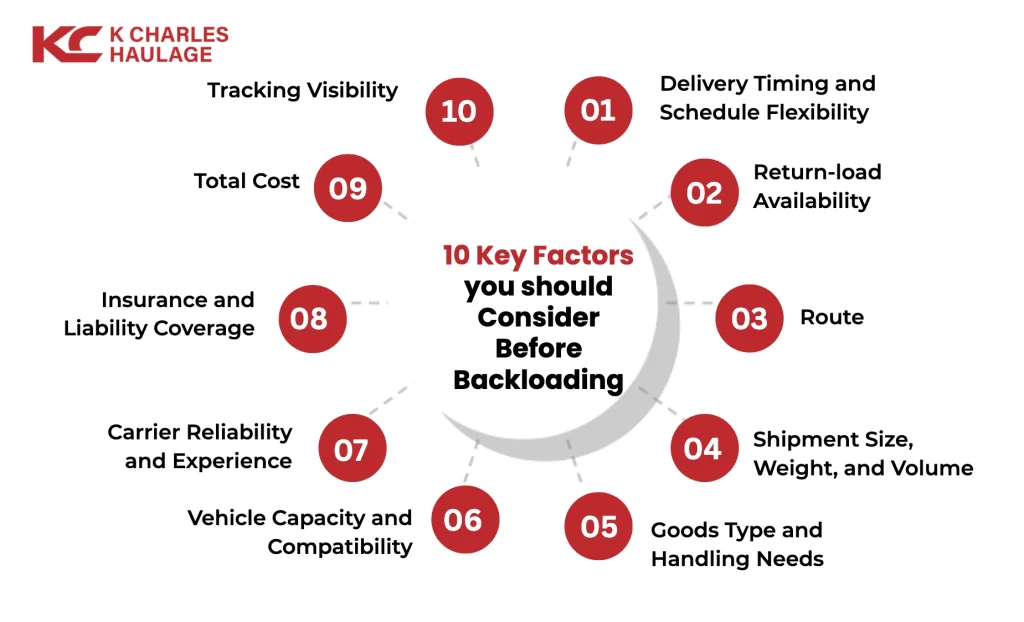
Before choosing a backload, you should consider factors such as delivery timing, schedule flexibility, return-load availability, route, shipment size, weight and volume, goods handling requirements, vehicle compatibility, carrier reliability, insurance coverage, total transport cost, and shipment tracking. Evaluating these components helps determine whether a backload is the most suitable, reliable, and cost-effective transport option for your shipment.
10 key factors you should consider before backloading are:
- Delivery Timing and Schedule Flexibility
Evaluate your delivery timing and schedule flexibility to determine whether a backload can meet your required delivery dates. Unlike dedicated transport, which typically delivers within 1–7 days, backloads usually arrive within 5–21 days, depending on the vehicle’s route and schedule. Since backloads operate around a truck’s existing return journey, fixed pickup or delivery times cannot always be guaranteed. Flexible schedules increase the likelihood of securing available truck capacity and lower transport costs.
- Return-load Availability
Confirm that a suitable return load is available because a backload can only be arranged when a truck has capacity on its return journey. If a return load is available through a freight exchange or moving company, you can reduce transport costs by up to 30–50%. If not, dedicated transport offers faster delivery, typically within 1–7 days. Limited return-load availability may delay collection or delivery. Checking availability before booking helps you choose the most practical shipping option.
- Route
Verify that your shipment route matches an existing return journey to ensure a backload is available for your destination. Transport providers can only offer backloading on routes their vehicles already travel. Regular freight corridors usually provide better availability and more competitive pricing.
- Shipment Size, Weight, and Volume
Assess your shipment’s size, weight, and volume to ensure it fits safely within the available truck capacity. Oversized or overweight freight may exceed the vehicle’s available space or legal limits. Providing accurate shipment details helps the carrier allocate suitable transport.
- Goods Type and Handling Needs
Identify your goods’ handling requirements to determine whether they are suitable for shared backload transport. Fragile, hazardous, temperature-controlled, or oversized freight may require dedicated vehicles or specialised equipment instead of standard shared transport.
- Vehicle Capacity and Compatibility
Ensure the selected vehicle is compatible with your shipment so it can be transported safely and efficiently. The truck should provide sufficient space, weight capacity, and suitable loading equipment. Choosing the right vehicle reduces handling risks and prevents transport delays.
- Carrier Reliability and Experience
Review the carrier’s reliability and experience to ensure your shipment is handled safely and delivered as agreed. An experienced transport provider is more likely to follow industry standards, communicate effectively, and minimise the risk of delays or freight damage.
- Insurance and Liability Coverage
Check the carrier’s insurance and liability coverage to understand how your shipment is protected during transport. Knowing what the policy covers helps you identify whether additional insurance is required for valuable, fragile, or commercial goods before booking.
- Total Cost
Calculate the total transport cost to determine whether a backload offers the best overall value for your shipment. For example, a London to Manchester move using a dedicated man-and-van service costs £350–£650, while booking a backload on the same route can often reduce the price by 20% to 30%, depending on return-load availability and shipment size.
- Tracking Visibility
Confirm that the carrier provides shipment tracking so you can monitor your goods throughout the journey. Real-time tracking and delivery updates improve shipment visibility, support better planning, and allow you to respond quickly if transport schedules change.
How Can You Find Backloads?
You can find backloads through freight exchanges, online load boards, freight brokers, logistics providers, or transport companies with available return-trip capacity. These platforms connect shippers with carriers seeking loads for their return journeys, making it easier to secure cost-effective transport. Comparing multiple carriers, booking in advance, and selecting the right haulage services that regularly operate on your shipping route can improve availability, reduce shipping costs, and increase the likelihood of reliable, on-time deliveries.