Skip to content
Road haulage is the transportation of goods by road using commercial vehicles such as vans, trucks, and HGVs, making it a vital component of the logistics and transportation industry. While haulage encompasses freight movement by road, rail, sea, and air, road haulage focuses specifically on road-based freight services that connect suppliers, manufacturers, warehouses, retailers, and end customers. Through services such as full-load, part-load, same-day, refrigerated, container, pallet, heavy, and contract haulage, businesses can transport a wide range of cargo efficiently across local, national, and international markets.
Beyond transporting goods between locations, road haulage plays a vital role in keeping supply chains connected and operational. Businesses benefit from door-to-door delivery, route flexibility, timely transportation, and seamless connections with ports, airports, and rail terminals. Road haulage relies on specialised vehicles such as LCVs, rigid trucks, articulated lorries, HGVs, refrigerated trucks, and flatbed trailers. Despite challenges including compliance requirements, customs procedures, driver shortages, rising costs, and traffic congestion, professional haulage companies continue to deliver reliable freight services. Future developments in digital technology, sustainability, alternative fuel vehicles, and automation are expected to shape the industry.
Is Road Haulage Different From Haulage?
Yes, haulage is the transportation of goods, materials, machinery, or freight from one location to another using any mode of transport, including road, rail, sea, and air, whereas road haulage is the movement of goods exclusively by road using commercial vehicles such as trucks, lorries, and vans. Haulage encompasses the broader freight and logistics sector, while road haulage focuses on flexible, door-to-door delivery services connecting manufacturers, warehouses, distribution centres, ports, retailers, and customers. Due to its accessibility and route flexibility, road haulage remains a vital component of modern supply chains and regional distribution networks.
How Does Road Haulage Relate to Logistics and the Transportation Industry?
Road haulage is related to the logistics and transportation industry by providing the physical movement of goods using heavy goods vehicles (HGVs) between key points in the supply chain, including manufacturers, warehouses, distribution centres, ports, retailers, and end customers. It serves as a critical link, ensuring products are transported efficiently, reliably, and on schedule across regional, national, and international networks. Within logistics operations, different types of road haulage address specific freight requirements.
Why is Road Haulage Important?
Road haulage is important because it provides door-to-door delivery, supports supply chain efficiency, offers route flexibility, enables timely deliveries, accommodates diverse cargo types, and connects road transport with ports and rail terminals. According to the Road Haulage Association’s industry statistics, approximately 89% of all freight in the UK is transported by road, highlighting the sector’s critical role in supporting supply chains, retail distribution, manufacturing operations, and economic activity.
Key reasons road haulage is important are:
- Door-to-Door Delivery: Road haulage enables goods to be collected from the sender and delivered directly to the destination, reducing handling requirements and improving delivery efficiency.
- Supply Chain Efficiency: The continuous movement of raw materials, finished products, and inventory between suppliers, warehouses, distribution centres, and customers helps maintain smooth supply chain operations through reliable road haulage services.
- Route Flexibility: Access to extensive road networks allows commercial vehicles to reach urban areas, industrial sites, retail locations, and remote destinations that other transport modes cannot directly serve.
- Timely Deliveries: Businesses use road haulage to meet delivery schedules, reduce transit delays, and respond quickly to customer requirements.
- Diverse Cargo Transportation: A wide range of freight can be transported efficiently, including palletised goods, refrigerated products, hazardous materials, construction equipment, and oversized loads.
- Intermodal Connectivity: By linking ports, airports, rail terminals, and warehouses, road haulage ensures goods can transition efficiently between modes of transport.
- Economic Support: The movement of products and materials between businesses and consumers facilitates trade, supports commercial activity, and contributes to economic growth.
How Does Road Haulage Work in the Logistics Chain?
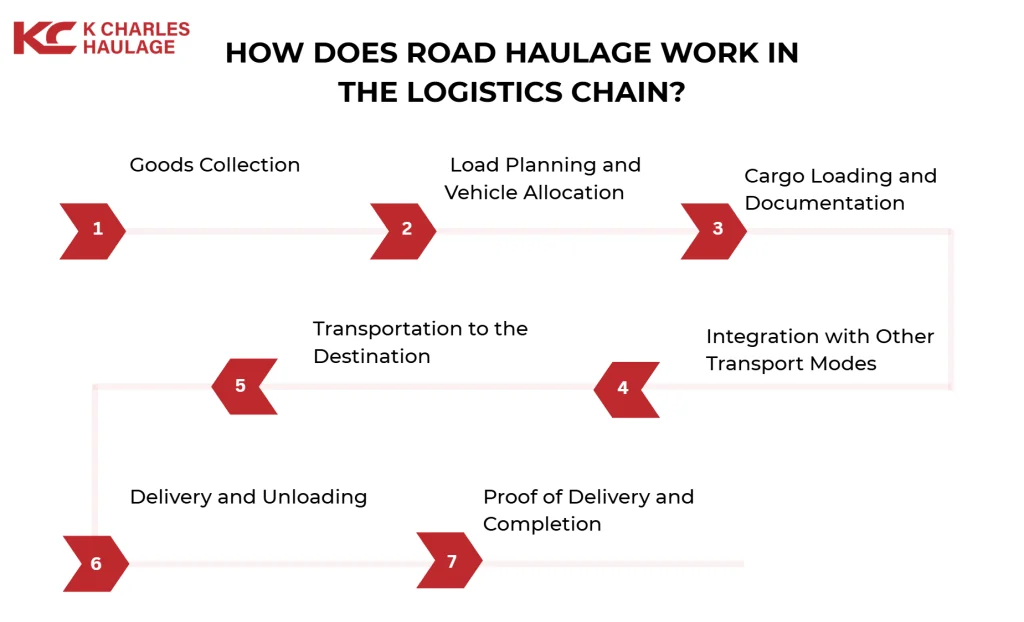
Road haulage works within the logistics chain by transporting goods between suppliers, manufacturers, warehouses, distribution centres, retailers, and end customers. It serves as a vital link that connects different stages of the supply chain, ensuring products move efficiently from their point of origin to their final destination. Using vehicles such as vans, trucks, lorries, and Heavy Goods Vehicles (HGVs), road haulage provides flexible transportation solutions for shipments of various sizes and supports reliable door-to-door delivery services.
Road haulage work in the logistics chain follows the following steps:
- Step 1: Goods Collection: The process begins when goods are collected from suppliers, manufacturers, warehouses, ports, or distribution centres and prepared for transportation.
- Step 2: Load Planning and Vehicle Allocation: The haulage company assesses the shipment size, weight, destination, and delivery requirements before assigning a suitable vehicle, such as a van, truck, or HGV.
- Step 3: Cargo Loading and Documentation: Goods are loaded onto the vehicle, secured for transport, and accompanied by the necessary shipping, customs, or delivery documentation.
- Step 4: Transportation to the Destination: The cargo is transported via road networks to its next point in the supply chain, whether to a warehouse, distribution centre, retailer, business location, or customer address.
- Step 5: Integration with Other Transport Modes: When required, road haulage connects with ports, airports, and rail terminals to transfer goods between modes of transport within the logistics chain.
- Step 6: Delivery and Unloading: Upon arrival, the shipment is unloaded and delivered to the intended recipient or facility in accordance with the agreed schedule.
- Step 7: Proof of Delivery and Completion: Delivery is confirmed through documentation or electronic proof of delivery, thereby completing the transportation process and ensuring supply chain continuity.
What Are The Advantages of Choosing Road Haulage?
The advantages of road haulage include lower freight costs, access to remote locations, faster local delivery, flexible collection times, simpler transport paperwork, live shipment tracking, UK and European coverage, door-to-door availability, and easy access to carriers. These benefits help businesses transport goods more efficiently, maintain reliable delivery schedules, and support supply chain operations across local, national, and international markets.
Key advantages of choosing road haulage include:
- Lower Freight Costs
Road haulage helps businesses reduce transportation expenses through optimised routing, shared-load options, and direct delivery services. Compared to transport methods such as rail freight, air freight, or sea freight, which require additional handling or transfers, road haulage often provides a cost-effective solution for moving goods while maintaining reliable delivery schedules and operational efficiency.
- Remote Location Access
Extensive road networks enable road haulage services to reach rural communities, construction sites, industrial facilities, and remote destinations that are difficult to access by rail, sea, or air. This accessibility ensures businesses can distribute products and receive supplies regardless of geographic location.
- Faster Local Delivery
For short- and medium-distance shipments, road haulage provides efficient transportation with fewer transit delays. Direct routes and flexible scheduling enable businesses to move goods quickly among suppliers, warehouses, retailers, and customers, improving delivery performance and meeting time-sensitive requirements.
- Flexible Collection Times
Road haulage offers collection schedules that can be adjusted to match business operations and shipment requirements. This flexibility helps companies coordinate inventory movements, production schedules, and customer deliveries more effectively while maintaining greater control over logistics planning.
- Simpler Transport Paperwork
Domestic and regional road haulage involves fewer administrative procedures than some international freight methods. Streamlined documentation requirements help businesses process shipments more efficiently, reduce paperwork burdens, and support smoother transportation operations throughout the logistics chain.
- Live Shipment Tracking
Modern road haulage services use tracking technologies that provide real-time updates on shipment locations and delivery progress. This visibility allows businesses to monitor freight movements, improve communication with customers, and respond quickly to transportation issues as they arise.
- UK and Europe Coverage
Through extensive transportation networks, road haulage facilitates the movement of goods across the UK and Europe. Businesses benefit from reliable domestic and cross-border freight services that support trade, distribution, and supply chain connectivity across markets.
- Door-to-Door Availability
Goods can be transported from the sender’s location to the recipient’s destination without requiring multiple transport arrangements, improving efficiency and reducing handling requirements. One of the primary advantages of road haulage is its ability to provide direct collection and delivery services.
- Easy Carrier Access
A broad network of road haulage providers gives businesses access to different vehicle types, transportation capacities, and service options. This availability makes it easier to find suitable freight solutions for shipments of various sizes, cargo types, and delivery requirements.
What Are the Main Types of Road Haulage?
The main types of road haulage include domestic, European, full-load, part-load, same-day, refrigerated, container, pallet, heavy, and contract haulage. Each service serves a specific logistics purpose, enabling businesses to transport different cargo types efficiently while meeting varying delivery schedules, distance requirements, and supply chain demands.
The 10 main types of road haulage include:
- Domestic road haulage
Domestic road haulage involves transporting goods within a single country using commercial vehicles such as vans, trucks, and lorries. Businesses use this service to move products between suppliers, warehouses, distribution centres, retailers, and customers. Domestic haulage supports local and national supply chains by providing reliable transportation for a wide range of cargo types and delivery requirements.
- European road haulage
Cross-border freight movement across European countries is facilitated through European road haulage, which connects businesses to suppliers, distribution hubs, and customers throughout the continent. This transportation method supports international trade while ensuring compliance with customs procedures, route regulations, and country-specific freight requirements.
- Full-load haulage
When a shipment is large enough to occupy an entire vehicle, full-load haulage provides a dedicated transportation solution. Commonly used for bulk goods, manufacturing materials, and high-volume freight, this service reduces cargo handling, minimises transit interruptions, and enables direct delivery from origin to destination. Because the vehicle is reserved for a single shipment, businesses also benefit from greater control over delivery schedules, improved cargo security, and faster transit times.
- Part-load haulage
For businesses shipping smaller freight volumes, part-load haulage offers a cost-effective alternative by combining multiple consignments within a single vehicle. This approach allows companies to transport goods efficiently without paying for unused vehicle space while maintaining reliable delivery schedules. It is particularly beneficial for businesses with regular shipments that do not justify a full truckload.
- Same-day haulage
Urgent shipments that require immediate transportation often depend on same-day haulage services. Whether transporting critical inventory, replacement parts, or time-sensitive products, this solution prioritises rapid collection and direct delivery to help businesses meet strict deadlines. The service helps minimise operational disruptions caused by unexpected supply requirements.
- Refrigerated haulage
Products that require controlled temperatures throughout transit are transported using refrigerated haulage services. Temperature-regulated vehicles help preserve the quality and safety of goods such as fresh food, frozen products, pharmaceuticals, and medical supplies from collection through delivery. Continuous temperature monitoring helps maintain compliance with industry regulations and product standards.
- Container Haulage
The movement of shipping containers between ports, rail terminals, warehouses, and distribution centres is handled through container haulage. This service plays an important role in international supply chains by linking maritime and rail freight operations to road transportation networks. Efficient container transportation helps reduce delays and improve cargo flow throughout the logistics process.
- Pallet haulage
Businesses that transport goods secured on pallets frequently use pallet haulage to streamline loading, unloading, storage, and distribution. This service is widely used for retail products, industrial supplies, and commercial goods that benefit from standardised freight handling methods. Standardised pallet systems also improve warehouse efficiency and transportation productivity.
- Heavy Haulage
Oversized machinery, industrial equipment, and abnormal loads often require heavy haulage solutions due to their size, weight, or transportation complexity. Specialised vehicles, route planning, and regulatory approvals help ensure these large cargo movements are completed safely and efficiently. Industries such as construction, energy, and infrastructure frequently depend on this type of transportation.
- Contract haulage
Companies seeking long-term transportation support often enter into agreements for contract haulage, in which a dedicated provider manages freight operations according to predetermined schedules and service requirements. This arrangement offers consistent vehicle availability, predictable transportation costs, and ongoing logistics support. Contract haulage also allows businesses to focus on core operations while outsourcing transportation management to logistics specialists.
What Vehicles Are Used in Road Haulage?
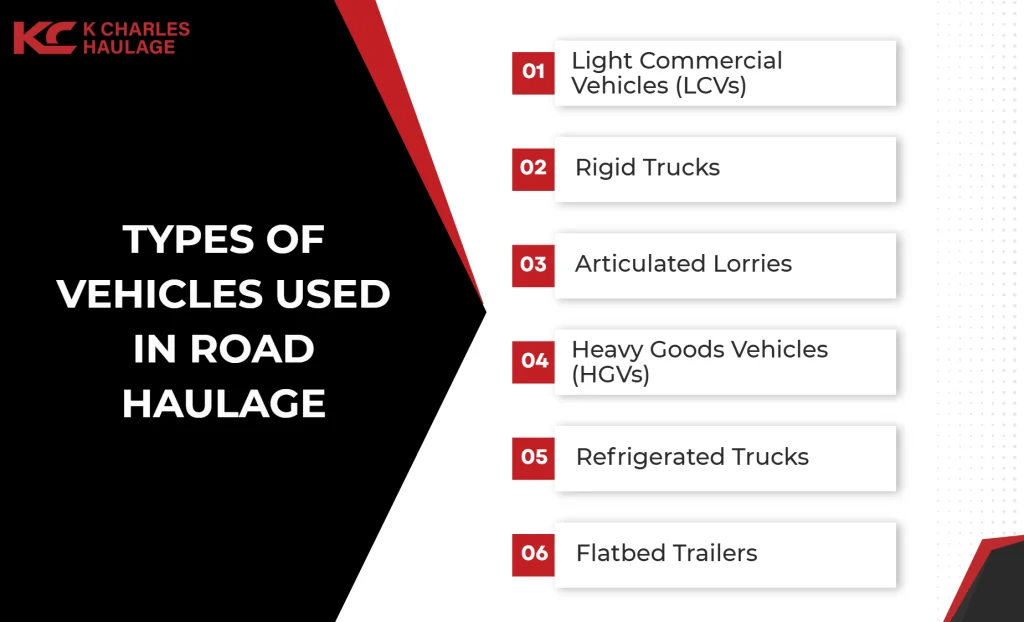
The vehicles used in road haulage include Light Commercial Vehicles (LCVs), rigid trucks, articulated lorries, Heavy Goods Vehicles (HGVs), refrigerated trucks, flatbed trailers, curtain-side vehicles, tanker trucks, container transport vehicles, and low-loader trailers. Each transportation type is designed to transport specific cargo types, shipment volumes, and freight requirements across local, national, and international road networks.
Types of vehicles used in road haulage are:
- Light Commercial Vehicles (LCVs)
Small deliveries and light freight movements are commonly handled using Light Commercial Vehicles (LCVs), including delivery vans and compact cargo vehicles. These vehicles support parcel distribution, last-mile deliveries, and time-sensitive shipments. Their flexibility makes them suitable for urban and regional transportation.
- Rigid Trucks
Freight that requires greater carrying capacity than an LCV is often transported using rigid trucks, which feature a fixed cab and cargo body. These vehicles are widely used for retail deliveries, construction materials, and regional distribution. Their design provides a balance between load capacity and manoeuvrability.
- Articulated Lorries
Large freight volumes are frequently moved using articulated lorries, which consist of a tractor unit connected to a detachable trailer. This configuration allows efficient transportation of substantial cargo loads over long distances. They are commonly used in domestic and international haulage operations.
- Heavy Goods Vehicles (HGVs)
High-volume freight transportation often relies on Heavy Goods Vehicles (HGVs), which are designed to carry substantial loads across extensive road networks. These vehicles support commercial logistics, industrial supply chains, and bulk cargo transportation. Their carrying capacity makes them suitable for demanding freight operations.
- Refrigerated Trucks
Temperature-sensitive goods such as fresh food, frozen products, and pharmaceuticals are transported using refrigerated trucks equipped with cooling systems. Controlled temperature conditions help maintain product quality throughout transit. These vehicles play an important role in cold chain logistics.
- Flatbed Trailers
Oversized, heavy, or irregularly shaped cargo is commonly transported using flatbed trailers because of their open loading design. Construction equipment, machinery, and large industrial materials can be loaded from multiple sides with ease. This flexibility makes flatbed trailers suitable for specialist haulage requirements.
What Challenges Do Road Haulage Operators Face?
The challenges road haulage operators face include strict regulations, border and customs requirements, carbon emission concerns, driver shortages, rising operating costs, poor road conditions, cargo security risks, unpredictable transit times, traffic congestion, and vehicle maintenance demands. These challenges can increase transportation costs, disrupt delivery schedules, and place additional pressure on logistics operations and supply chain efficiency.
Common challenges road haulage operators face include:
- Strict Compliance Rules
Road haulage operators must comply with transportation laws, driver working-time regulations, vehicle safety standards, and freight documentation requirements. Meeting these obligations requires ongoing monitoring, staff training, and operational adjustments. Failure to comply can result in financial penalties, legal issues, and disruptions to transportation services.
- Border and Custom Issues
International freight transportation requires compliance with customs declarations, border inspections, and clearance procedures, which can create operational challenges for road haulage operators. Delays can occur when documentation is incomplete or regulatory requirements change. These issues can increase transit times, disrupt delivery schedules, and create uncertainty for businesses that rely on efficient cross-border logistics operations.
- Environmental Impact Due to Carbon Emissions
Growing environmental regulations place pressure on road haulage operators to reduce carbon emissions and improve fuel efficiency. Investments in cleaner vehicles, alternative fuels, and sustainability initiatives can increase operating expenses. Meeting environmental targets while maintaining profitability remains an ongoing challenge.
- Workforce & Driver Shortages
Road haulage operators frequently struggle to recruit and retain qualified drivers, despite the UK having around 684,000 HGV drivers (Source: RHA), due to industry-wide labour shortages. An ageing workforce and increasing demand for freight transportation further intensify this issue. Driver shortages can reduce fleet availability and affect service capacity.
- Rising Fuel and Operating Costs
Fluctuating fuel prices, increasing insurance premiums, labour expenses, and vehicle ownership costs directly impact road haulage operators, as these expenses can reduce profit margins and make pricing more competitive. Managing operating costs has become a key concern for many haulage businesses.
- Poor Road Condition
Damaged road surfaces, potholes, roadworks, and inadequate infrastructure pose challenges for road haulage operators in their daily operations. Poor road conditions can increase vehicle wear, fuel consumption, and maintenance requirements. They may also contribute to delays and route disruptions.
- Security and Cargo Crime
The risk of cargo theft, vehicle break-ins, and freight-related crime remains a significant concern for road haulage operators. High-value goods are particularly vulnerable during transit and temporary storage. Protecting shipments often requires investment in tracking systems, secure facilities, and vehicle monitoring technologies.
- Unpredictable Transit Times
Road haulage operators regularly face uncertainty due to adverse weather, road incidents, customs delays, and other unexpected disruptions. These factors can make delivery schedules difficult to predict and manage. Inconsistent transit times can affect customer satisfaction and supply chain planning.
- Delivery Delays and Traffic Congestion
Heavy traffic, road closures, and urban congestion frequently affect road haulage operators’ ability to meet delivery schedules. Delays can increase transportation costs and reduce fleet productivity. Congestion is particularly challenging in major cities and busy commercial corridors.
- Vehicle Maintenance Pressure
Maintaining fleet reliability is a constant responsibility for road haulage operators, requiring regular servicing, inspections, and repairs. Unexpected breakdowns can disrupt transportation schedules and create additional costs. Balancing maintenance requirements with vehicle availability is essential for efficient operations.
Why You Should Work With a Professional Haulage Company?
You should work with a professional haulage company because it provides experienced logistics management, reliable transportation services, regulatory compliance, shipment visibility, and access to specialised freight solutions. Professional haulage providers help businesses move goods efficiently while reducing transportation risks and operational challenges. A reliable haulage service also helps maintain consistent delivery schedules, improve supply chain performance, and ensure freight reaches its destination safely and on time.
Key reasons to work with a professional haulage company include:
- Professional haulage companies coordinate freight transportation efficiently through effective route planning, shipment scheduling, and logistics expertise.
- Consistent transportation services help ensure goods are delivered safely, on time, and in accordance with agreed-upon delivery schedules.
- Professional providers understand transportation regulations and maintain compliance with driver, vehicle, safety, and documentation requirements.
- Businesses can utilise a range of vehicles, including refrigerated trucks, flatbed trailers, and HGVs, to transport different cargo types.
- Real-time tracking systems provide greater visibility into freight movements and allow businesses to monitor delivery progress.
- Security measures such as GPS tracking, secure facilities, and monitored transportation routes help protect goods during transit.
- Professional haulage companies can increase transportation capacity as business requirements grow, supporting long-term operational needs.
What Does The Future of Road Haulage Look Like?
The future of UK road haulage will be defined by the transition to zero-emission vehicles, digital transformation, and ongoing workforce challenges. According to the UK Government, all new HGV sales must be zero-emission by 2040. The Faraday Institution forecasts that 61% of those will be battery electric vehicles. According to Logistics UK, nearly half of all current HGV drivers are over 50, signalling a looming workforce crisis. The Road Haulage Association warns that industry profit margins currently average just 2%. Meanwhile, Kinaxia’s 2024 data shows that AI route optimisation has already cut empty running from 27% to 16%, a sign of where survival lies.